A collection of good funds can still make a poor portfolio
Good venture managers can still combine into a poor portfolio. Their funds may own the same companies, stages and sectors or raise money in the same cycle. Those shared exposures connect their risks, timing and cash needs.
Each commitment needs a clear role. Core funds can provide a broad portfolio, while specialists add a focused strategy. Co-investments and SPVs add selected company risk. Secondaries can change the vintage mix or shorten the expected wait for cash.
HarbourVest's study looks at infrastructure and the use of secondary stakes. It shows why the route into an asset class matters for risk and return. An LP can ask the same question about venture, but must test it with venture data.
HarbourVest tests infrastructure weights of 0%, 10%, 20% and 30%. A venture LP can also test different weights to see what each adds. Its model needs venture data and a view of how the new stakes overlap with its current holdings.
This sample puts forty percent in core funds and twenty percent in specialist managers. Thirty percent goes to co-investments or SPVs, with ten percent in secondaries. Each part serves a different role.
A Layered LP Venture Portfolio
Funds can form the core, with specialists and selected deals adding a more focused mix. Secondaries can change entry years and the expected wait for cash.

- Core venture funds40%
- Funds run by specialists20%
- Co-investments or SPVs30%
- Secondaries: stakes bought from other LPs10%
View allocation data and assumptions
| Portfolio segment | Share | How to read it |
|---|---|---|
| Core venture funds | 40% | Manager-led diversified company exposure. |
| Specialist managers | 20% | Focused strategy, sector, stage, or emerging-manager access. |
| Co-investments or SPVs | 30% | Selected company or transaction-level exposure. |
| Secondaries | 10% | Vintage shaping, liquidity access, or shorter-duration private exposure. |
The LP is constructing across relationships and time
A GP divides its fund among companies. The LP chooses managers, commitment sizes and entry years, then decides whether to add direct or secondary stakes. All of those choices draw on the same cash pool.
The reason for owning venture should guide the mix. An LP seeking early innovation may drift from that aim if it moves into growth funds simply because they take larger cheques. Capacity alone does not make a fund fit the plan.
Every building block solves one problem and creates another
| Choice | What it can add | What it can cost |
|---|---|---|
| More managers | Less dependence on one team | Smaller commitments and more oversight |
| More vintages | Exposure across market cycles | Longer build period and ongoing re-ups |
| Earlier stage | Higher upside and earlier ownership | More losses, dilution, and longer holding periods |
| Growth stage | More operating evidence and nearer exits | Higher prices and public-market sensitivity |
| Co-investments | Company choice and lower fee load in some cases | Concentration and fast diligence |
| Secondaries | Later entry and possible earlier cash flow | Complex pricing and seller selection |
More managers reduce reliance on one team but add oversight. Early-stage funds offer greater upside with more losses and a longer wait. Co-investments may reduce fees while increasing company risk. The mix should fit both the LP's goal and the resources it can devote to the work.
Commitments Across Fundraising Years
Committing across years reduces reliance on one pricing market and gives the LP time to learn. New funds, re-ups and co-investments all use the budget. If cash is tight or exposure is above target, a slower pace leaves more room for existing calls.
Suppose an LP builds a $100 million programme over 3 years. It commits $30 million in each of the first 2 years and $20 million in the third. The final $20 million can support selected co-investments, secondaries, or a later vintage.
Funds call cash over time, and a successor may raise before older funds pay much back. The schedule must allow for both re-ups and calls still due. Otherwise, whichever managers raise first can use too much of the budget.
The Holdings Beneath Fund Labels
An illustrative mix puts 40% in core funds and 20% with specialists. Co-investments or SPVs take 30%, leaving 10% for secondaries. Within a $100 million programme, the $30 million deal budget supports 3 first cheques of $10 million before costs and follow-ons.
NVCA's 2025 stage data shows more dollars going into later VC and venture growth than seed. Those larger deals may absorb a large LP cheque more easily. The LP must still check whether that route fits its intended stage exposure.
If the top 5 managers hold 50% of NAV, the programme still relies heavily on them despite a long manager list. Co-investments can add even more exposure to the same companies. Looking through the funds reveals that combined risk.
Successor funds may share a management team, while different funds may own the same company. Combine their holdings by company, stage, sector and region. This reveals shared risks hidden by separate fund names.
Liquidity Is Part of Portfolio Construction
Unfunded commitments, calls, fees and distributions share the same cash pool. Weak public markets and few exits can strain it at once. An attractive expected venture return may still come with a forced sale of liquid assets at a poor time.
The target range and yearly pace set the size of the plan. Limits on managers and companies keep large stakes in check, while the cash plan covers difficult markets. Rules for re-ups, pauses and replacements guide the response when conditions change.
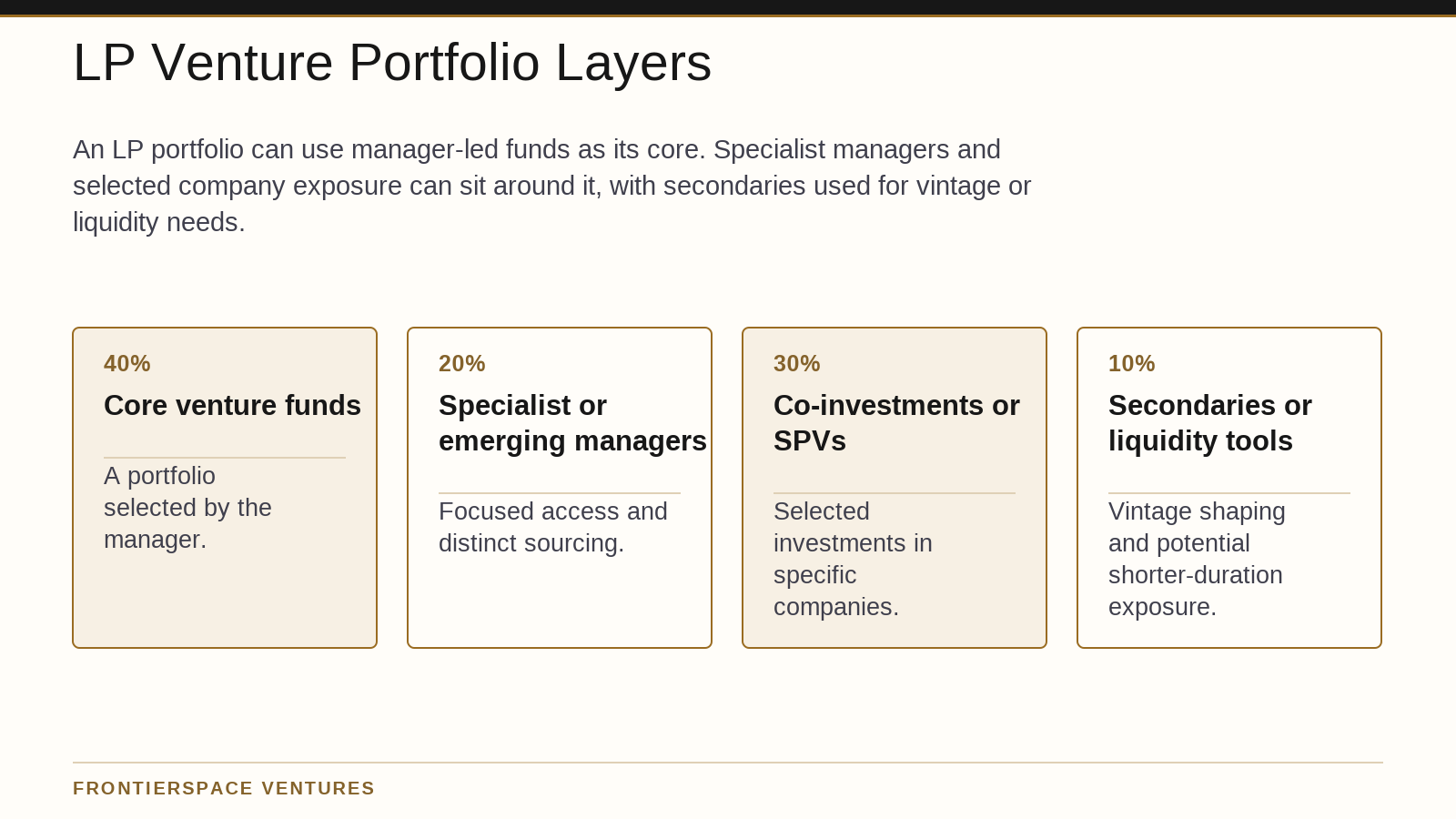
This sample $100 million budget puts $40 million in core funds and $20 million with specialists. Co-investments or SPVs receive $30 million, with $10 million left for secondaries. The mix illustrates roles rather than a fixed target for every LP.
LP Venture Portfolio Layers
Manager-led funds can form the core. Specialists and selected deals add a focused mix. Secondaries then help adjust the entry years or expected wait for cash.
View layer assumptions
| Layer | Allocation | Role |
|---|---|---|
| Core venture funds | 40% | A portfolio selected by the manager. |
| Specialist or emerging managers | 20% | Focused access and distinct sourcing. |
| Co-investments or SPVs | 30% | Selected investments in specific companies. |
| Secondaries or liquidity tools | 10% | Vintage shaping and potential shorter-duration exposure. |
Frequently Asked Questions
How is LP construction different from GP construction?
A GP spreads its fund across companies. The LP spreads cash across managers and entry years, then chooses stages and regions. The combined choices determine what the LP ultimately owns.
When can co-investments or SPVs form a real allocation?
Deal-by-deal investing needs reliable access and a sound review process. Stakes of $10 million or more may also need large follow-on cheques. Combined holdings and cash reports show whether those deals fit the wider portfolio.