The same headline can describe two different funds
Two funds can report 2.0x TVPI yet offer very different evidence of success. One may be young with almost all value unrealized; the other may have returned most of it to LPs. The multiple, IRR, cash distributions, age and peer benchmark together explain that difference.
The young fund may be on track, but most of its value still depends on marks and later funding. The older fund has already put more cash in the LP's account. Its remaining holdings still matter, though the result relies less on estimates.
Start with funds that took similar risks over the same period. Then check how long the money was invested and how much has come back as cash. Together, those comparisons put the return in context.
The Comparison Group Determines the Rank
S&P Global's Cambridge VC index covers more than 600 managers and 2,816 funds, with $810 billion raised in total. The full pool is broad, so choose peers by vintage, strategy and region. Compare gross with gross or net with net to keep costs on the same basis.
Seed and growth funds face different risks and waits for exits. A 2012 fund also bought into a different market from a 2021 fund. A top-quartile claim is useful only after the LP knows which funds and return measure define the group.
Age Changes the Available Evidence
A young fund may have little DPI while companies grow and raise money. Holdings, valuation evidence and reserves reveal more about its prospects at that stage.
After a decade, a fund still holding most of its value needs a clear route to cash. Check that result after the fees and carry charged to LPs. Gross deal returns leave those costs out and can overstate what the investor earns.
Three Measures Describe Different Parts of the Result
MOIC tells the LP how many dollars of value were produced for each dollar invested. IRR adds the effect of time. DPI then separates value already distributed from value that still depends on an exit.
A 1.5x return in two years can have a high IRR yet create less wealth than a later 3.0x return. But taking twenty years to earn 3.0x may offer too little reward for the wait. The LP needs both the gain and the time it took.
Fund Size Determines the Winner's Impact
Seed funds need large winners to cover more failures. Growth funds pay more for companies with a longer record. At those higher prices, there may be less room for a large multiple, so the path to a strong fund return changes.
A $100 million gain can transform a $100 million fund but has less effect on a much larger one. The manager's planned stakes and plausible exits must be large enough to move the whole fund. Size therefore changes what a successful deal needs to deliver.
A practical return ladder
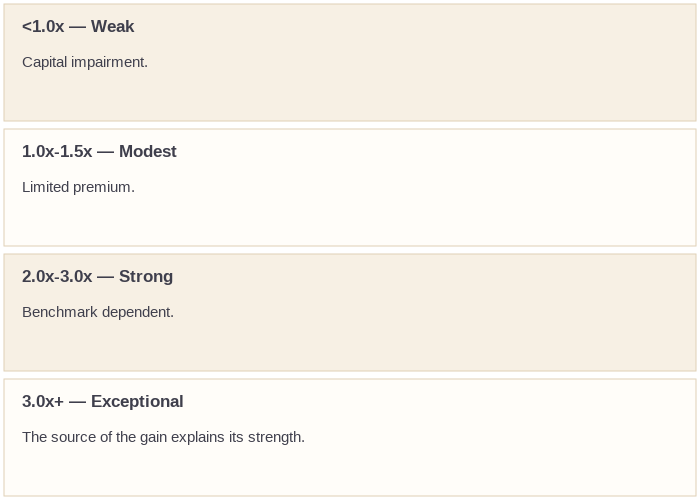
For a mature fund, net TVPI below 1.0x shows a loss on the reported values. A 1.0x to 1.5x result ranges from capital returned to a modest gain. A largely realized 2.0x to 3.0x can be strong, while more than 3.0x net can be exceptional. These are guideposts, not fixed grades; time, cash returned and a suitable Cambridge VC benchmark give them context.
The ranges start the review rather than settle it. The LP then checks large holdings, borrowing and the public return available on the same cash-flow dates. Tracing gains to each company shows whether one winner drove almost all the value.
A simplified mature-fund ladder treats net TVPI below one times as weak. One to one point five times is modest, while two to three times is strong. Results above three times can be exceptional, subject to benchmark context.
Mature Venture Fund Return Quality Ladder
The same multiple can mean different things depending on fund age, DPI, vintage, and stage.
View return-quality assumptions
| Net TVPI range | Plain-language label | LP caution |
|---|---|---|
| <1.0x | Weak | Capital losses, write-downs and remaining reserves explain the shortfall. |
| 1.0x-1.5x | Modest | May not compensate for illiquidity and manager-selection work. |
| 2.0x-3.0x | Strong | Vintage and stage benchmarks give the gain context. |
| 3.0x+ | Exceptional | DPI, concentration and repeatability explain its strength. |
What the Return Ladder Reveals
Company costs, sale proceeds and remaining stakes explain the gross result. When most value is still on paper, later funding can dilute the stake before an exit. The LP needs to see how those next steps could turn marks into cash.
PME adds a public-market comparison using the same cash-flow dates. A fund that beats both relevant peers and a suitable public index has stronger support for its return claim. Cash paid back then shows how much of that result is secured.
Frequently Asked Questions
Is a 3x venture fund always good?
It can be strong, but the basis matters. A 3.0x net result largely paid back to LPs offers firmer evidence than a 3.0x gross mark in unsold companies. Time and peer results still affect the judgment.
Should LPs care more about IRR or MOIC?
MOIC describes total value, while IRR reflects its timing. DPI reveals how much has actually returned as cash. Each answers a different part of the return question.