The Reserve Has a Specific Job
A seed fund keeps reserves for later rounds rather than new companies. How much to keep depends on the opening portfolio and which firms may earn more support. The stake it wants to retain then helps set the cash needed as those firms grow.
First cheques set the opening portfolio; reserves fund what comes next. As results diverge, some firms may deserve much more support than others. Planning both stages together reduces the risk that the fund cannot afford the follow-ons it expected.
Why a Seed Fund Needs Follow-On Capital
A successful seed company will often need more cash to grow. New rounds add shares, so the seed fund's slice of a future exit shrinks unless it buys more.
Carta's 2025 report put median dilution at about 16% per round from seed through Series C. This helps frame the funding path, but does not set a reserve rule for every fund. Even a strong company can dilute early holders as it raises more cash.
The ability to protect a stake starts with the fund's budget. Wanting a larger stake later does not create the cash needed to buy it.
A Percentage Changes the Opening Portfolio
A $100 million seed fund with a 40% reserve keeps $40 million for later and $60 million for first cheques. Raising the reserve to 60% leaves only $40 million for the opening portfolio. The added support later comes at the cost of fewer or smaller first bets.
Each dollar reserved for later is unavailable for a new company today. More first investments and larger reserves fit the same budget only if cheques shrink or the fund grows. The two choices are linked.
What the Reserve Can Fund
Suppose the fund's $60 million initial budget buys six stakes at $10 million each. Its $40 million reserve then covers four follow-ons of $10 million. If all six firms ask for that amount, the manager must choose, write smaller cheques or seek cash from outside the fund.
At that point, the reserve rule becomes a choice about company quality. Progress and round terms help decide which firms deserve more cash. Equal cheques would treat a strong company and a rescue bridge alike, despite their different prospects.
New Evidence Changes the Allocation
A firm may earn more support as customers stay, revenue quality improves and a credible new lead backs the round. Another may need cash because its original case has weakened. Both need funding, but the new cheques buy different chances of success.
Each cheque leaves less for another company. Agreed rules make that trade-off clear before a difficult round. An existing stake alone gives little reason to prefer it over a better use of cash.
Ownership and Capital Change Together
Larger rounds make pro rata support more costly. Keeping 10% of a company raising $100 million in new primary shares may take roughly $10 million, depending on the terms. Two such rounds would use half a $40 million reserve.
Keeping a stake and adding more to the best firms draw on the same reserve. Larger or earlier rounds can use that cash faster than planned, leaving less for later choices.
This $100M seed-fund example shows the budget trade-off. Cash reserved for follow-ons leaves less for first cheques.
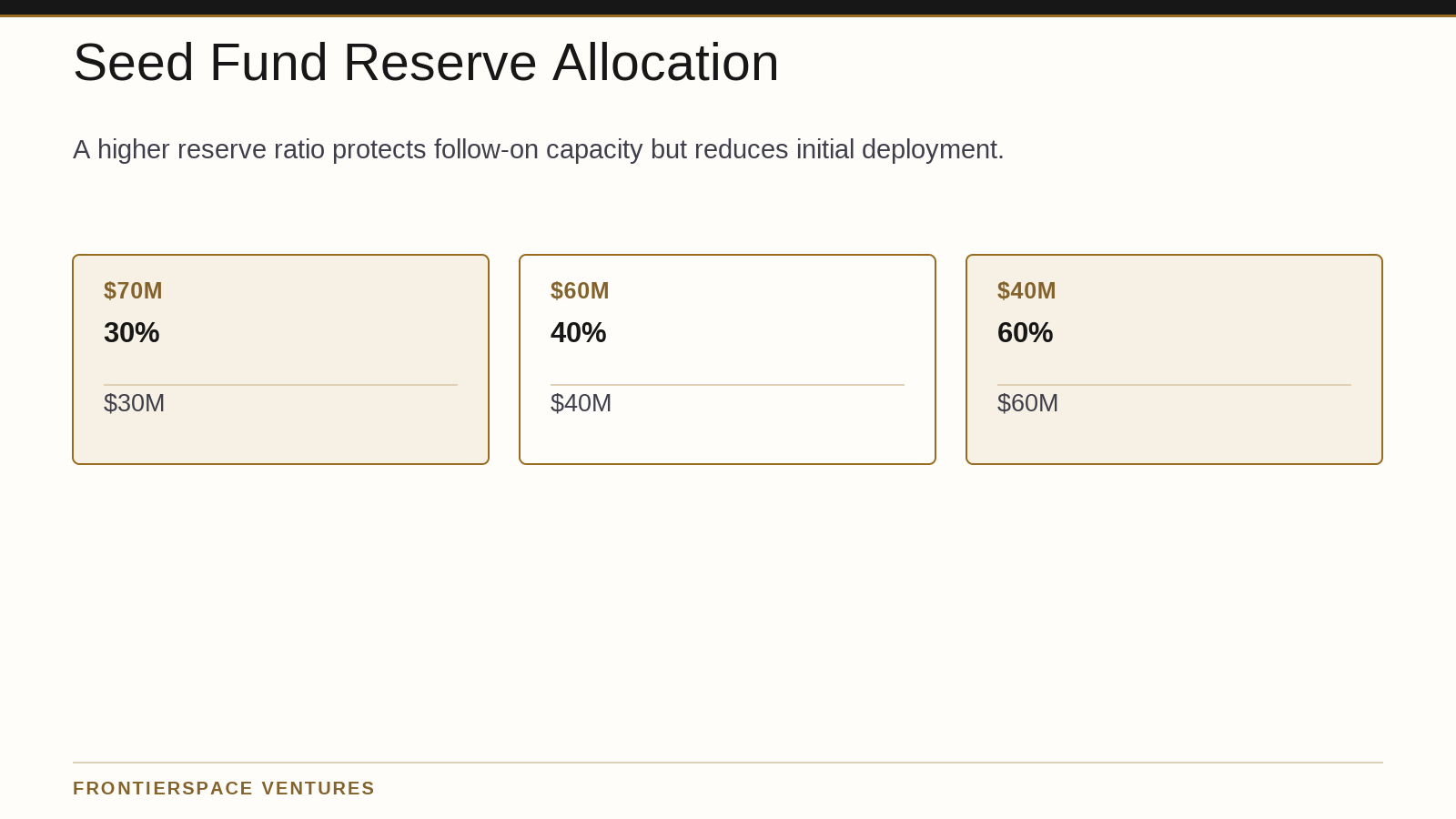
Seed Fund Reserve Allocation
A larger reserve keeps more cash for later rounds. It also leaves less to build the opening portfolio.
View allocation data and assumptions
| Reserve ratio | Initial capital | Follow-on reserve |
|---|---|---|
| 30% | $70M | $30M |
| 40% | $60M | $40M |
| 60% | $40M | $60M |
The Expected Value of Each Follow-On
The chart shows how much cash is available, not what the later cheques will earn. Their value depends on the price, stake and company prospects at each round. Adding cash to a weak holding does not repair the first decision.
Backing a likely winner can preserve more of its eventual proceeds for the fund. Fees, costs and carry then shape what LPs keep. That final contribution matters more than whether all available cash was spent.
Questions That Make the Policy Concrete
- How many companies can receive full pro-rata support? The answer depends on the reserve and assumed round sizes.
- What must a company prove to get another cheque? Past company results and round terms show how the manager has made that choice.
- Can cash move between companies? Fixed budgets for each can leave money tied to weak holdings.
- What if rounds arrive early? Several firms needing cash at once can force choices the original timetable left out.
A useful reserve policy lets the manager back firms that earn more support. The same rules should help it stop funding those that do not, keeping cash available for better cases.
Frequently Asked Questions
Is a 50% reserve too high?
A 50% reserve may fit a focused manager with strong pro rata rights. It is too large if the cash left cannot build the opening portfolio the strategy needs.
Should every company get follow-on support?
Progress, round terms, price and expected return determine the case for more funding. Each company competes with other uses of the fund's cash.