The First Cheque Is Already Gone
More funding is harder to justify when the next dollar offers less than other uses of the fund's cash. Demand, runway, round terms and outside support shape that choice. Money already spent is a sunk cost, even if declining the round forces a write-down.
A visible write-down can make a follow-on hard to decline, but the old cheque is already spent. Today's price and evidence set the case for new cash. They also let the fund compare it with other uses of reserves.
What Can the New Money Achieve?
A follow-on may fund growth in a stronger business or bridge it to a signed funding round or sale. A clear milestone links the cheque to that goal and helps set its size.
A vague promise of more runway offers less evidence. Repeated missed plans and a lack of outside leads may mean an insider extension only postpones the same problem. The case is stronger when the new cash changes what the company can achieve.
The Other Uses of the Cheque
A $100 million fund with $40 million of reserves could give each of four priority firms $10 million. That even split ignores their different progress and likely returns. The budget needs to follow the cases for support.
The fund might put $10 million into a flat insider round or a stronger company with a credible path to 5x. The insider round competes with that alternative for cash. Its future value comes from today's price; the old mark does not improve the return on a new cheque.
A Better Market Still Leaves Company-Specific Risk
Carta's 2025 private-market review found fewer than 14% of new rounds in Q4 2025 were down rounds. This was the lowest share in the prior three years.
That sub-14% share points to stronger market pricing. It does not settle the case for a specific company, which may still face weak demand or poor terms.
Patterns Across Reporting Periods
A weak quarter can be part of normal startup risk. A pattern matters more: fewer customers stay while each new customer costs more to win. Senior staff leaving or weak financial controls can also make the evidence harder to trust.
Who will fund the round adds evidence. If several outside investors decline while insiders extend runway again, the risk may exceed that of an ordinary follow-on. Price and control rights shape how much of it the fund accepts.
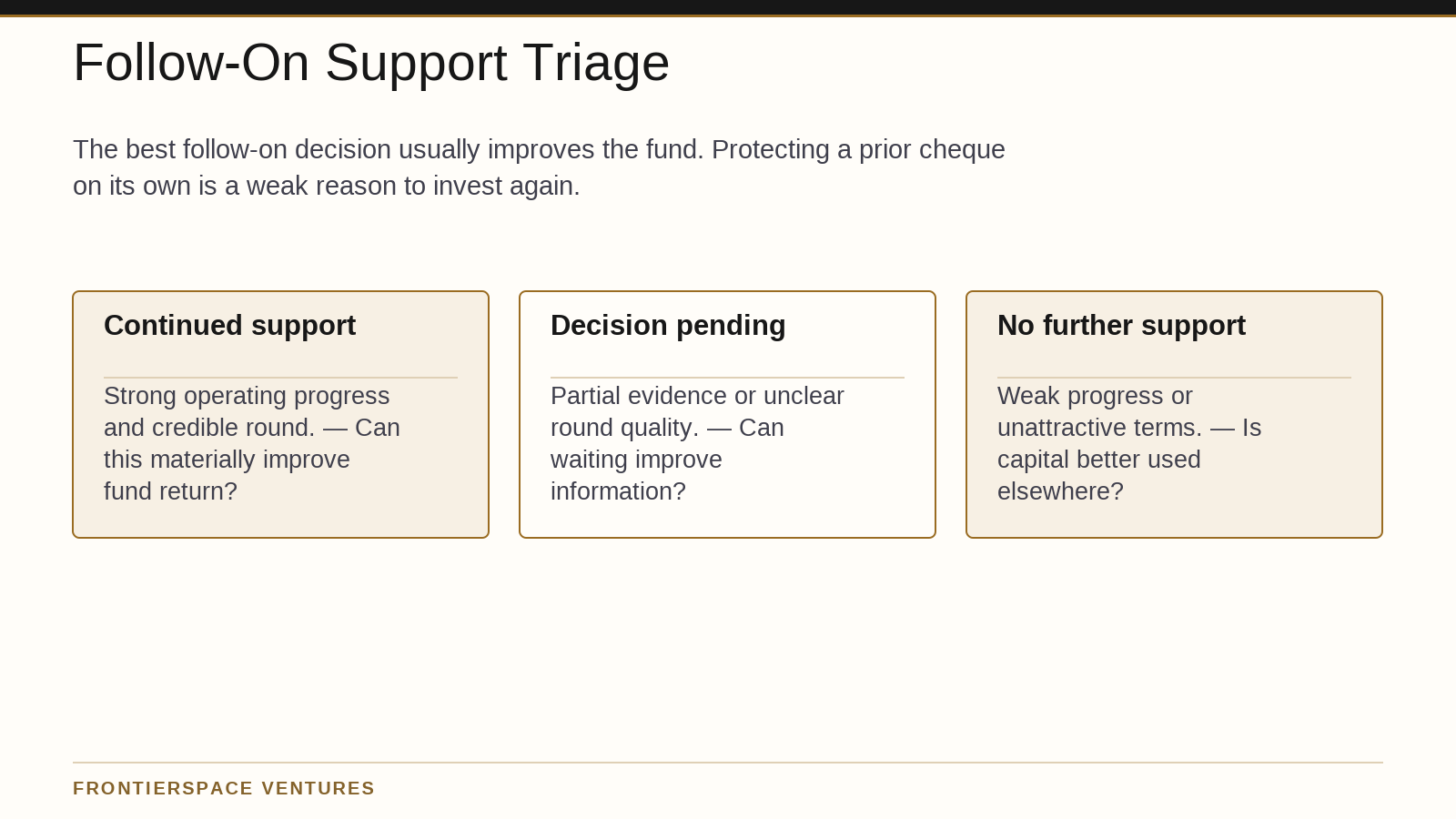
The follow-on choice brings company evidence, funding risk and price together. Other uses of the cash show what the fund gives up. The diagram maps this process without assigning scores.
Follow-On Support Triage
The best follow-on decision usually improves the fund. Protecting a prior cheque on its own is a weak reason to invest again.
View decision data and assumptions
| Decision | Typical evidence | Fund-level question |
|---|---|---|
| Continued support | Strong operating progress and credible round. | Can this materially improve fund return? |
| Decision pending | Partial evidence or unclear round quality. | Can waiting improve information? |
| No further support | Weak progress or unattractive terms. | Is capital better used elsewhere? |
The Fund Can Stop Investing and Still Help
The fund could wait for evidence, help find a buyer, accept dilution or offer a small bridge tied to a milestone. Each uses a different amount of cash. Comparing them shows what value the fund might preserve for that cost.
A conditional cheque needs a deadline and a clear plan if the milestone is missed. Those limits keep a short bridge from turning into repeated emergency funding.
The Reasoning Behind the Decision
- The prospective return depends on today's price.
- A defined milestone explains what the new cheque funds.
- The fund's other uses for the cash show what it gives up by writing this cheque.
- Agreed stopping conditions make the limits of support clear.
- Recording disputes shows which risks people disagreed on at the time. A later review can use that record instead of hindsight alone.
A good manager will sometimes stop funding a company it once backed. Clear reserve rules let stronger cases compete for that cash. An old decision that looked sound need not tie the fund to every later round.
Frequently Asked Questions
Can skipping a follow-on damage relationships?
Declining a round can strain a relationship. Explaining why helps the company understand the choice. The fund still has a duty to use its reserves well.
Should a fund follow on just to avoid dilution?
Avoiding dilution helps only when the company and new price justify more money. Keeping the same share of a weak investment does not make the next cheque a good one.