What Does 20% Carry Apply To?
Two SPVs may buy and sell shares at the same prices and charge the same carry rate. What that rate applies to can still change the payout. One may use gross proceeds; another may first deduct capital, fees and costs to define profit.
The legal waterfall sets the order in which sale cash is paid out. Following each step shows what reaches the investor. The headline carry rate is only part of that calculation.
How the Waterfall Divides the Proceeds
The sale brings cash into the vehicle. Under its terms, it may pay deal costs and debts, then hold some cash for taxes. Returning capital and meeting any hurdle can come next. The agreement sets which amount earns carry and what remains to pay investors.
Carta's SPV setup guide supports carry settings from 0% to 100%, along with expense reserves. That range describes what can be set up, not how often each rate is used. The vehicle's papers still set the actual calculation.
A Simple Version of the Calculation
A $10 million stake sold for $30 million makes $20 million of gross profit. Applying 20% carry to that profit gives the sponsor $4 million. Investors receive the remaining $26 million before other costs or cash held back.
That example has no costs between sale proceeds and profit. In a real SPV, admin charges or sale costs may reduce the amount on which carry is paid. A reserve can then delay some of the cash even after the stake is sold.
Expense Ordering Changes the Carry Base
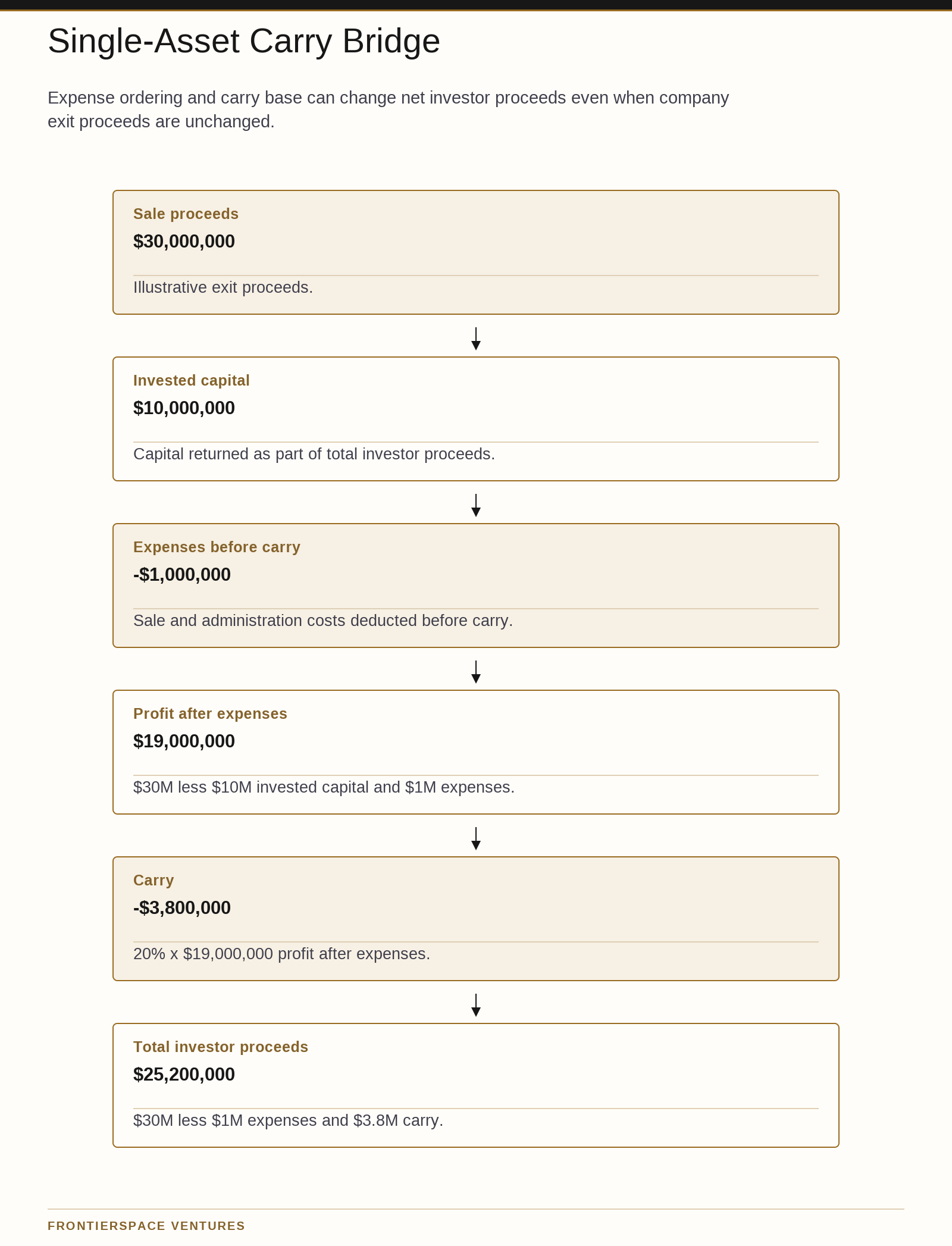
Deduct $1 million of sale and admin costs first, and profit falls to $19 million. The 20% carry is then $3.8 million, leaving investors $25.2 million before taxes or other cash held back.
If those costs come after carry on $20 million, sponsor carry remains $4 million. The gap grows with the vehicle's size, so the same rate can produce different payouts.
Partial Sales Create a Timing Problem
Suppose an SPV invests $100 million and later sells half the position for $80 million. If $50 million of cost is allocated to the shares sold, that first transaction appears to create $30 million of realized profit. A 20% carry payment would be $6 million.
If the remaining shares sell for $20 million, both sales together return only the original $100 million cost. The vehicle has no overall profit before expenses. Viewed across the whole stake, the first sale paid too much carry.
Holding carry in escrow or using a clawback can help recover that excess. Waiting until more of the stake is sold can also limit it. The cost assigned to each sale and the final true-up set what the investor keeps.
Distributing Unsold Shares Makes the Carry Calculation Less Certain
A vehicle may pay out both cash and unsold shares. Charging carry on those shares requires a value estimate that may later fall. Waiting for sale cash avoids that estimate, though tax reserves or sale-related claims may still hold cash back.
The order of costs and carry changes the payout even when the company sale price stays the same. Here, $10 million of capital produces $30 million of sale cash. Taking out $1 million of costs leaves $19 million of profit on which to charge 20% carry.
Single-Asset Carry Bridge
The same company sale can leave different amounts for investors. Costs and carry decide how much cash reaches them.
View bridge data and assumptions
| Step | Amount | Calculation |
|---|---|---|
| Sale proceeds | $30,000,000 | Illustrative exit proceeds. |
| Invested capital | $10,000,000 | Capital returned as part of total investor proceeds. |
| Expenses before carry | -$1,000,000 | Sale and administration costs deducted before carry. |
| Profit after expenses | $19,000,000 | $30M less $10M invested capital and $1M expenses. |
| Carry | -$3,800,000 | 20% x $19,000,000 profit after expenses. |
| Total investor proceeds | $25,200,000 | $30M less $1M expenses and $3.8M carry. |
Investor-Level Net Proceeds
An investor that owns 10% of the SPV would receive $2.52 million from $25.2 million of total proceeds after the illustrated waterfall, before its own taxes or adviser fees.
The investor's share of the SPV determines its share of the payout. Costs outside the vehicle can then reduce the cash it keeps.
Questions Before Commitment
- What amount does the agreement use as the carry base?
- Which costs come out before carry is charged?
- Does the investor get its capital back before profit is shared?
- How are partial sales protected by escrow or clawback?
- When are remaining reserves released?
A worked example turns the vehicle's terms into cash for each party. If the same inputs give different answers, part of the formula may be unclear. Resolving that gap makes the actual payout easier to assess.
Frequently Asked Questions
Is carry always charged only on profit?
Many waterfalls charge carry on realized profit. The agreement defines that profit and sets when carry is paid. It also decides whether costs come out first.
Why does expense ordering matter?
It changes the sum on which carry is charged. Taking costs out first usually reduces that sum, leaving less carry than if the costs came out later.