An Early Winner Can Create a Later Clawback
American terms may pay carry after a deal makes a profit. European terms tend to wait for LPs to get their capital back across the fund. That delay avoids early carry on gains wiped out by later losses.
Whole-of-fund terms test the fund's returns before paying carry. Deal-by-deal terms may pay once Company A makes a profit. That early payment creates the timing gap in the example below.
How an Early Winner and a Later Loss Interact
Assume 20% carry and no hurdle. Under simple deal-by-deal terms, Company A's $30 million profit could pay the GP $6 million. Whole-of-fund terms would pay no carry yet, since LPs have not recovered all $100 million put into the portfolio.
Now Company B sells for $30 million, bringing total proceeds to the original $100 million cost. The fund has made no overall profit. In this simple case, no carry is due to the GP at the end.
The whole-of-fund approach paid no carry, so there is nothing to reclaim. Deal-by-deal terms may need the GP to return the earlier $6 million through a clawback. Full recovery gives the same final result, but LPs faced repayment risk along the way.
What the Labels Usually Mean
'European' means the GP waits for LPs to recover an agreed amount across the whole fund. The terms may include deal cost, fees, expenses or a preferred return in that amount. Those choices set when carry can start.
'American' terms can pay carry deal by deal. A qualifying exit may release it while the fund still holds other assets. The LPA may first deduct prior losses or write-downs from that gain.
The labels describe how cash is split, not where the fund is based. A European GP may choose deal-by-deal terms. A North American GP may use whole-of-fund terms.
The Market Data Confirms That the Labels Overlap
ILPA's 2021 fund-terms report used a Colmore dataset of 695 LPAs. It found whole-of-fund terms in 73% of the European sample and 58% of the North American sample. That difference helps explain the names, but each region used both structures.
The same sample found 71% of funds used a 20% carry rate. A common rate leaves room for different timing. Carry paid after each profitable deal may reach the GP years before carry that waits for all capital to be returned.
Why Early Carry Needs Recovery Protection
In its September 30, 2025 filing, KKR reported roughly $514 million of carried interest subject to clawback. This assumed the relevant funds sold all holdings at their reported fair values on that date. The filing does not classify each waterfall. It shows how carry already paid can still depend on later results.
A clawback creates a duty to repay, but the recipient must also be able to pay. Test dates, escrow and guarantees affect recovery. Tax limits and how long the duty lasts can then change the amount returned.
LPs put $100 million into this two-deal fund. Deal-by-deal terms pay $6 million of carry after the early win. Once the second deal loses money, LPs have $94 million before clawback. Whole-of-fund terms pay no early carry, leaving LPs with $100 million. The model uses 20% carry, with no preferred return, catch-up, fees, expenses, taxes, recycling or GP commitment.
Early Carry Creates a Clawback Exposure
The American waterfall pays $6 million of carry after the early win. The later loss means that cash must come back to restore the final fund-level split.
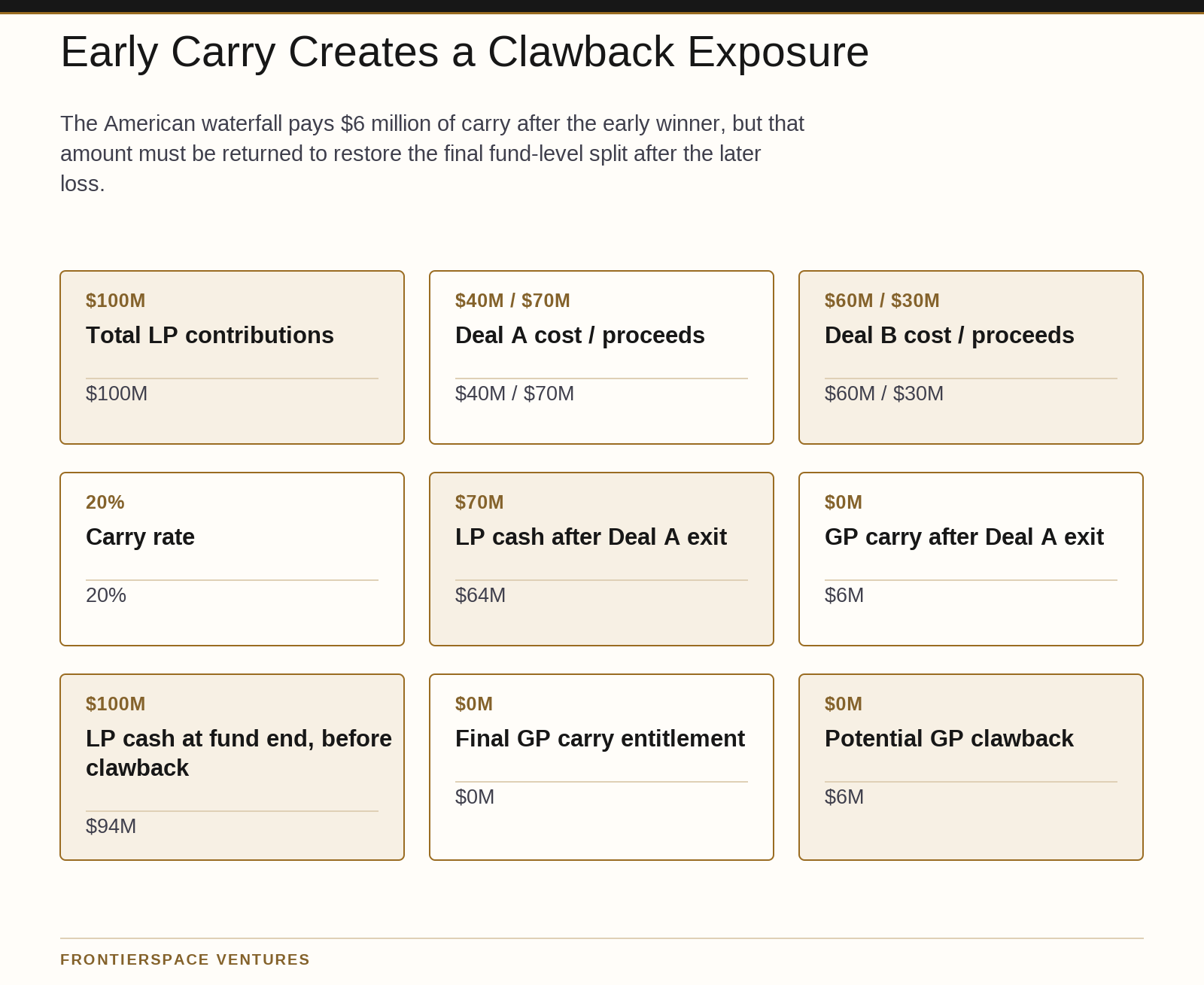
View chart data and assumptions
| Item | European / Whole-of-Fund | American / Deal-by-Deal |
|---|---|---|
| Total LP contributions | $100M | $100M |
| Deal A cost / proceeds | $40M / $70M | $40M / $70M |
| Deal B cost / proceeds | $60M / $30M | $60M / $30M |
| Carry rate | 20% | 20% |
| LP cash after Deal A exit | $70M | $64M |
| GP carry after Deal A exit | $0M | $6M |
| LP cash at fund end, before clawback | $100M | $94M |
| Final GP carry entitlement | $0M | $0M |
| Potential GP clawback | $0M | $6M |
The LPA Definitions Decide the Actual Result
Two funds can charge 20% carry but send out cash on different terms. The agreement sets what comes back before carry starts. It also sets how a preferred return builds and when earlier losses reduce the gains.
What Counts as Returned Capital?
One LPA may repay only the cost of deals already sold before paying carry. Another may return all paid-in capital and fund costs. Recycling early payouts puts that cash back to work, which can change the capital still due to LPs.
How Does the Preferred Return Work?
A hurdle's effect depends on when it starts and whether it compounds, as well as its rate. After it is met, the GP catch-up determines how the next dollars are divided.
Can Excess Carry Actually Be Recovered?
The clawback needs an enforceable duty and someone able to pay it. The agreement names who owes the cash and when the amount is tested. Other terms that affect recovery include:
- cash held in escrow or guarantees to back the duty to repay;
- tax rules in the agreement that may limit what comes back;
- the survival period after the fund ends; and
- whether each person paid carry must return some of it.
Invest Europe guidance also stresses clear terms for sharing profits and losses. Carry timing and clawback turn those terms into cash payments. Their effect matters more than the name of the waterfall.
The Same Portfolio Under Two Payout Rules
A dated cash-flow model puts the early win and later loss on one schedule. Add a partial sale or a longer hold to test less tidy outcomes. The timing then shows how each waterfall responds.
Capital returned, carry paid, reserves and preferred return show the balance at each date. Then test what carry would be due if all unsold assets sold at current values. A gap between that figure and carry already paid can reveal a possible clawback.
Deal-by-deal terms can work with strong rules for netting losses and recovering excess carry. The real test is when cash leaves and how much can be recovered if later deals lose money.
Why the Carry Rate Does Not Tell the Whole Story
Two funds charging the same carry rate can release it at different times. The legal terms determine when cash moves to the GP and what could later have to be repaid.
Exits and write-downs change fund value and the return left after carry. A clear record of payments lets the committee follow how much carry could have to come back as the fund matures.
Frequently Asked Questions
Is a European waterfall always used by European funds?
It usually means whole-of-fund terms, which can be used anywhere. Funds in Europe may choose deal-by-deal or mixed terms. North American funds may choose to pay on whole-of-fund results.
Does an American waterfall always pay carry after every profitable exit?
The LPA may require costs of sold deals and their expenses to be repaid first. Earlier losses, write-downs or a preferred return may also sit ahead of carry. Escrow and interim clawback tests can then limit how much of the carry the GP can keep at once.
Does a GP clawback eliminate the risk of early carry?
A clawback lowers risk but may not recover all the cash. Tax limits and late tests can restrict repayment, while the recipient may lack funds or dispute the amount. A guarantee helps only to the extent that it covers those obligations and can be enforced.
Which waterfall is better for LPs?
Whole-of-fund terms tend to delay carry and reduce the risk of paying too much early. Deal-by-deal terms can also return capital and account for losses. Escrow or interim clawback tests may back that up. Compare the strength of those safeguards as well as costs and the GP relationship.