One Decision Selects a Manager; the Other Selects a Company
The difference is what the LP chooses. In a fund, it picks a manager and lets that manager choose the companies. In a co-investment, it also assesses a specific business, the security and the price.
An invitation can make a deal feel attractive before the LP checks it. Access rules help explain why the offer arrived. ILPA's guidance covers what the sponsor should disclose and how costs are shared. These details help the LP judge the deal rather than the value of being invited.
The fee comparison begins with what each route charges. Carta notes that 2% management fees and 20% carried interest are common venture terms. A co-investment has its own fee and carry charges, which may be lower but still depend on the structure used.
Choosing a company gives the LP more control and more work, often under a short deadline. Since the result rests on that business, the LP must be able to make and support the choice.
The Same Cheque Buys a Different Unit of Risk
A $10 million commitment is 10% of a $100 million fund that may back several companies. Put the same $10 million into one co-investment, and the result rests on that company alone. The cheque is the same size, but the sources of risk differ.
- Fund investment: The LP promises cash to a pooled fund. The GP calls that cash and puts it into companies under the fund's plan.
- Co-investment: The LP backs one company, either directly or through an SPV. It usually joins a lead investor or sponsor in the deal.
A fund review focuses on the manager and how it plans to build the portfolio. A co-investor can study the company itself. But there is often less time, and the amount it can invest may change close to closing.
Knowing the Company Is Only the Beginning
A direct holder owns the company's security, while an SPV sits between the LP and the company. That extra layer can change who receives reports and makes decisions. It can also add SPV fees and carry, reducing what the LP keeps.
- Direct holding: The LP owns the company's security. Its rights come from the signed terms for funding and holding the shares.
- SPV holding: The LP owns a stake in a vehicle that holds the company shares. Reports and control may pass through the SPV manager.
- Sponsor-led access: The lead may keep part of a round for its main fund. It can then offer the rest to other investors.
Suppose a company raises $100 million and the lead takes $60 million. Other investors share the remaining $40 million. A $10 million co-investment is therefore 25% of that pool but just 10% of the full round.
A fund lets a manager choose a group of companies. A co-investment gives the LP more say over one deal, so a wider portfolio can use both routes. This model draws on the cited sources. The legal terms and the facts of each investor's case govern the outcome.
Fund Versus Co-Investment Choice
Funds and co-investments can serve different needs. A large venture portfolio can use both with a clear purpose for each.

View chart data and assumptions
| Option | Role | When it may fit |
|---|---|---|
| Fund | The manager selects and manages a portfolio of companies. | When the LP wants a manager to choose companies and manage reserves. |
| Co-investment | Adds a stake in a chosen company or deal. | When the LP wants to choose the company, set its stake size and build a business relationship. |
| Combination | Uses both routes within one portfolio structure. | When a diversified portfolio and deal-specific choice are both valuable. |
How Fund and Co-Investment Exposure Differ
| Dimension | Fund Investment | Co-Investment |
|---|---|---|
| Diversification | Exposure to multiple companies within one vehicle. | Exposure to one company or a small number of selected companies. |
| Primary Review | Manager, strategy, allocation mix, and terms. | Company, price, security, sponsor, and fit with the rest of the portfolio. |
| Diligence Workload | Heavy before manager selection, lower per company afterward. | Heavy per transaction, often under a compressed timetable. |
| Liquidity | Long-dated fund interest with restricted transfers. | Long-dated company or SPV interest with single-company exit dependency. |
Specificity Improves the Questions
Knowing the company lets the LP test its price and share rights. The LP can then check whether its funds already own the same business. That links the deal's merits to the risk it would add to the portfolio.
- Known business: Current sales, costs and cash needs help the LP judge the company. It can also check who owns the shares.
- Exact security: The share class sets rights to cash. Transfer limits and vehicle terms add rules on holding or selling the stake.
- Chosen exposure: Each company adds a sector, stage, place and business model. The LP can check whether these repeat what it already holds through funds.
- Known price: The business and its cash needs help frame a fair price. Public peers and likely exit values then help test the scope for a return.
A $50 million pool split equally across 5 companies puts $10 million, or 20%, in each. A sixth deal at the same size needs more cash or a smaller holding elsewhere. The planned company count therefore limits the cheque size.
That clearer view takes work. A sponsor or administrator can manage the process, but the LP still needs facts to assess and track each holding.
Where the Company Fits in the Whole Portfolio
A fund with twenty equal stakes starts with 5% in each company. A stand-alone co-investment puts 100% of its vehicle into one business. Before further funding, a failure therefore has a much larger effect on that vehicle.
A fund spreads risk across several companies. A co-investment ties much more of the result to one business, so that choice needs a closer review.
- Fund investments: Cash is spread across companies. If one fails, it will usually account for only part of the money the fund invested.
- Co-investment exposure: Cash is tied to one company. That can express a strong view or add to a theme. It also makes the business's success or failure more important to returns.
A Short Review Can Lead to a Long Commitment
A co-investor may have only 10 business days to review a deal that ties up cash for years. Goodwin gives a typical closed-end private fund a life of 8 to 12 years. Agreeing the review process before an offer arrives leaves more of the deadline for assessing the deal itself.
The sponsor's interests and rules for sharing deals explain why the offer arrived. The company, price and share rights then show what the LP could earn or lose. Both parts belong in the review.
- Fund review: Check how the manager finds deals, makes choices and keeps its team stable. Its reserves, prices and control rights show how that plan works. Conflicts and the terms offered to LPs may change the result.
- Sponsor review: Check the lead's role and interests in the deal. How it shares the round and plans to help the company can show why it wants to take part.
- Company review: Test the business, price, share rights and future cash needs. Then compare the deal with existing holdings to judge how it fits.
Agree who handles the investment, legal, tax and other work before a deal arrives. The team can then spend a short deadline reviewing the offer. Without clear roles, it may miss the deal or rush checks that should protect it.
The deal memo template records who reviews the company, sponsor and terms. It then links those checks to the effect on the LP's wider holdings.
Where the Full Cost Comes From
Carta reports median venture-fund terms of 2% management fees and 20% carry. To see how carry works, take a simple $10 million investment that doubles before fees. It makes $10 million of profit, of which 20% carry takes $2 million.
Lower headline fees do not always mean a cheaper deal. Sponsor carry, vehicle fees and the LP's own legal and monitoring costs all reduce the saving. The comparison needs to include the full bill.
- Fees and carry: Some deals cut or remove these charges.
- SPV costs: The vehicle may charge an upfront fee, running costs, deal expenses or its own carry.
- LP costs: The LP may pay its own bills for legal work, tax, custody and reports. Checks on the holding can add costs too.
- Stake size: Fixed costs take a larger share of a small cheque. That can leave too little cash working in the deal.
Each Invitation Still Needs a Sizing Decision
LPs usually gain fund access when a manager raises a fund. Co-investment offers arrive from time to time, and a data room invite does not promise a stake. The LP gets what remains after the lead and the company's preferred investors take their shares.
When there is too little room for every eligible LP, the sponsor must divide what is left. The final stake may therefore be smaller than the amount the LP approved.
- How much cash the company wants from outside investors.
- What the lead investor can commit from its main vehicle.
- Which investors the company wants on its cap table.
- How the sponsor shares space among LPs and other buyers.
Several good deals may arrive at once. Even with enough cash, the LP may lack time to assess them or room for more risk. Clear priorities help the team choose among them instead of letting their order of arrival decide.
Why the Sponsor Offers an Allocation
A lead may share a round because it is too large for its fund. It may instead face an exposure limit or weak demand for the deal. The LP needs to know which reason applies before treating the available stake as an attractive offer.
- Possible reasons: The round may be larger than the lead fund can finance. The company may also want more investors who can stay for the long term.
- Points to check: Find out how much the lead can invest and how the company plans to raise cash. Check whether the offered terms match the sponsor's own stake.
Questions to ask:
- Is the sponsor investing from its main fund on the same terms?
- How is the round shared when buyers want more than is available?
- Does the sponsor use the same rules to share each deal?
- What help can the company expect if the business gets into trouble?
How Information Reaches the LP
A fund manager gathers company reports for the LP. An SPV adds another step, and an administrator may prepare reports and tax records. The signed terms still decide what the LP has a right to receive.
- Rights to reports: The deal's signed terms set what the LP can receive.
- Fund transfers: Selling a fund interest may require GP consent.
- Cash from the company: The deal relies on one business. Its funding and exit path drive when cash can return.
Neither route guarantees cash when needed. A delayed exit or weak funding market can leave the LP waiting longer than planned. Authority over follow-on funding also matters because keeping the stake may call for more cash.
Most surveyed LPs co-invest. Many use shared teams or external support, while a standalone internal unit is less common. ILPA surveyed 97 LPs in Q4 2025. The 73% figure uses all respondents; the 55% figure uses the subset of LPs that co-invest.
Co-Investment Is Mainstream Across LPs
Most LPs in the survey co-invest. Many use shared teams or help from sponsors, advisers and administrators. A separate team within the LP is less common.
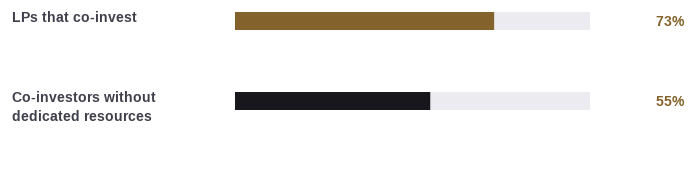
View chart data and assumptions
| Measure | Value |
|---|---|
| LPs that co-invest | 73% |
| Co-investors without a standalone dedicated unit | 55% |
How the Two Structures Can Work Together
- A fund may fit: The LP wants a spread of companies and access to the GP's wider portfolio. It wants the manager to decide on reserves and monitor the holdings.
- A co-investment may fit: The LP wants to back one company and can assess the deal. It may use help from the sponsor, advisers, lawyers and administrators.
- Both may fit: Funds and co-investments can work together. Each needs a clear purpose in the wider portfolio.
Reviewing company and fund stakes together can reveal risks their separate reports hide. The stages, funding needs and likely exits show when those holdings may need cash at the same time.
CalPERS: fund commitments and co-investments in the same program
In November 2023, CalPERS listed three types of deal. They were a fund, a co-investment in one firm and a secondary deal. The list shows how one LP used several paths into private markets.
B Capital Opportunities Fund II was the pooled fund. Its manager chose where to invest the cash.
The Coefficient Capital co-investment was a separate deal. It gave the LP a stake in one company rather than a pool of holdings.
B Capital Global Growth III used a third route. The report listed it as a secondary deal.
Each route changes the LP's consent rights, costs, review work and limits on risk. But the report gives no company returns or deal terms. It therefore cannot establish which route performed better.
Primary source: CalPERS private equity report, March 2024. These public records show the routes used by CalPERS. They do not describe a Frontierspace result.
Frequently Asked Questions
Which is usually more diversified: a venture fund or a co-investment?
A fund normally spreads money across more companies. A co-investment gives the LP a closer view of one business. That company also has more influence on the result.
Are co-investments always cheaper than fund investments?
Lower management fees can be offset by SPV costs or sponsor carry. The LP's own review and monitoring costs also reduce the saving. The full set of charges determines whether the co-investment is cheaper.