What Does the Corporation Want From the Company?
A strategic investor may seek both a return and a business benefit. It might want a partner, access to a product or a closer view of a market. Those goals shape the price it will pay, the stake it wants and when it chooses to sell.
NVCA's five deal documents cover rights that go beyond the share count. They set terms for voting, control, reports and transfers. A corporate investor also needs to decide what its deal team can share with the rest of the business.
How the Relationship Shapes the Investment Route
A venture fund lets a company learn about a broad market through a manager. A direct stake or co-investment brings it closer to one business. If it mainly wants to test a product, a business contract may serve that goal. Buying the company gives it control instead.
The intended relationship helps decide which structure fits. A product partnership needs ways to work together. Control of the whole business calls for a different set of rights.
What the Different Routes Provide
| Route | Best for | Main trade-off |
|---|---|---|
| Venture fund | Broad access and manager-led selection | Less control over company choice |
| Co-investment | Selected company exposure alongside a sponsor | Concentration and fast review |
| Direct minority | Financial and strategic relationship | Ongoing cap-table and business-unit work |
| Commercial partnership | Product, customer, or distribution test | No equity upside |
| Acquisition | Control and integration | Full purchase price and operating risk |
The Commercial Contract and the Shares Serve Different Purposes
A startup may fear that one corporate backer will put off other customers or buyers. Broad rights to control its choices or block partners can make that risk real. The terms can therefore affect how the company grows.
A commercial contract can limit which customers or partners the startup works with. That cost remains even if the shares were bought at a good price. Looking at the contract on its own makes the trade-off easier to see.
What a Lead Sponsor Adds
A lead sponsor can organise the review and negotiate the deal. Its reason for investing may differ from the corporate buyer's. The buyer still needs to test what business value the company could bring it.
The lead's own cheque and shares show which risks and rewards it takes. Compare the new stake with the buyer's existing holdings too. That reveals whether it adds something useful or more risk in a field the buyer already owns.
Questions for Participation
- What is the goal? Access, return, partnership and control lead to different kinds of investment.
- Who makes it work? A named business sponsor takes charge of the partnership inside the corporate buyer.
- Do the rights fit? Rights that protect the buyer can also limit the startup's future choices.
- What happens if strategy changes? The security may last longer than the partnership.
- How will success be measured? Financial returns and business results reveal different parts of the outcome.
The startup should gain a useful partner, while the buyer receives a clear set of share rights. The startup also needs room to build value with other partners. Leaving that room is part of making the deal work for both sides.
Financial Returns and Business Benefits Can Diverge
In 2025, AI and machine learning made up 68.1% of US VC deal value involving corporate investors, but only 19.1% of deal count. Large rounds in one theme thus drew much of the money, despite being a smaller share of the deals.
The same stake can serve several goals for a corporate buyer:
- Share return: A gain on the shares can add value apart from any business benefit.
- Market insight: The buyer can learn from the startup. New products, customers and rivals may come into view through that work.
- Business ties: The startup may buy from the investor, supply it or help it reach new customers.
- Future choices: A stake may leave room for a deeper partnership or a later deal.
Give each business goal a clear owner so its value can be tested. A useful partnership may meet that goal. The price and share terms must then show whether the stake also meets the buyer's return target.
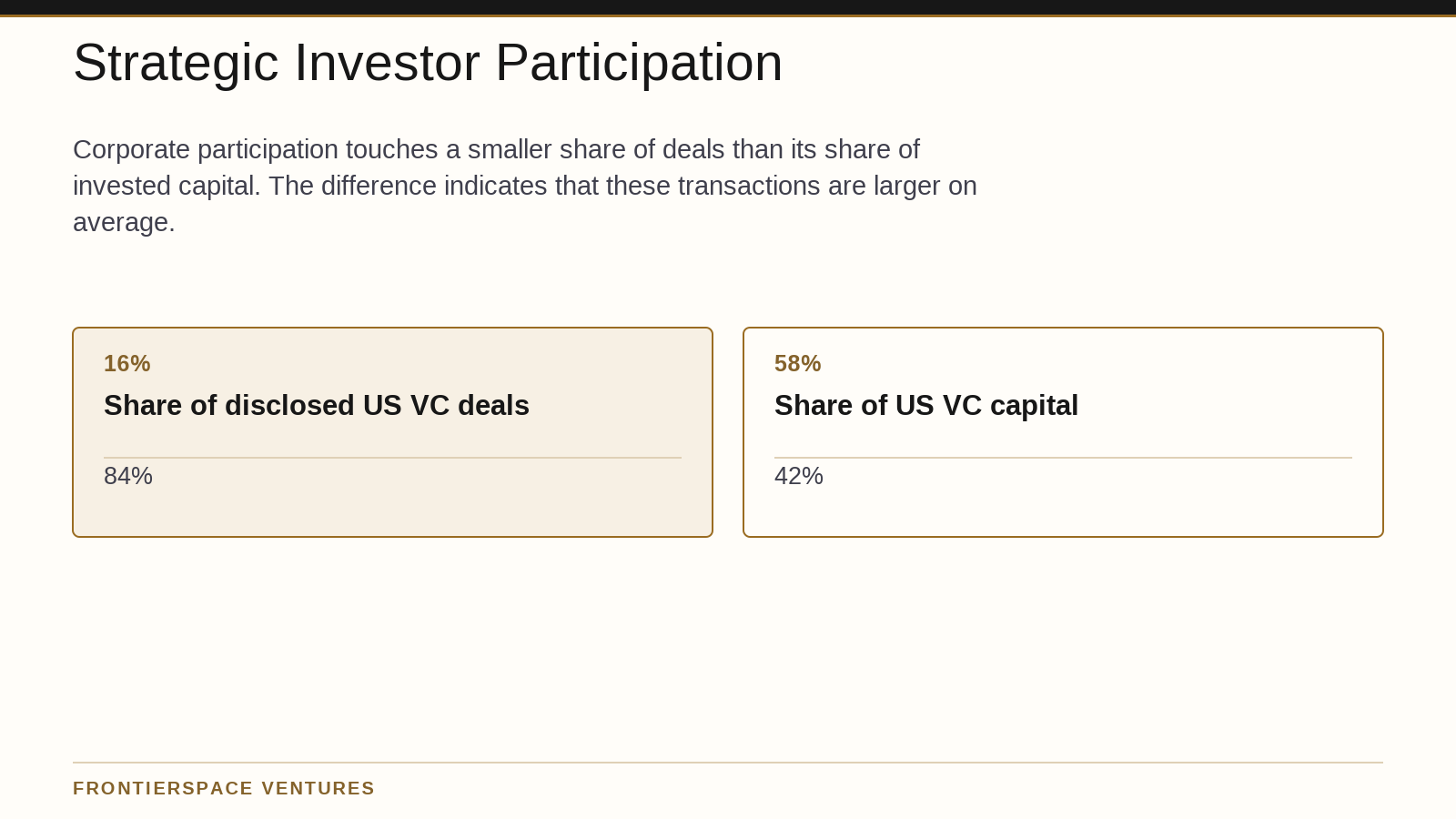
Deals with corporate backers make up a larger share of money invested than of deal count. They are therefore larger on average. The sample covers 2025 US VC deals with disclosed investors. NVCA reports CVC involvement in 16% of deal count and 58% of capital value.
Strategic Investor Participation
Deals with corporate backers make up a larger share of money invested than of deal count. They are therefore larger on average.
View chart data and assumptions
| Category | CVC involved | No disclosed CVC |
|---|---|---|
| Share of disclosed US VC deals | 16% | 84% |
| Share of US VC capital | 58% | 42% |
Corporate VC Versus Balance-Sheet Investing
US venture investment reached $320 billion across 15,352 deals in 2025. No corporate team can review that whole market. A broad search offers more variety, while a narrow focus can concentrate the team's knowledge on fields that matter most to the business.
- CVC team: A standing team can use a set plan, budget and approval process to choose and manage deals.
- Balance-sheet deal: A strategy team or business unit may lead one deal. The team that buys companies could also take charge.
A standing CVC team can use one process across many deals. A balance-sheet investment may fit a rare opportunity. It still needs a person or team able to manage the stake for years.
Confidentiality and Conflicts
A corporate buyer can own 5% of a company yet have 0 board seats and few rights to reports. The share count alone does not give it control or business access. Those rights come from other deal terms.
An investor may also be a rival or customer, or later buy the company. These roles affect which facts it should see. Agreeing limits before closing lets both sides judge what they can share while they still have a choice about the deal.
- What data can each team receive and share internally?
- Who can attend, and when can the company exclude the observer?
- Business talks: Plans to work together do not give the buyer control as a shareholder. The right to approve a deal or direct the company must come from the agreed rights.
- Conflicts: Business goals can clash with the buyer's goals as a shareholder. Agreed rules set how it makes decisions when they do.
Minority Ownership
A 10% stake falls to 8% after 20% dilution. If a later round dilutes it by another 20%, it falls to 6.4%. Using pro rata rights to buy more shares can let the investor defend its stake.
Most corporate stakes leave control with the company and its other holders. The minority stake's rights set which choices the buyer can influence. They also show which remain outside its control.
- Can the buyer vote, approve key choices, attend board meetings or receive reports?
- Can the investor sell, and what approvals are required?
- Can ownership be maintained in future rounds?
- Could any term affect a future sale or strategic deal?
- Does the company want a strategic partner, or does it mainly need cash?
More corporate venture investors joined US deals through 2021-2022, before the count fell from its peak. The chart counts each investor once in a given period. It measures neither the cash they put in nor their returns.
The Number of Active Corporate Venture Investors Has Normalized
More corporate venture investors joined US deals through 2021-2022, before the count fell from its peak.

View chart data and assumptions
| Period | Unique CVC investors |
|---|---|
| 2015 | 1315 |
| 2016 | 1409 |
| 2017 | 1589 |
| 2018 | 1858 |
| 2019 | 1930 |
| 2020 | 2020 |
| 2021 | 3047 |
| 2022 | 3124 |
| 2023 | 2311 |
| 2024 | 2322 |
| 2025 | 1937 |
How the Investment and Business Cases Fit Together
The shares can have an investment case without any partnership value. The business relationship can also offer benefits without a gain on the shares. Each has its own evidence.
- Share return: Company quality, entry price and share terms shape the gain. Later funding can dilute the stake, while the route to a sale sets when that gain may become cash.
- Business case: A useful product that fits customer needs can offer a gain beyond the shares. The work needed to make it useful shows whether that hope is realistic.
- Value that remains: A gain on the shares may still have value if the partnership falls short. A useful partnership may also survive a poor investment return.
Separate evidence shows where the share return and business case support each other. It also reveals when they do not. A vague business goal may hide poor returns, or a sound share purchase may be tied to a partnership that cannot work.
The guide to private tech co-investments explains how to review the stake. The guide to company quality and price then tests what it may be worth.
Databricks and Meta: strategic capital inside a large financing
Meta joined Databricks' January 2025 round as a new strategic investor beside buyers seeking share returns. They bought equity, while banks supplied a separate credit line. The round thus joined different goals and claims in one funding package.
Meta could seek a gain on its shares and use the stake to pursue its own product and business goals.
The business goals still sat beside an entry price. The Series J valued the equity at $62 billion.
The lenders had a different claim on the company. Their contracts gave them a different place in the payment order and different risks from those of equity holders.
A corporate stake can support a business tie while creating conflicts. Rights to reports and privacy rules set what the buyer can learn. Limits on control and on sharing sensitive facts matter most when it is also a rival.
Primary source: Databricks' Series J and debt round (2025). This public deal shows how a corporate buyer can join a larger round. It is not a Frontierspace result.
Frequently Asked Questions
How do strategic and financial objectives differ?
A corporate buyer may seek a return, product insight or closer ties to a market. Those goals can favour different choices. The terms need to make clear who decides when the goals pull apart.
Which conflicts should strategic investors review?
Private data and business ties can create conflicts. A later round may add more tension if the buyer can influence the company. Rules for sharing deals and deciding when to sell help show how those conflicts will be handled.