A GP Commitment Is More Than a Percentage
Cash, loans and waived fees expose partners to different risks. The split among them also matters, especially as funds grow. A 2% commitment to a larger successor fund may put far more of their personal wealth at stake.
ILPA's principles call for clear terms and shared interests between a fund and its LPs. A GP commitment can help create that link. Who receives the gains and bears the losses shows how strong it is.
Under familiar 2 and 20 terms, the GP receives management fees and may earn carry. Its commitment adds a separate stake beside the LPs' cash. The LP must weigh all three to understand the manager's rewards and risks.
The amount matters, but so do its source, the split among partners and their conduct under stress. This example uses terms from public sources. The fund's own documents and each partner's funding terms set the actual commitment.
GP Alignment Check
The amount matters, but so do its source, the split among partners and their conduct under stress.
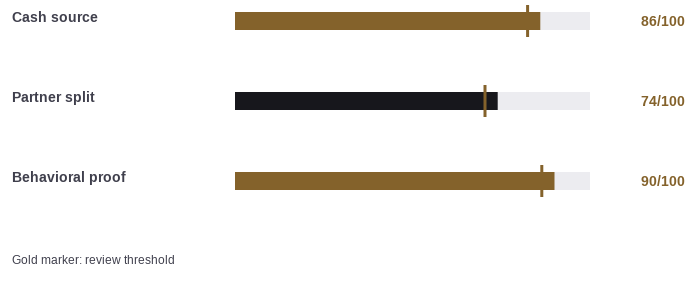
View chart data and assumptions
| Review area | Illustrative score |
|---|---|
| Cash source | 86/100 |
| Partner split | 74/100 |
| Behavioral proof | 90/100 |
A fund may present a 2% GP commitment as proof of shared risk. Yet one senior partner could supply nearly all of it through a loan. Other partners choosing deals may put in little cash, leaving losses unevenly spread.
What the Headline Commitment Leaves Out
The cash amount makes the commitment easier to judge. A 2% GP commitment equals $2 million on a $100 million fund and $5 million on a $250 million fund. The same percentage can impose very different personal risk.
The cash amount and its split show who supplies the capital. Its source then reveals how they fund it. Own cash, waived fees and management-company loans place different demands on partners.
The effect of a commitment depends on each partner's finances. Would a poor fund result cause a meaningful personal loss? That is more useful than a fixed wealth test for all partners.
The same GP commitment percentage creates very different dollar alignment as fund size scales. A 1.5% commitment equals $1.5 million on a $100 million fund, $3.75 million on a $250 million fund, and $7.5 million on a $500 million fund.
GP Commitment Dollar Alignment by Fund Size
The same percentage can put very different cash sums at risk for each partner.

View GP commitment assumptions
| Fund size | 1.5% GP commitment | 3.0% GP commitment | Diligence implication |
|---|---|---|---|
| $100M | $1.5M | $3.0M | Partner-level dollars reveal the personal stake. |
| $250M | $3.75M | $7.5M | Funding sources, loans and fee waivers change exposure. |
| $500M | $7.5M | $15.0M | The economic split shows each decision-maker's stake. |
Partner-Level Allocation Matters
On a $250 million fund, a 1.5% commitment is $3.75 million and a 3% commitment is $7.5 million. The partners supplying those dollars bear the exposure, which may be spread unevenly across the team.
One founder may supply most of the cash while newer partners make many deal choices. A firm-wide total hides this split. Each partner's stake shows whose money those choices put at risk.
Fee Waivers and Loans Change the Signal
A 2% annual fee on a $100 million fund brings in $2 million a year. Over a 5-year investment period, that is $10 million before any fee step-down. A partner who funds a commitment by giving up some of those future fees takes a different risk from one who pays cash now.
Fee waivers and partner loans can fund a larger commitment. Their repayment terms show whether the partner still owes money if the fund performs poorly. That obligation helps determine how much personal risk remains.
If future fees can cover the whole sum owed, less of the partner's own wealth may be at risk. The headline commitment can then overstate the personal loss it would face.
Carry Allocation Is Part of Alignment
If a $100 million fund returns $300 million before carry, its gross profit is $200 million. At 20%, the simple carry pool is $40 million. The actual payout may change under the waterfall, hurdle, escrow and clawback terms, so this is only a starting figure.
Carry rewards partners when the fund does well. Someone making key choices may receive little carry and invest little cash. Their long-term stake may then be smaller than their role suggests.
Owning the management company can encourage partners to build a lasting firm. If a few people own nearly all of it, a handover may be harder. Sharing those rewards can therefore affect whether the team stays together.
Behavior Under Stress
The documents show what rewards and risks the partners face. Their conduct in a tough period shows how those terms affect the choices they make.
- Does the GP mark assets down when the evidence supports it?
- Does the GP invest more because it expects a good return, or to protect an earlier cheque?
- Will the team decline an attractive company when the round is overpriced?
- Does the GP explain bad news directly and promptly?
- Will the firm wait to raise a larger fund until its results and deal flow justify the size?
Co-Investments and SPVs
Partners may also hold stakes in SPVs or co-investments with different fees and carry. Those terms can make one vehicle more rewarding than another. A conflict arises when both want the same deal.
A better-paid side vehicle may reward the GP for directing deals away from the main fund. Clear rules for sharing deals help address that conflict, but the LP must also see how they work in practice.
The Alignment Question That Matters
Partners' capital and carry show how the fund's terms reward them. Their choices when holdings struggle then test whether those incentives encourage care with the LP's cash.
ILPA and Carta: Alignment in Dollars
ILPA's guidance on terms, oversight and shared interests frames the review. Carta's data adds context on common fees and carry. Together, they help the LP compare each partner's cash at risk with their share of the firm's rewards.
The GP can earn fees and carry alongside a return on its own stake. Each provides a separate source of income.
Turning the percentage into dollars shows the cash at stake. The LP can then assess who bears that risk.
A large headline commitment may reflect how partners fund it. Their records show who supplied the capital and on what terms. The amount alone cannot prove that the GP and LP share more risk.
Each partner's share and funding source show the financial stake. Their conduct through the fund's life reveals how that stake affects decisions.
Primary sources: ILPA Principles 3.0; Carta's 2025 report on fund terms. These are public sources for the review. They do not describe a Frontierspace investment result.
Frequently Asked Questions
What is a typical GP commitment in venture capital?
No single percentage suits every fund. A larger fund turns the same rate into more cash, while partners have different resources. The source and split of the commitment then show whose wealth is actually at risk.
Is a fee waiver equivalent to a cash GP commitment?
A fee waiver can still give the partners a financial stake in the fund. But its liquidity, tax treatment and loss risk may differ from contributing cash.