Why a Larger Fund Is a Different Investment Product
Moving from $100 million to $500 million gives a fund much more cash to deploy. The manager may write larger cheques, back more companies or enter later rounds. Those choices change the strategy and the exits needed to reach its target.
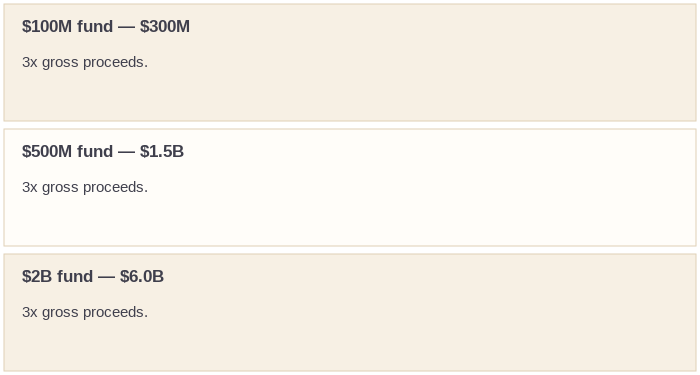
A 3x gross outcome requires $300 million of proceeds on a $100 million fund. The amount rises to $1.5 billion on a $500 million fund and $6.0 billion on a $2 billion fund before fees and carry. More ownership, more companies or higher exit values would have to supply the difference.
Where Can the Extra Value Come From?
The manager has only a few broad choices. It can write larger cheques, invest in more companies or retain more capital for follow-ons. A move into later rounds offers another way to deploy more money at once. Each choice changes the strategy that produced the earlier record.
Larger cheques buy more ownership only if good companies accept them at sound prices. More companies add chances to win but stretch partner time. Later rounds can use more capital at once. Their higher prices may leave less room for a large return multiple.
Fund Size Sets the Portfolio Budget
Ignoring fees and expenses, a $100 million fund uses all its cash on ten $10 million deals. It has no follow-on reserve unless it recycles proceeds or changes the plan. A $500 million fund could instead make twenty-five $10 million first cheques and keep $250 million for later rounds. Costs reduce that investable budget in practice.
The larger fund has more room but also more cash to put to work. It needs enough strong deals and staff to follow them. Keeping the company count low means bigger cheques, which founders may not need or want.
The Market Limits the Opportunity Set
The 2026 NVCA Yearbook reported $67 billion of US VC fundraising in 2025, the lowest in nine years. Deal value was $320 billion. The contrast shows that a busy deal market did not mean raising a new fund was easy.
NVCA noted that AI and large rounds drove much of the $320 billion deal total. Those deals may sit outside a manager's strategy. The overall market therefore says little about how much that particular fund can invest well.
The relevant market is the one the manager can reach. Large AI rounds do little to justify more cash for an early-stage healthcare fund. Its own pipeline, stakes and follow-on needs should support the proposed size.
A 3x gross target requires $300 million on a $100 million fund, $1.5 billion on a $500 million fund, and $6 billion on a $2 billion fund.
Fund Size and 3x Gross Proceeds Requirement
As a fund grows, the same gain has less effect on its return. Larger winners, bigger stakes or more strong deals must make up the difference.
View fund-size calculation data
| Fund size | 3x gross proceeds target | Return implication |
|---|---|---|
| $100M | $300M | Can be driven by a smaller number of large outcomes if ownership is real. |
| $500M | $1.5B | Requires larger winners, more contributors, or later-stage scale. |
| $2B | $6.0B | Usually needs very large exits, substantial ownership, or multi-winner breadth. |
A Larger Fund Depends on a Larger Opportunity Set
The chart shows gross arithmetic. A $2 billion fund may use its scale to buy larger stakes or keep funding growing companies. That advantage helps only if good deals can absorb the extra cash and produce enough gains.
Risk rises when the need to invest starts to drive deal choice. The manager may accept weaker companies, pay more or move into an unfamiliar stage. The larger fund has then changed both the return target and the process meant to achieve it.
Workload Grows Alongside Capital
More companies mean more board work, hiring advice and follow-on decisions. The same partners may struggle to do all of it well, even if they still find good deals. Added staff and clear decision rights affect how much the firm can support.
Reviewing the prior fund can reveal a mismatch. Small first cheques may have grown into valuable stakes, yet the next fund may find those deals too small. As the strategy moves away from those choices, the old record becomes less relevant.
Questions After a Major Step-Up
- Where will the extra cash be invested?
- How will cheque size, stage and company count change?
- Can the team buy its target stakes without paying too much?
- Which partners have time to support the larger portfolio?
- How much would a typical winning deal add to the new fund's return?
A larger fund works when its market, team and portfolio plan can all support it. Trouble starts when the need to spend pulls the manager away from the choices that made the old strategy work.
Frequently Asked Questions
Do larger venture funds always produce lower returns?
A larger fund can work when its market and ownership plan support the extra cash. The team also needs time to handle the portfolio and credible paths to exit. Raising more than the proven strategy can use well increases the risk.
What should LPs check when a manager raises a much larger fund?
Changes in cheque size, stakes, reserves and stage mix can reveal strategy drift. Even a similar plan may require more partner time. Check both the deals it needs and the team's ability to manage them.