Why 3x Gross Produces a Lower Net Return
To pay LPs 3x net, the portfolio must earn more than 3x gross. Fees, expenses and the manager's share of profit reduce what LPs receive. How much more the fund needs depends on its terms and when it invests and exits.
Gross MOIC adds cash returned to the value of unsold stakes, then divides by invested cost. Net MOIC uses the LP's payouts and remaining net value, divided by its paid-in capital. Fees reduce what reaches companies, while carry gives the manager part of the profit. Those costs explain the gap between gross and net.
The Gross Return Behind the Net Target
A 3x net result on a $100 million fund needs $300 million of value for LPs. Working back from that target shows what the companies must produce before fund costs.
Suppose fees and expenses use $10 million of the fund, leaving $90 million for companies. That smaller cost base must produce the LP's $300 million result. It must also earn enough profit to pay carry.
A Portfolio Returning 3x Gross
If the $90 million portfolio returns three times cost, it produces $270 million. That is only 2.7 times the $100 million paid in by LPs even before carry. The portfolio has created $180 million of profit above invested cost.
With simple 20% carry, $36 million of that profit goes to the manager. LPs keep $234 million, or 2.34x their $100 million paid in. Actual terms can change both the amount and timing, but the example shows how the gross multiple falls on its way to net.
The Proceeds Required for 3x Net
Under the same assumptions, $352.5 million of gross proceeds creates $262.5 million of profit over the $90 million portfolio cost. Carry takes $52.5 million, leaving $300 million for LPs. The portfolio has produced 3.92x gross MOIC so that LPs can receive 3.0x net.
The 3.92x result belongs to this example. Change its fees, expenses or carry and the required gross return changes too. A rule of thumb is useful only with those terms in view.
Market Conditions Affect Whether the Bridge Can Become Cash
The 2026 NVCA Yearbook reported $67 billion of US VC fundraising in 2025, the lowest in nine years. This does not change the maths. It shows why funding conditions may differ when the fund next needs a follow-on round or exit.
The same source put US VC exit value at $217 billion in 2025. That was twice the 2024 level but only 27% of the 2021 peak. A target based mostly on unsold holdings still needs buyers, so reported value may take much longer to become cash for LPs.
The portfolio plan tests whether the required gross return is plausible. The stakes held, likely sale prices and timing show what must go right to reach it.
The example uses a $100 million fund with $10 million of fees and expenses. Invested portfolio cost equals $90 million and carry equals 20%. Gross proceeds of $352.5 million then leave $300 million of net LP distributions.
Gross-To-Net Requirement
A 3.0x net LP result can require roughly 3.92x gross MOIC on invested cost once fees and 20% carry are separated.
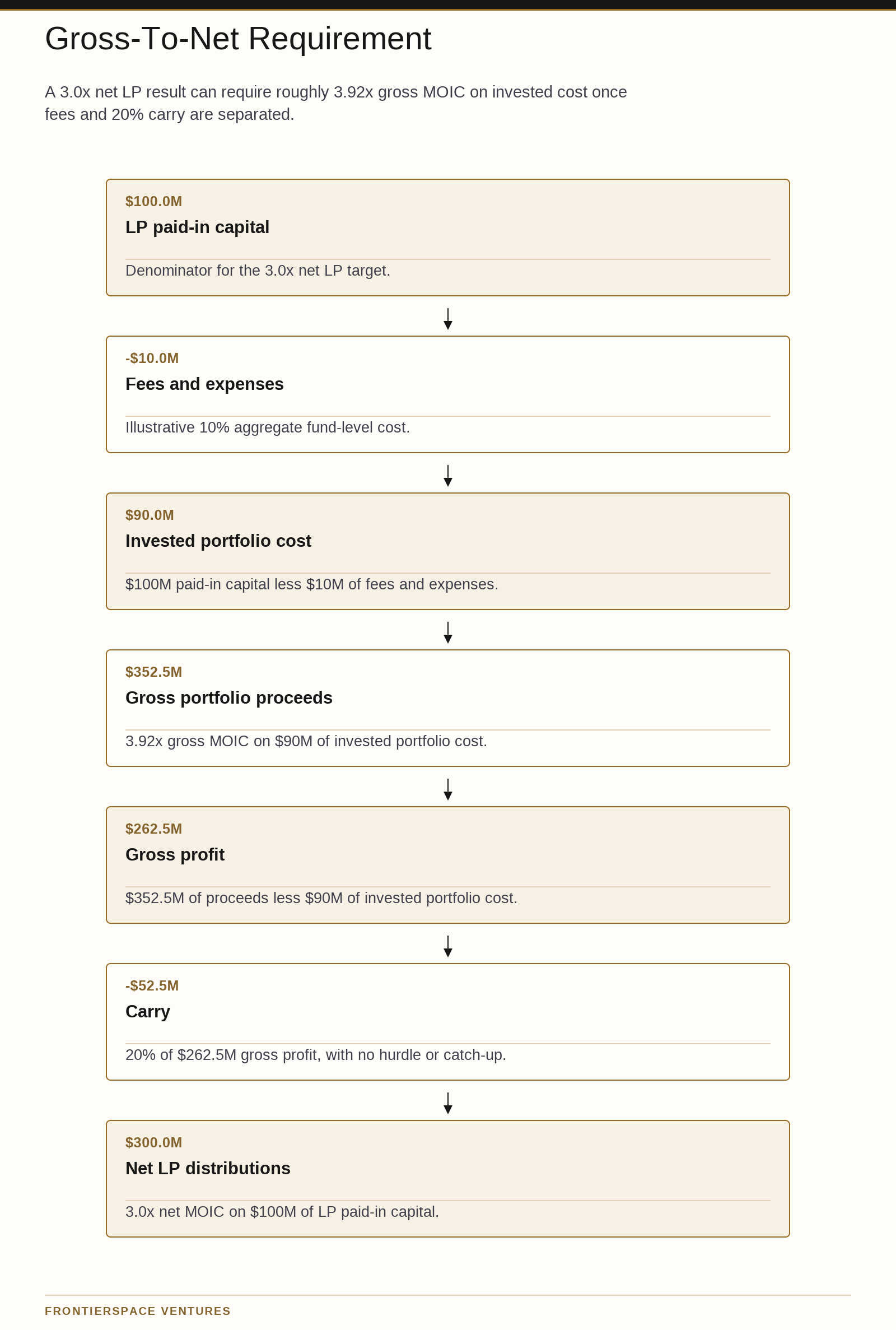
View bridge data and assumptions
| Item | Amount | Assumption |
|---|---|---|
| LP paid-in capital | $100.0M | Denominator for the 3.0x net LP target. |
| Fees and expenses | -$10.0M | Illustrative 10% aggregate fund-level cost. |
| Invested portfolio cost | $90.0M | $100M paid-in capital less $10M of fees and expenses. |
| Gross portfolio proceeds | $352.5M | 3.92x gross MOIC on $90M of invested portfolio cost. |
| Gross profit | $262.5M | $352.5M of proceeds less $90M of invested portfolio cost. |
| Carry | -$52.5M | 20% of $262.5M gross profit, with no hurdle or catch-up. |
| Net LP distributions | $300.0M | 3.0x net MOIC on $100M of LP paid-in capital. |
Actual Fund Terms Change the Illustration
The example uses simple carry terms. A real fund's fees, costs, GP stake, recycling rules and payout order set its own path from gross to net.
Each deduction explains part of the gap. Clear steps make funds easier to compare because similar labels can hide different fee and carry rules.
Multiple, Timing and Realization Differ
A 3x net multiple received in six years differs from the same multiple received in twelve. MOIC measures value created, while IRR also reflects when cash went in and came back. Together, they show both the size and timing of the return.
DPI compares cash paid out with capital paid in by LPs. TVPI also counts the value of unsold holdings, which a new round may mark up without proving an exit price. The gross-to-net calculation must therefore distinguish sale proceeds from value still awaiting a buyer.
Questions to Put Beside the Target
- How much of the LPs' cash is expected to reach companies?
- What fee and expense schedule produces that figure?
- How does the carry waterfall change the LP result?
- How much of the target depends on unrealized value?
- When is the cash expected to reach investors?
The model shows the range of portfolio outcomes that the fund's own terms must convert into a 3x net result. That is more useful than treating one gross hurdle as permanent.
Frequently Asked Questions
Is 3x gross enough for 3x net?
A 3x gross portfolio usually falls short of 3x net after fees, costs and carry. If unsold stakes fetch less than their reported values, that gap grows further.
Should LPs focus on gross MOIC or net MOIC?
They answer different questions. Gross MOIC tests the company portfolio, while net MOIC shows what remains for LPs after fund costs and carry.