What Security Is the Buyer Purchasing?
An LP buying a secondary stake gets an existing holder's shares before a public exit. Their class and rights set what it owns. Carta's Q1 2026 report describes tenders and other sales that give holders cash while IPO access remains limited.
The buyer still needs to agree the terms of a private deal. Share rights and transfer rules set what it can own. The strength of the business then helps determine what that stake may be worth.
Many closed-end funds have a planned life of 8 to 12 years. When exits take longer than expected, secondary sales can become more important to holders who need cash.
An employee may offer common shares below the last preferred-round price. The preferred shares may carry stronger rights to reports or protection in a weak exit. Part of the discount can therefore reflect weaker rights rather than a cheaper stake in the same business.
How the Buyer Obtains Ownership
SEC Rule 144 generally uses a 6-month hold for reporting issuers and a 1-year hold for non-reporting issuers. Even after that wait, the deal's terms may still prevent a sale. The buyer must check both the legal route and the limits tied to the shares.
A secondary describes a change in who owns an existing stake. In a direct purchase, common or preferred shares pass to the buyer. In an SPV deal, the buyer instead gets a stake in the vehicle that owns the company shares.
Some routes use forward contracts; company-led tenders set rules on who may take part. These can give the buyer different legal assets. The buyer must establish what it would own before comparing price and rights.
The company may need to consent to the transfer, or another holder may have a right to buy first. Rights to reports, votes, later rounds and co-sales may not pass with the shares. The buyer must check both whether it can close and which rights it keeps afterward.
Primary and Secondary Capital Serve Different Purposes
Primary shares bring fresh cash into the company. In a pure secondary, existing shares move from one owner to another and the seller gets the cash. The company's own cash does not change.
A company raises $20 million at an $80 million pre-money value. Its post-money value is $100 million. The new investors own 20% just after closing, before options or later dilution.
A $10 million purchase from an existing holder puts $0 into the company. It therefore adds nothing to the company's cash runway. The buyer still needs to assess whether another funding round is likely.
The last primary round may have issued preferred shares with stronger rights than the common shares now offered. Those differences can explain part of a discount to the last funding round. Comparing price alone may overstate the bargain.
Why the Holder Wants to Sell
Recent tender data shows how seller participation has changed. Across Carta tenders, median seller participation rose from 36.6% in Q1 2021 to 56% in the first half of 2025, while median subscription rose from 73.8% to 99.9%.
More sellers in a tender do not necessarily mean the business has weakened. Employees may want to spread their wealth, while an older fund may need to return cash. The buyer needs to understand the seller's reason for leaving.
A seller may fear that funding or an exit is out of reach. That needs closer review when insiders know more and sell on terms the buyer cannot get.
How a Secondary Reaches Closing
Buyer and seller may agree on price before the company approves the transfer. The deal can close only when the signed terms and company process allow the shares to change hands.
- Shares on offer: Check that the seller owns them and confirm their class. Liens or other claims may limit what can be sold.
- Transfer rules: The company may need to consent, or another holder may have a right to buy first. The buyer must also meet any rules on who can take part.
- Closing: The purchase agreement sets the conditions for the sale. Once those are met, payment and an update to the cap table or SPV register complete the ownership transfer.
A direct buyer holds the company security in its own name. An SPV stays between the buyer and the company. Its agreement sets vehicle fees and who can make decisions.
What the Business Can Sustain
A familiar company name gives little evidence that its success will last. The buyer needs to understand the problem customers pay it to solve and why they choose its product.
Sales growth is more useful when customers stay and gross margins support it. The buyer should also check how much comes from a few large customers. Losing one of them could put that progress at risk.
Cash runway affects what happens after the purchase. If the company raises again soon, the new holder may be diluted before it has any chance to sell.
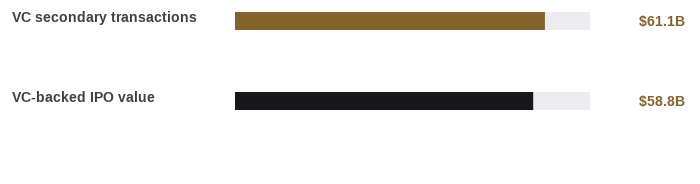
The value of private secondary deals has recently exceeded that of VC-backed IPOs. These are Carta estimates for the 12 months ending June 2025. They measure market volume, rather than the return a buyer should expect from a deal.
Private Secondary Volume Versus VC-Backed IPO Value
Carta puts the value of private secondary deals above that of VC-backed IPOs. This compares the size of the markets, not their returns.
View chart data and assumptions
| Measure | Value |
|---|---|
| VC secondary transactions | $61.1B |
| VC-backed IPO value | $58.8B |
Why the Security Determines the Price Comparison
A secondary label does not ensure a discount. In Carta's tender data for the first half of 2025, both the median and 25th-percentile discount were 0%; the 75th percentile was 15%. The price still needs to be tested against current business facts and the rights on offer.
A past round's price may no longer fit the business. Lower public share prices can reduce its valuation multiple, while the old preferred shares may carry rights the buyer will not receive.
A lower entry price has less value if later rounds dilute the stake or the wait for an exit is long. Even a 15% discount can leave the buyer paying too much when the price used as a reference is too high.
Information Access Matters
A formal tender generally stays open for 20 business days. The buyer must use that window to review current accounts, the cap table and the shares on offer. The timetable keeps the process moving but does not replace those checks.
Even a formal process may leave gaps in the reports. Secondary buyers often see less than investors in a new round. The buyer needs to judge whether the evidence is strong enough for the size of stake it plans to take.
A lower price may compensate for uncertainty if the buyer can confirm what it will own. A missing cap table or an unverified security leaves a more basic gap. In that case, declining the deal may be wiser.
How Long the Buyer May Wait for Cash
A strong company can remain private for years. Its likely buyers and the state of the exit market help show when a sale is plausible and when cash might return.
A strong market can bring an exit forward. A weaker one may leave the company raising again before a later sale at a lower value. Even an IPO may be followed by a lockup, so the listing date and the holder's first chance to sell can differ.
Governance and Conflicts
A sponsor may earn fees or carry for arranging the deal and may also know the seller. Those interests can shape its recommendation, alongside its view of the company.
The source of the shares and required approvals explain how the offer reached the buyer. The sponsor's stake and terms then show whether it shares the risks of the investors it invites.
When a Secondary Can Fit
A secondary can fit when the business, rights, price and likely wait suit the buyer. The evidence must also support the stake's size. If key facts remain uncertain, a smaller position may make more sense.
Fund stakes can add to what the buyer already owns in the company. The secondary sale memo template brings that context into the review. It covers price, rights, approvals, gaps in reports and the likely path to cash.
Stripe: Company-Organised Liquidity Without an IPO
In February 2024, Stripe signed a tender offer at a $65 billion value. It let current and former staff sell shares while the company stayed private. Investors funded most of the purchase, and Stripe also used its own cash to buy back shares.
The company set a price and a time window in which holders could sell.
Demand came from both outside investors and Stripe itself.
That mix let shareholders receive cash while Stripe stayed private.
A tender can make the price and transfer process clearer. Its terms still determine who may sell, which shares are offered and what buyers can learn. The allocation and settlement rules then set what each buyer receives.
Primary source: Stripe's employee share sale (2024). This tender is a public example. It is not presented as a Frontierspace result.
Frequently Asked Questions
How should an investor assess a secondary discount?
The buyer needs to compare rights as well as prices. A discount to the last preferred round may have little value if the new shares have weaker rights. The other claims on company value also affect what those shares could pay.
What can delay liquidity in a private-company secondary?
Company consent and a right of first refusal can delay a sale. Rules on who may buy can narrow the market too. Even after closing, gaps in reports and a slow company exit may make the buyer's own wait longer.