How Share Class and Preferences Shape the Capital Structure
Two investors can pay the same amount into the same company and get different returns. If they own different share classes, senior preferred may get paid before common receives anything. At a large enough exit, the classes may pay much the same. The capital structure shows which case applies.
A share's class and series set its place in the payment order. They also set when a switch to common shares might pay more. Rights to vote, receive reports and sell affect what the holder can do before exit. An ownership percentage alone misses those differences.
The NVCA model set has five core deal documents. Much of the preferred stock's economics sits in the company charter. The share purchase and investor rights agreements add terms to that claim. Voting and transfer agreements then set how holders can vote and sell.
Common and Preferred Shares
Common stock usually gets what is left after higher-ranking claims. Preferred stock adds agreed rights to a stake in the same business. A liquidation preference can give priority in a weak exit. If common shares would pay more, conversion can let the preferred holder share that upside.
An investor putting in $10 million with a 1x liquidation preference starts with a $10 million claim ahead of common. Debt or a senior preferred series may come first. Terms on sharing the balance then set who gets the rest. The claim therefore does not guarantee a $10 million payout; it sets the holder's place in line.
Share rights also shape what happens before exit. Voting rights and consent rights can give a minority holder a say in key choices. Reports help it follow the business, while pro rata rights let it buy more shares in later rounds.
A secondary buyer may receive fewer rights than the seller held. The NVCA model set shows how the five agreements connect, though a company's signed terms can differ. Some side-letter rights belong to a named holder and do not travel with the shares. Information, observer, pro rata or fee rights may therefore remain with the seller.
Capital-Structure Waterfall
When the sale value is modest, the order of preferred claims can shift cash from one class to another.
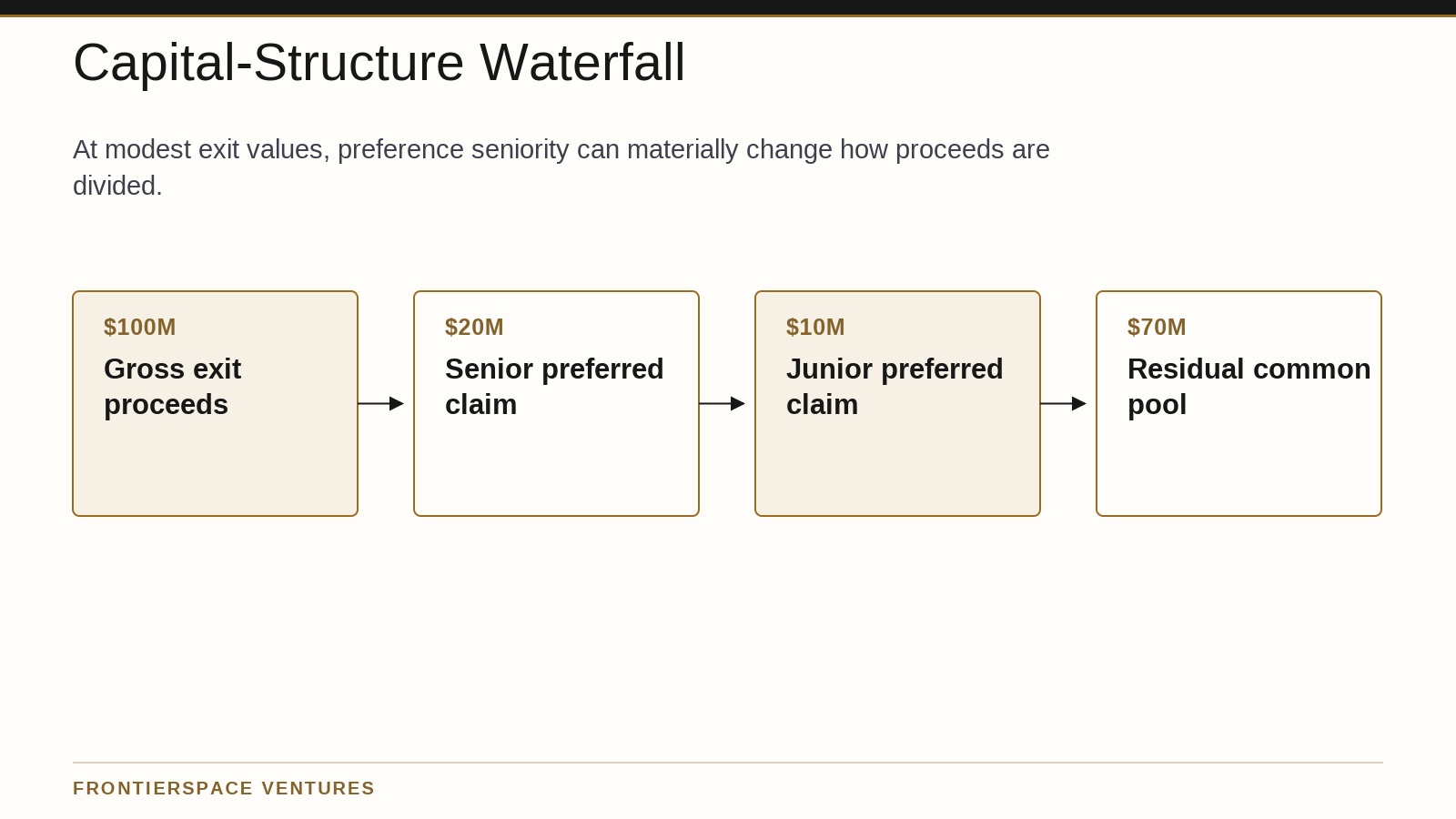
View chart data and assumptions
| Item | Amount |
|---|---|
| Gross exit proceeds | $100M |
| Senior preferred claim | $20M |
| Junior preferred claim | $10M |
| Residual common pool | $70M |
Liquidation Preference
A liquidation preference gives a claim based on the cash invested. Its multiple sets the size of that claim. Participation can add a share of the cash left over, while conversion offers a choice if common shares would pay more.
A 2x preference on $20 million gives a $40 million claim. That is twice the claim under the same 1x terms. When the sale price is close to the total cash invested, the extra $20 million can leave much less for junior preferred and common.
These rules matter most when sale proceeds are low. At a high enough exit, non-participating preferred often converts. The two classes may then receive similar value per share.
Seniority and Stacking
The multiple sets the size of a claim; seniority sets when it is paid. A later round can rank above earlier holders or share their level on a pari passu basis. It can also rank below another series, leaving that claim to be paid first.
Three rounds with $10 million, $20 million and $30 million of 1x preferences create $60 million of claims before common gets paid. This assumes no series converts. If the latest $30 million series is senior, it gets paid before the earlier claims.
A ‘1x preference’ is one term in a larger set of claims. Its value depends on what else must be paid and in what order. Debt, deal costs and change-of-control payments may come before all equity. They reduce the cash left when each series weighs its claim against conversion.
Conversion and Anti-Dilution
Preferred holders may convert if common shares would pay more than their preference. A down round may lower the conversion price under anti-dilution terms. That gives the holder more common shares on conversion and can change which choice pays more.
Weighted-average protection responds to the price and size of the new share issue. Notes, SAFEs, warrants and the option pool also affect how many shares exist on a fully diluted basis. Pay-to-play terms can change a holder's rights if it does not invest again. A single ownership column leaves out those possible changes.
How the Waterfall Explains the Return Multiple
Each exit value moves through the same sequence of claims:
- Sale value: The gross proceeds form the pool of cash from which claims are paid.
- Senior claims: Debt and transaction costs reduce the amount left for equity.
- Preference stack: Preferred claims receive payment in the order set by their contracts.
- Conversion: A preferred holder may get more by switching to common shares than by taking its claim.
- Cash left over: Holders with a right to the remaining common pool share this balance.
- Cash to the investor: SPV costs and carry, where charged, reduce what the investor keeps.
The model shows when a change in exit value makes conversion pay more than the preferred claim.
Why Structure Changes Outcomes
At a $100 million exit, a senior 1x claim of $20 million leaves $80 million for later claims before any conversion. At a $15 million exit, that senior claim can take all the cash. The payment order matters more as the pool shrinks.
Two buyers can pay similar prices yet receive different payouts. A higher claim may put one first in line. Its right to convert can also change what it takes from the same sale.
Vehicle costs can widen the gap in what investors keep. Their rights may differ too, giving them different ways to follow the business or sell their stake.
The Documents Behind the Ownership Model
The current charter defines the share rights, while the cap table records the holdings. Stock purchase, investor-rights, voting and transfer agreements add terms governing those holdings. Side letters may give rights only to the seller or sponsor.
Debt, convertibles, warrants and the option pool change the claims and share count used in the model. A pending round can change them again. An SPV adds its own terms because the investor holds a stake in the vehicle, which owns the company shares.
The type of purchase also matters. New shares send cash to the company, while existing shares pay the seller. The rights to reports and transfers then shape what the buyer can do with its stake.
Instacart: A Preferred Security Issued Beside the IPO
Instacart shows why the shares matter as much as the company name. Just after its September 2023 IPO, it issued $175 million of Series A redeemable convertible preferred stock. Those shares cost $30 each in a private sale beside the common-stock offer. Their buyers received a different claim.
The company sold these shares in a private deal beside its common-stock IPO. The two groups bought different claims.
The filed terms make the preferred shares' stated value grow each year. Common shares have no such term.
In a liquidation, that preferred stock ranks ahead of common. It receives the greater of its stated value or what it would get after converting.
The order of payment, growth in stated value and choice to convert all affect the payout. Redemption, dividend and voting terms add rules for when the claim changes or a right can be used.
Primary source: Instacart's September 2023 Form 10-Q. This case comes from public SEC records. It is not a Frontierspace result.
Frequently Asked Questions
Are common and preferred shares economically equivalent?
Preferred shares can have rights that change the exit payout. A preference sets a prior claim, while conversion and anti-dilution terms can change the common shares the holder receives. At a high exit value, the classes may pay much the same. Their terms decide whether that happens.
Does a 1x liquidation preference guarantee a full return?
A 1x preference gives a prior claim under the contract. What it pays depends on the cash left after senior claims. The terms for sharing the balance then help set the final amount.