A Price Ages With the Evidence Behind It
A private mark becomes stale when the last round no longer supports it. Time may have passed, the business may have changed or the market may have moved. Keeping the same value needs current evidence, even if the company has not raised another round.
The IPEV Valuation Guidelines set out best practice for reporting private assets at fair value. That calls for a current review even when the best-known price is old. The 2025 edition replaced the 2022 guidelines.
An old mark can shape an LP's choice to re-up or affect how much room it has under an allocation limit. It also feeds reported returns and, under some fund terms, fees or carry. Changing the report date does not refresh the evidence that supports the price.
Valuations Between Financing Rounds
Start with how the business has changed since the round. Revenue, margins and cash use show whether it met the plan behind that price. They also help judge whether it will need new cash sooner than expected.
Market evidence adds another test. Public prices may have moved, while a recent share sale may show what buyers will pay. Compare the rights too: a new investor may receive protection that older shares lack.
No new round does not by itself explain the old mark. A strong company may have no need to raise. A weaker one may be waiting because investors will no longer pay the old price. Current business evidence helps tell those cases apart.
Evidence Beyond the Age of the Mark
| Evidence | What it can show | Caution |
|---|---|---|
| Company performance | Revenue, margin, retention, and cash progress since the round | Growth without cash efficiency may not support the same multiple |
| Public comparisons | How market valuation multiples have moved | Private company size, growth, and liquidity differ |
| Secondary trades | Real buyer and seller price discovery | Share class, size, and seller pressure may affect price |
| New financing terms | Current investor appetite | Structured protection can hide a lower common-equity value |
| Cash runway | How soon the company must return to market | A long runway can delay price discovery without removing risk |
New Share Rights Can Change the Value of Older Shares
A flat round can still change who gets paid at exit. The new investor may receive a senior claim or protection against losses that earlier holders lack.
The proceeds waterfall shows how those rights work at different exit values. If the new shares take more of a modest sale, less remains for older holders. Their shares may then be worth less despite an unchanged headline price.
Consistent Triggers for a Valuation Review
Set review triggers before a mark comes under pressure. Time alone may call for a review; a missed budget, lost customer or leadership change adds fresh evidence. Funding plans and sharp moves in public prices can also challenge the old assumptions.
Uneven rules can produce quick write-ups for strong firms while weak ones keep old prices. Stating what prompted each review and what facts it used helps LPs judge whether both cases were treated fairly.
What Valuation Reporting Explains
- Last round: Its date and terms show what investors paid for, beyond the headline price.
- Business progress: Results since the round and the cash runway show what has changed.
- Method: The mark may use a recent deal, similar firms or cash-flow forecasts. State which method supports it.
- Assumptions: Show how the mark changes when key inputs move.
- Governance: Who reviewed and approved the mark.
The last round may still be the best evidence after review. The manager needs to show why it still fits the company and market today.
Age Changes the Burden of Proof
A mark set 24 months ago needs closer review than one set last quarter. That is especially true if the firm missed its plan or market prices changed.
An older price therefore needs fresh support. Its age prompts a review, while the evidence decides whether the mark needs to change.
IPEV's 2025 guidelines call for fair value to reflect evidence at the reporting date. That makes current facts central to the review.
Company and Market Signals Together
Suppose revenue multiples for similar public firms fall from 10x to 6x. The private company also misses its plan. Keeping the old mark without review could overstate the value still held.
Neither signal fixes the right value on its own. When both move against the company, the manager needs a stronger reason to keep the old mark.
The age of a price gives it context. Business results, market changes and recent deals show whether it still fits.
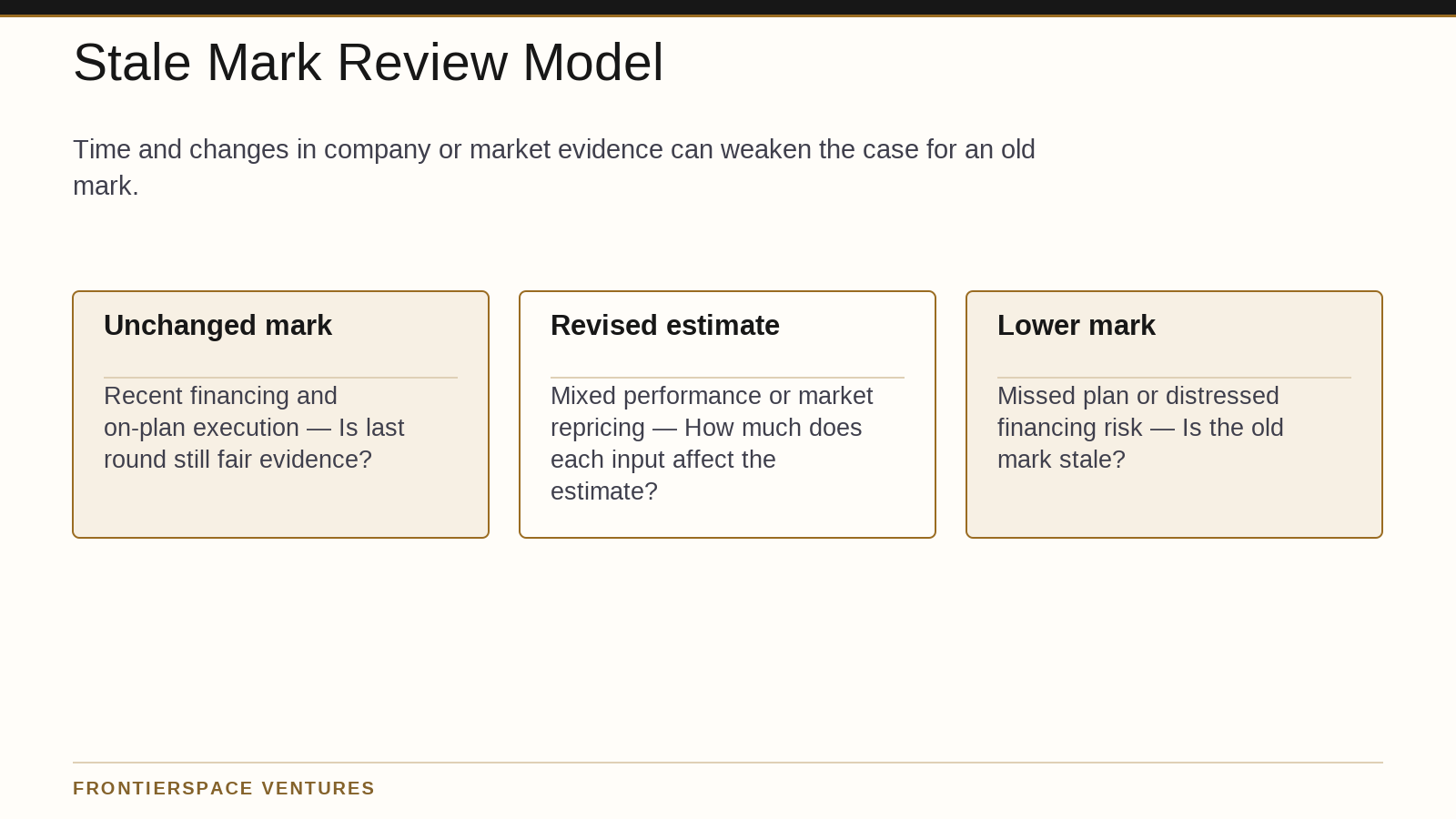
Stale Mark Review Model
Time and changes in company or market evidence can weaken the case for an old mark.
View model data and assumptions
| Treatment | Common evidence | Valuation question |
|---|---|---|
| Unchanged mark | Recent financing and on-plan execution | Is last round still fair evidence? |
| Revised estimate | Mixed performance or market repricing | How much does each input affect the estimate? |
| Lower mark | Missed plan or distressed financing risk | Is the old mark stale? |
What Drives the Mark?
The fund's mark depends on its stake and what those shares are worth. A new round can reduce the stake through dilution. Reserves then set how much cash the fund can use to protect its share.
The LP can carry those changes into the fund model. Fees and carry reduce the net result, while follow-on cash affects the total cost. The rest of the portfolio then shows how much this position can change the fund's outcome.
Frequently Asked Questions
Is the last round always fair value?
A recent round between independent parties can give strong evidence of fair value. As the company and market change, that price needs fresh support.
Should funds disclose valuation uncertainty?
A recent round, a model or similar public firms may support the mark. Clear assumptions show where the manager used judgment and where it could rely on an actual deal price.