What Is the Mark Trying to Say?
Unrealized NAV estimates the value of holdings still owned at the report date. Round terms, business results and similar firms help set that value. A change may reflect company progress, market shifts or a new method of setting the mark.
The AICPA guide overview describes how to measure fair value for fund holdings. Showing the evidence behind a mark lets the reader see how the estimate was formed.
AICPA's PE/VC task force wrote the guide to help value company holdings. It covers investment companies under ASC 946. It offers guidance and examples rather than new accounting rules.
The Companies Behind NAV
The same NAV can rest on very different evidence. One fund may hold many companies with recent rounds. Another may rely on an old mark for a single large stake, leaving much more of its reported value open to question.
Cost records what the fund paid, while realized proceeds record cash from sales. Fair value estimates what the holdings are worth now. The fund's stake and share rights connect each company value to what the fund itself owns.
What Belongs in the Company Schedule
| Field | Why it matters |
|---|---|
| Invested cost | Shows the cash at risk and the basis for gross MOIC |
| Current fair value | Shows the manager's present estimate |
| Realized proceeds | Separates cash received from value still at risk |
| Last financing date and terms | Shows how current the price evidence is and whether the round was structured |
| Ownership and share class | Connects headline company value to actual fund proceeds |
| Valuation method | Explains whether the mark uses a transaction, comparison, model, or blended view |
What Changed During the Quarter?
A quarterly bridge traces opening NAV to closing NAV. It separates cash called from LPs and paid back to them from changes in asset values and fund costs.
A higher mark can come from an outside-led round, business progress or rising prices for similar firms. The same change in value can therefore rest on different evidence.
Concentration Determines How Much Judgment Matters
If the largest company is 40% of fund NAV, cutting that mark by 25% reduces total NAV by 10%. A concern about that price is therefore a risk to the fund's whole reported value.
A large position's share of NAV reveals its weight in the fund. Evidence behind its mark matters more when that single estimate can change the overall result.
Cash and Estimates Describe Different Value
Company schedules often show gross values before fund costs and carry, while LP statements show net values. Both views help if clear labels and a bridge let the LP trace the difference.
The same care is needed with performance multiples. A 2.0x TVPI made up of 1.5x DPI and 0.5x RVPI is largely realized. A 2.0x TVPI with no distributions remains entirely dependent on future exits.
Questions for the Quarterly Review
- Which marks changed, and what evidence explains each movement?
- How old is each price, especially where the company has not raised a recent round?
- Which positions and sectors account for the largest share of NAV?
- How much value has become cash, and how much remains in RVPI?
- What financing, exit, milestone or risk could change the mark next?
A good report makes uncertainty visible. It shows the LP where that uncertainty sits and how much of the result depends on it.
How the Metrics Connect
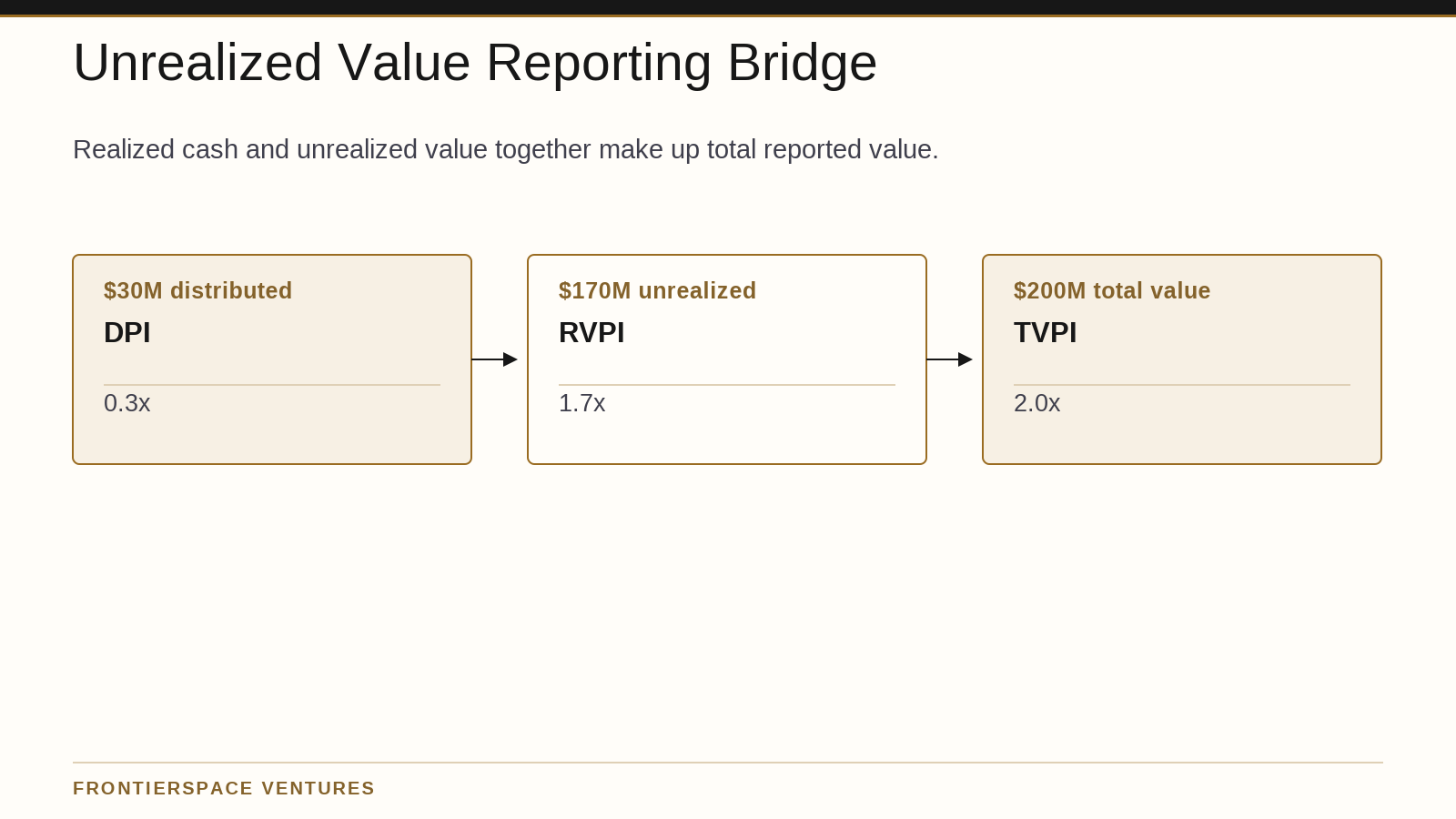
With $100 million paid in, $30 million paid back and $170 million still held, a fund has 0.3x DPI and 1.7x RVPI. These add to 2.0x TVPI before fees and carry in this example. The fund's valuation policy also affects the mark.
The split shows where the reported value sits. LPs have received only $30 million in cash. The remaining $170 million still depends on company results and a chance to sell.
AICPA's guide helps funds under ASC 946 measure fair value for their reports. This frames what the holdings are worth at that date. It does not make the estimated value cash that LPs can spend.
The Evidence Behind Major Marks
If a position rises from $40 million to $80 million, it adds 0.4x TVPI where LPs have paid in $100 million, before fees and carry. That single mark can change the view of the whole fund, making its evidence worth close review.
DPI measures cash paid back against capital paid in. RVPI measures the value still held against the same base. Adding them gives TVPI.
Unrealized Value Reporting Bridge
Total reported value combines cash paid back with the value of holdings still owned.
View bridge data and assumptions
| Metric | Amount | Multiple on $100M fund |
|---|---|---|
| DPI | $30M distributed | 0.3x |
| RVPI | $170M unrealized | 1.7x |
| TVPI | $200M total value | 2.0x |
The Fund's Stake Can Change
A new round may support the headline company value while reducing the fund's stake. It may also give new shares a senior claim. Those changes can alter the value of the fund's own shares even if the company price holds.
The Quarterly Roll-Forward
Cash called from LPs, cash paid out, gains or losses and fund costs connect prior NAV to the current report. Currency moves and other large changes complete the bridge. Buying shares with cash already held changes what the fund owns; it does not itself create NAV.
The manager can then explain each company's main changes. A model based on public peers rests on different evidence from a round led by an outside backer. A flat mark also needs support if the company missed its plan or used much of its cash.
This bridge shows where judgment shaped the result. The LP can then tell company progress apart from market moves and cash paid back.
Frequently Asked Questions
Can unrealized value be reported at cost?
Cost may be useful soon after purchase if little has changed. As new evidence arrives, the mark needs to reflect current fair value even when that differs from the price paid.
Why do LPs care about RVPI?
RVPI represents value still held. A sale and payout can turn some into DPI, while the rest may rise, fall or disappear as the company and exit market change.