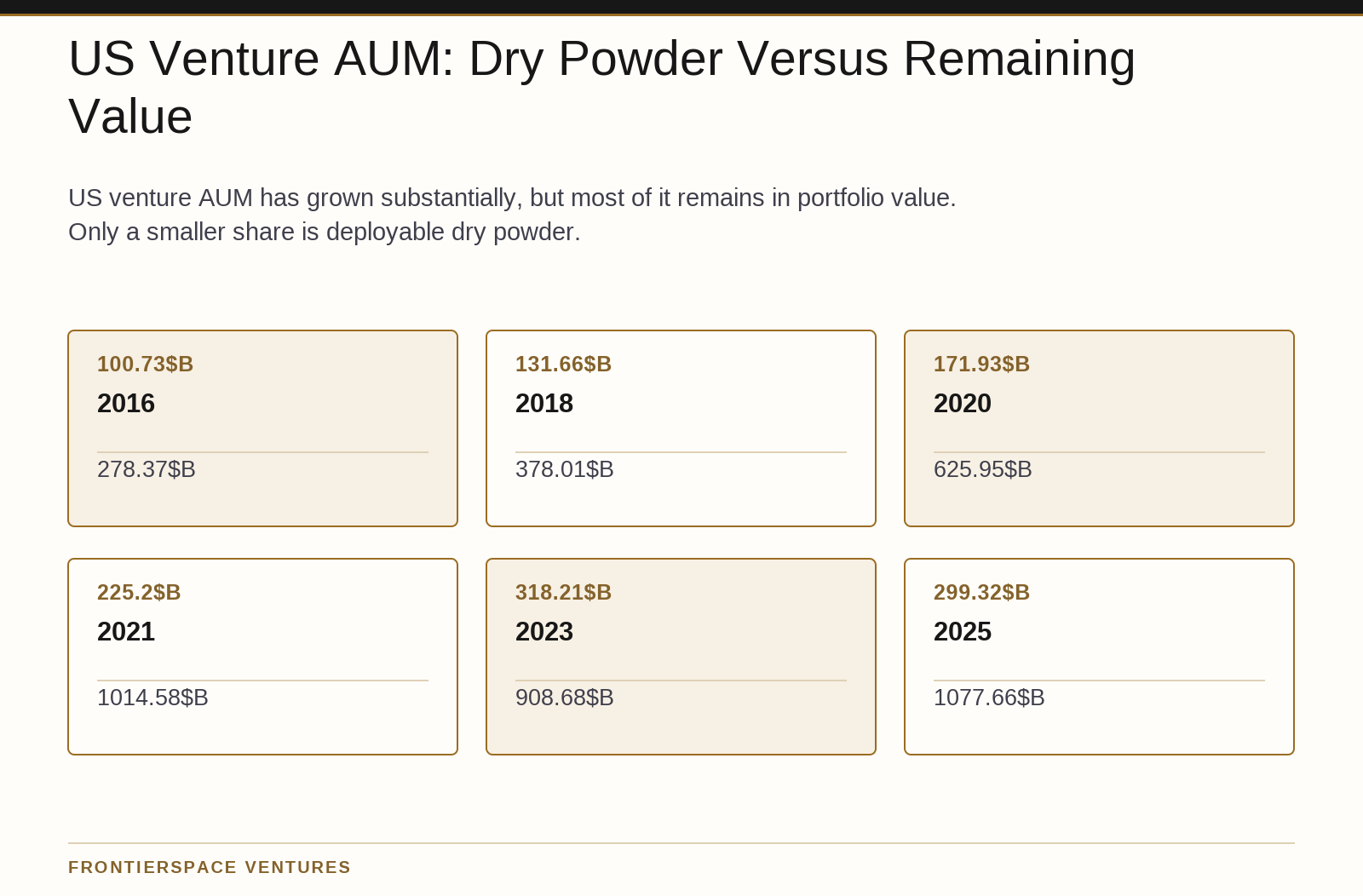
US venture assets have grown, but most remain tied up in companies. A smaller share is dry powder, or capital available to invest. The NVCA 2026 Yearbook data pack puts 2025 dry powder at $299.3B and remaining value at $1,077.7B.
US Venture AUM: Dry Powder Versus Remaining Value
US venture assets have grown, but most remain tied up in companies. A smaller share is dry powder, or capital available to invest.
View chart data and assumptions
| Category | Dry powder | Remaining value |
|---|---|---|
| 2016 | 100.73$B | 278.37$B |
| 2018 | 131.66$B | 378.01$B |
| 2020 | 171.93$B | 625.95$B |
| 2021 | 225.2$B | 1014.58$B |
| 2023 | 318.21$B | 908.68$B |
| 2025 | 299.32$B | 1077.66$B |
What Obligation Must the Portfolio Meet?
Venture funds can call cash for years before paying much back. Pensions, endowments and foundations must still pay benefits, grants and bills during that wait. The commitment schedule and cash plan need to cover both demands through strong and weak markets.
Funds, co-investments, secondaries and direct stakes each require different work. They draw on the same pool of cash and staff time. The mix must therefore fit what the institution can fund and manage.
Why One Fund Commitment Is Only the Beginning
CalPERS' 2026 private equity review uses fund results to assess the whole programme. That wider view helps test what a new manager would add. A strong fund may add little if other managers already own the same stages and companies.
CalPERS notes that GP reporting can arrive 120 days after quarter-end. Cash may have moved before those values arrive. The LP needs systems that combine old marks with newer cash flows. Its committee can then see how both shape the portfolio.
Who Can Use Venture Capital?
Legal tests decide who may invest. Cash needs and staff capacity then help decide what fits. The SEC's accredited-investor rules include several entity types with more than $5 million of assets or investments. Passing that test alone does not make a venture fund suitable.
Each type of institution faces its own constraints:
- Endowments and foundations must meet spending plans and grants while funding long-term promises. Those bills limit the cash they can tie up.
- Pension plans must pay benefits and follow formal approval rules. A venture fund needs to fit the wider plan for meeting those future bills.
- Insurance companies may face extra capital rules. Their assets may also need to match the dates and amounts of future claims.
- Sovereign and government-linked investors may seek both returns and public-policy goals. Rules on who approves and oversees deals help decide how they pursue both.
- Smaller institutions may lack the staff to run a large venture programme. A fund of funds, outside investment team or specialist manager can take on some of that work.
These differences shape what can work. A large endowment team may manage a fund easily. A smaller institution may struggle with the same fund even if both meet the legal tests.
Venture Capital Requires Patient Capital
Cambridge Associates describes private capital as commonly tied up for 10 years or more. Extensions can add to the wait. Bills due during that period limit how much money the institution can leave in these funds.
Fees begin before companies have had time to grow, so early returns may look weak. Later marks can rise without producing cash. NAV describes reported value, while liquidity shows what the LP can actually use.
Why Capital Calls Can Outlast Expected Distributions
A commitment promises cash when the manager calls it. At year-end 2025, Carta's funds still held 72% of 2025-vintage capital as dry powder. The shares were 53% for the 2024 vintage and 35% for 2023. The pace varies by manager and market, but these figures show that investing a commitment can take years.
Calls, payouts, cash still owed and likely re-ups follow different schedules. Put them in one forecast to see whether the LP can fund them together. The plan must still work through years when little cash comes back.
More Managers Can Still Leave Hidden Concentration
A broad manager list can hide repeated company stakes. In the 2025 US market, 487 megadeals represented 3.2% of deal count and 67% of value, according to NVCA. With much of the cash going into a few large rounds, managers may own the same companies or rely on the same exit market.
Separate funds may own the same firms. Their holdings show that overlap if it is disclosed. Stage and vintage totals reveal other shared risks. Together, these records link funds and secondaries to the firms and markets they share.
Emerging and Established Managers Solve Different Problems
An established firm may offer a longer record and mature reporting systems. A new manager may have a narrow focus and more hands-on work from senior partners. The portfolio's needs decide which strengths matter most.
For either type, check who drove earlier returns and whether those people remain. A new fund size may also change how well their deal sourcing works. Specific reference accounts help test that link more than broad praise does.
Governance and Reporting Are Part of the Investment
The way a manager approves deals, reviews marks and handles conflicts shows how the firm works. It reveals who owns each task more clearly than a list of outside providers.
After commitment, reports explain changes in cash, cost and value. A price from a new funding round provides different evidence from a mark based on the manager's own model. Making the source clear helps the LP understand what changed and why.
The Investment Beneath the Vehicle
The company's prospects and share rights shape what the stake is worth. Entry price and later funding needs then affect returns and dilution. The vehicle adds its own terms for how those results reach the LP.
These checks apply to funds and SPVs, as well as co-investments, growth deals and secondaries. The structure changes costs, rights, reports and concentration. The investor still needs to understand the companies beneath it.
CalPERS: Changing the Allocation Before Changing the Deal Flow
In March 2024, CalPERS approved an increase in its total private-markets target from 33% to 40% of plan assets. Private equity moved from a 13% target to 17%.
Private equity and private debt sat within the new target. It also covered other private assets.
The committee raised the private-equity target from 13% to 17%.
CalPERS cited this past return from private equity to help explain its choice.
The figures apply to CalPERS. They show how agreed ranges and approval rules guide manager choices. Co-investments and single-company stakes then need to fit that wider plan too.
Primary source: CalPERS' 2024 private-markets plan. This public case shows the pension's own decision. It is not a Frontierspace return.
Frequently Asked Questions
Can smaller institutions invest in venture?
Smaller institutions can choose routes that fit their cash and staff. Direct funds, a fund of funds, an outside team or a specialist manager offer different support. Each still leaves work to approve, track and fund the stakes through a slow exit market.
What is usually the hardest part of evaluating a venture manager?
The hard question is whether the team can repeat its earlier success. Deal records show how it found and chose companies, then used ownership and follow-ons to earn returns. Net results complete that account. Names and logos alone reveal much less.