What Is the Manager's Investment Advantage?
The team's history can show whether it repeatedly finds, wins and supports good deals. Bringing that skill to a new firm also requires sound reporting and clear decision rules. The firm's age alone says little about its ability to do either job.
ILPA's DDQ helps test whether the firm can serve large LPs. Outside providers may value assets, check figures and prepare reports. Someone on the team must still take responsibility for each task.
A new fund may need five to six years before its overall return is useful to assess. Until then, it lacks a mature quartile rank. The LP must rely more on records of each person's work and references that confirm it.
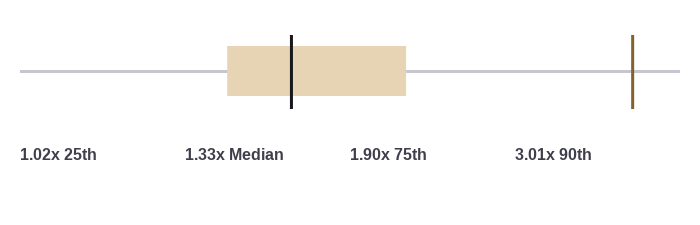
Venture fund results vary widely, so a market average says little about one manager. These figures rank TVPI for 2019-vintage funds tracked by Carta as of Q4 2025. They show the stated percentiles for that group. Newer vintages are still too young to give a mature picture.
2019-Vintage Venture Fund TVPI Dispersion
Venture fund results vary widely. Evidence about one manager is more useful than an average for the whole market.
View chart data and assumptions
| Percentile | TVPI |
|---|---|
| 25th | 1.02x |
| Median | 1.33x |
| 75th | 1.90x |
| 90th | 3.01x |
One partner may have found a deal while another led the review or won the stake. Records of board work and exit choices then show who stayed involved. The emerging-manager scorecard helps compare these roles across teams using records and references.
The Person's Work and the Old Firm's Brand
For 2019-vintage Carta funds, 90th-percentile TVPI was 3.01x, versus 1.90x at the 75th percentile and 1.33x at the median. That wide range makes the source of each manager's results especially relevant.
The old firm may have opened doors, funded later rounds and used its name to win deals. The team's own work may survive a move, while some of those supports disappear.
Trace who found each deal, argued for it and stayed involved through later rounds and exit. This ties the result to specific people. Their contribution can then be assessed apart from the old firm's record.
Why This Firm Might Have an Advantage
A team may know a technical field or group of founders well. That narrow claim is easier to test than a broad promise of special access. Deals won and good deals declined show how the team uses its knowledge.
Access alone is not enough; poor judgment can turn it into costly mistakes. Records of passed deals show where the team set limits. The deal pipeline and founder references then help test whether it finds good prospects and wins those it wants.
How Fund Size Fits the Strategy
The 10 largest US venture funds took 32.9% of traditional VC fundraising in 2025, according to NVCA. A new team may offer different deals, but its record must support that claim. Its proposed fund size must also fit both the strategy and the cost of running the firm.
Too much capital can push a manager into later rounds and larger cheques. Too little can limit support for winners or the systems promised to LPs. Fund size therefore changes what the strategy can deliver.
First cheques, reserves, fees and running costs draw on the same fund budget. If they fit only after the strategy changes, the proposed size may be wrong for the plan the LP reviewed.
Reporting and Administration in Practice
CalPERS describes 120 days for GP reports and a typical lag of two quarters in fund results. A clear process helps the LP assess figures that are old when they arrive. It cannot remove the delay, but it can make the data more reliable.
Trace a quarter-end close from the books and investor records to each private asset value. Check who proposes the value and who challenges it. This shows who is responsible more clearly than a list of providers.
Suppose a company fits the main fund, an SPV and a partner's own account. The rules for sharing deals should explain who decides where it goes and why. A real example can show whether the policy works.
Dependence on Key People
Suppose a 3-partner team splits carry 50%/30%/20%. Losing the partner with 50% may have a larger effect than losing one-third of the headcount suggests. Rewards and decision rights help show how much depends on that person.
Headcount can hide reliance on one partner. Checking who approves deals, owns the firm and receives carry reveals where power sits. Those rights may be less evenly spread than the list of names.
If that key person leaves, the firm may have gaps in both new deals and work on existing holdings. Key-person clauses set what the fund can do after such a departure. Their terms therefore matter alongside the team's plan to cover the work.
How the Strategy Could Fail
Ask the manager how the strategy could fail. Its answer gives the LP specific risks to watch after it commits:
- The flow of leads may not produce enough deals worth backing.
- The team may see strong companies but rarely win a stake.
- The fund may lack the cash to keep its stake in its best companies.
- Rival bids may drive prices too high for the ownership plan to work.
- The chosen market may not contain enough deals that meet the fund's needs.
The ten largest US venture funds took 32.9% of cash raised in 2025, versus 13% in 2021. This shows where new fund money went. It does not forecast returns for large or small funds.
Venture Fundraising Has Become More Concentrated
The ten largest US venture funds captured 32.9% of capital raised in 2025, compared with 13% in 2021.

View chart data and assumptions
| Period | Share captured by ten largest funds |
|---|---|
| 2021 | 13% |
| 2025 | 32.9% |
When the Firm-Building Risk May Be Worth Taking
An LP may accept a young firm's risks if the manager has a clear edge it can repeat. A smaller first cheque can reflect the limits of the evidence. The LP can then link a larger re-up to progress it sees over time.
The team, plan and fund size form the investment case. Staff and systems determine whether the firm can carry it out. The venture fund review checklist brings both parts into the wider review.
CalPERS: A $1 Billion Emerging-Manager Investment Plan With Explicit Objectives
CalPERS' 2023 plan shows how a large LP can back newer managers. It committed $1 billion to find and support emerging and diverse managers. The plan had three goals: earn returns, broaden access and help future investment talent grow.
At that size, CalPERS can back a group of managers. It does not have to rely on a single choice to prove the whole case.
CalPERS has run programmes for emerging managers for more than three decades. Its 2023 commitment builds on that history.
Returns test the plan's financial goal. Which teams receive backing then helps show whether it widens access and develops future talent.
The LP needs to know who drove past returns and whether those people will stay. It must then test how their approach fits the new fund's size. Sound daily work and reporting help turn that plan into practice.
Primary source: CalPERS' programme for emerging and diverse managers. This is a public example of how CalPERS invests. It has no link to Frontierspace returns.
Frequently Asked Questions
What qualifies as an emerging venture manager?
The term often covers first-time funds for large LPs, spinouts and young firms with a short fund record. The key question is what the current team can claim from its past work. That evidence must also fit the strategy it now plans to use.
How can LPs verify a manager's track-record attribution?
Deal records show who found the company, led the review and won access. The LP can then trace board work, later cheques and exit choices. This shows how each person's role continued after the fund first invested.