How Does a Liquidation Preference Waterfall Work?
A liquidation preference sets which shares get paid first and the size of their claim. ‘1x non-participating’ describes part of that deal. Debt and the rank of each series affect the cash left to pay it. A holder may choose common shares instead if conversion would pay more.
Cooley's Q1 2026 report covered 165 negotiated US venture deals worth $39.9 billion. The sample shows the terms used in that work. It helps explain why investors so often see 1x non-participating preferred.
Of those deals, 98.2% had a 1x liquidation preference and 96.4% used non-participating preferred stock. These figures cover Cooley's own work and show why the terms are familiar. A company's full waterfall still depends on its actual papers.
What a Waterfall Actually Does
A waterfall turns legal claims into payments. Debt and other claims ahead of equity reduce the buyer's offer to a smaller pool. Each preferred class then weighs its rights against that pool. Converting to common may pay more than taking its preference.
- Value to divide: The offer may include cash, stock, earn-outs, escrow and other forms of payment. Debt, deal costs and claims ahead of equity reduce what reaches shareholders.
- Payment order: The terms set each claim's size and place in line. They show which series comes first, shares a rank or comes last.
- Choice to convert: A non-participating holder can take its preference or common shares. The exit value helps show which path pays more.
- Sharing the balance: Participating preferred may take its claim and then share in the cash left. A cap can limit that total payout.
- Cash left over: Common and participating preferred share the balance. The split treats the preferred shares as if they had converted.
The buyer holds a $20 million 1x non-participating preference and would own 25% if it converted. At an $80 million equity value, both paths pay $20 million: 25% of $80 million equals the claim. Below that point the preference may pay more. Above it, common may pay more if no other claim changes the split.
These choices draw on the same pool. Debt and senior series leave less for junior holders, changing what their claims are worth. A preference therefore needs to be tested beside all the other claims on the sale.
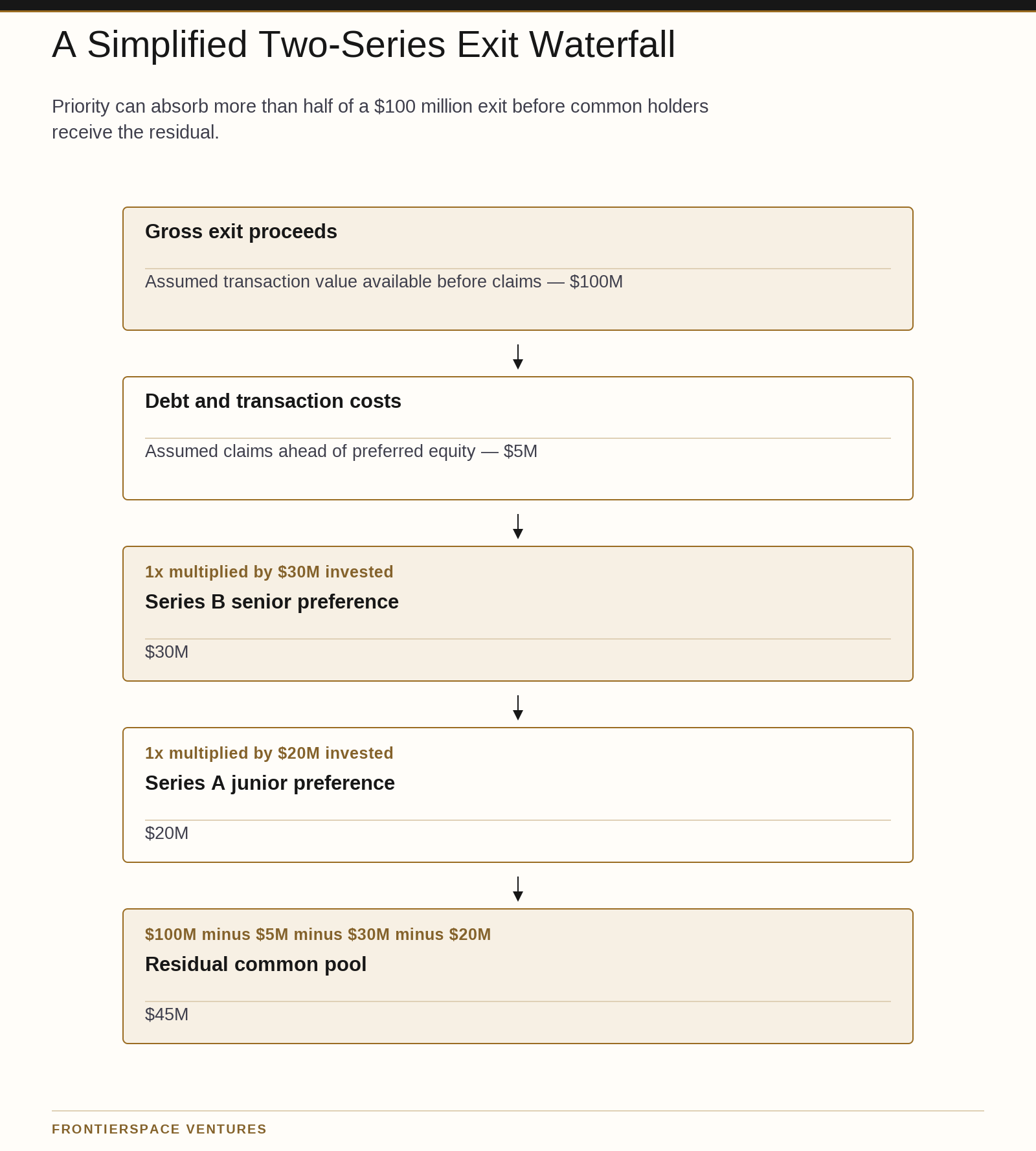
In this $100 million exit example, $5 million pays debt and deal costs first. Series B then takes its senior $30 million claim, followed by Series A's junior $20 million claim. Common gets the last $45 million. All claims are 1x non-participating. No holder converts, and the model has no accrued dividends or participation.
A Simplified Two-Series Exit Waterfall
In this $100 million sale, prior claims take more than half the value. Common holders receive what remains.
View chart data and assumptions
| Payment step | Calculation | Amount |
|---|---|---|
| Gross exit proceeds | Assumed transaction value available before claims | $100M |
| Debt and transaction costs | Assumed claims ahead of preferred equity | $5M |
| Series B senior preference | 1x multiplied by $30M invested | $30M |
| Series A junior preference | 1x multiplied by $20M invested | $20M |
| Residual common pool | $100M minus $5M minus $30M minus $20M | $45M |
Non-Participating and Participating Preferred
Participation sets whether a holder shares in the cash left after its prior claim. Without it, preferred usually takes either the preference or common shares. With it, the holder may take the preference and then share in the balance.
- Non-participating preferred: The holder chooses its claim or the payout from common shares. It generally takes the path that pays more.
- Participating preferred: The holder can take its claim first. It may then share the remaining cash with common holders.
- Capped payout: An agreed multiple may limit the total. At a higher exit, switching to common may let the holder receive more.
- Accrued dividends: Some dividends add to the claim rather than being paid in cash. Amounts that accrue or are paid in kind may make the preference grow over time.
Take a $20 million 1x preference with 25% ownership. At a $100 million exit, preferred that does not participate can convert and get $25 million. With full participation, it takes the $20 million claim plus 25% of the remaining $80 million. That gives it $40 million before any cap. WilmerHale explains these paths with different example figures.
Seniority, Pari Passu, and Shortfalls
A 1x multiple says how much a series may claim. Seniority says when that claim is paid. The second question can matter more in a modest exit because a senior 1x claim may be paid in full while a junior 1x claim receives only part of its stated amount.
- Senior: One series is paid before another.
- Pari passu: Series at the same rank share the pool if it falls short. The documents set how that shortage is divided.
- Junior: This series waits for senior preferred claims to be paid. It can then receive cash toward its own claim.
- Events that trigger payment: The terms may treat a merger, asset sale or other deal as a liquidation. The company need not be wound up for the preference to apply.
If equity has $40 million to divide, a senior Series B 1x claim takes $30 million first. Only $10 million remains for Series A, which invested $20 million, and common gets $0. Both preferred claims are 1x. Their ranks explain why one gets paid in full and the other does not.
Why Different Exit Values Produce Different Results
A low exit may leave preferred claims unpaid. As the price rises, common begins to get cash. Further gains can make conversion pay more or bring a participating series to its cap. These turning points show why one exit estimate cannot explain the whole claim.
- If the exit cannot pay all preferred claims, their rank decides who bears the shortfall.
- Each series has a point where conversion may pay more or a cap limits its gain. Its terms set where that point falls.
- Base case: The business result and exit price set the value to divide. The fully diluted cap table then supplies the holdings used in the payout rules.
- Once most preferred holders convert, the cash may split more like common shares. Fewer prior claims remain to change that split.
- Escrows, earn-outs and stock consideration affect when value reaches the holder and in what form. The amount stated at closing does not all arrive as cash.
If the LP holds through an SPV or fund, the company payout is the first step. The vehicle then pays its own costs and carry. Less cash may reach the LP than the company waterfall shows.
Where the Payout Rules Come From
- Each series has terms for its claim, rank, right to share the balance and choice to convert. Dividend rules may add to that claim. The terms also define which events trigger payment.
- Start with issued shares, then account for options, warrants, SAFEs and notes. Their conversion terms set the holdings used to split the payout.
- Debt and deal costs reduce the value left to share. Escrows, earn-outs and indemnity holdbacks may delay some payments. The cash-and-stock mix then changes what the holder receives at closing.
- Side letters and other contracts may give rights to a named holder. Those rights may stay with the seller when someone else buys its shares.
- Vehicle terms: An SPV or fund has its own fees, carry and reserve rules. These affect how the vehicle divides its proceeds and what reaches the LP.
As of July 25, 2026, the NVCA model set included a charter updated in October 2025 and a voting agreement updated in June 2026. The models show how the papers fit together. The company's signed charter and debt terms set its actual payment order. Side letters and the sale agreement can add further terms.
Following the Proceeds Through the Waterfall
A high entry price can make even a strong company need a large exit before common gains much. A senior claim may protect some value in a weaker business if enough cash remains. That same claim can give holders different goals when a sale is proposed.
- The whole stack: A good claim on one series may help less once debt, senior rounds and vehicle costs are counted.
- Turning points: Test where claims start to fall short, common starts to get cash or conversion pays more. Those points explain changes in the payout.
- Model limits: State the payment order and the terms left out. They show how the model reaches its result and where the example stops applying.
Test plausible exits to see which sale values support the target return. The changing payouts also show which claims gain or lose as the price moves. That is more useful than one headline exit figure.
Frequently Asked Questions
Does a 1x liquidation preference guarantee a full return of capital?
A 1x preference gives priority, but it does not promise full payment. Debt, deal costs, senior preferences and other valid claims draw on the same pool. There may not be enough left to pay the holder in full.
When does non-participating preferred convert into common?
Conversion generally makes sense when common shares would pay more than the preference. The exact point depends on ownership and dilution. Other preferred claims and the legal terms also affect it.
Are pari passu preferences always divided pro rata by invested capital?
The charter and deal papers set how to divide a shortfall. Check their method before applying it; an assumed split can give the wrong payout.
Can a capitalization table determine the waterfall by itself?
The cap table supplies the shares and holdings. The charter and debt papers set much of the payment order, while side letters and the sale agreement may add terms. These sources need to work together to produce the final waterfall.
This article explains the general method. It gives no personal legal, tax or investment advice. The deal's facts and legal terms decide the actual payments.