Why the Vehicle Can Outlast Its Original Manager
An SPV may need years of work after closing. Company rights, tax reports, bank accounts and cash payouts all need someone to act. Named backups and a clear handover process keep that work going when the original manager is absent.
ILPA Principles 3.0, published in 2019, links key-person terms with timely updates to LPs. An SPV can apply that idea to its single holding. It needs to name who acts, where records sit and how a new manager is chosen. Its own documents still set the trigger and replacement process.
An SPV Needs a Continuity Plan
A sudden absence can turn a routine company notice into a missed deadline. The next manager also takes on capital calls, tax work and investor records. It needs to handle these duties while the handover is still under way.
What Must Continue?
| Function | If no one owns it | Continuity control |
|---|---|---|
| Company notices | Financing and consent deadlines may be missed | Shared records and backup contact |
| Follow-on decisions | Pro-rata rights can lapse | Defined authority and reserve policy |
| Administration | Tax, statements, and capital accounts fall behind | Independent administrator and documented data |
| Distributions | Cash can be delayed or misallocated | Bank controls and successor signers |
| Exit and transfer | The vehicle may be unable to approve or settle a sale | Successor manager or replacement process |
Authority and Knowledge Are Different
The right to act is only part of a handover. Company history, the cap table and records of pending choices give the next manager the facts it needs. Files in the vehicle's systems are easier to pass on than those held only by the old manager.
How the Documents Handle a Manager's Absence
The documents set what triggers a handover and who can act at once. Choosing the permanent manager may take longer. Interim powers let urgent work continue while investors make that choice.
A change of manager can lead to disputes over fees and carry. Agreeing how those payments change helps keep such a dispute from delaying the transfer of records and control.
What a Handover Depends On
- Who is the key person? A defined role and a named person make responsibility clear. A reference to the firm alone leaves uncertainty about whose absence triggers the handover.
- Who is the backup, and can that person act? Bank access and a company contact are needed alongside legal authority.
- Where are the cap table, agreements, notices and investor data held? The backup needs access when a deadline arrives.
- Who can replace the manager? The voting threshold and timetable decide how quickly investors can act.
- How do fees, carry and costs change after replacement? Clear terms keep the payment question separate from urgent work.
The same successor needs both authority and records before key deadlines pass. Authority without facts may lead to a poor choice. Records without the right to act may leave the deadline missed.
The Manager Coordinates Five Essential Functions
One SPV manager may handle at least five key jobs. It talks to the company, votes, decides on follow-ons, handles transfers and pays out exit proceeds.
- Reports: Get updates from the company and share them with LPs under the agreed terms.
- Voting and consents: Use the rights held by the SPV.
- Follow-ons: Decide whether to ask for more cash or waive the right to join a round.
- Transfers: Handle a sale of an investor's SPV stake under the vehicle's terms.
- Exit payments: Collect sale cash and pay it out under the agreed rules.
Replacement Mechanics Protect the Vehicle
If replacement needs holders of 66.7% of interests to agree, a few large holders may control the vote. A 50.1% threshold gives a different balance of power. The chosen rule affects who can make the handover happen.
The handover terms need to answer four questions:
- What counts as loss of the key person?
- How quickly must investors be told?
- Who can act while the replacement is pending?
- What skills and credentials must the new manager have?
Each urgent right needs a named person who can use it and records that person can reach. A clear replacement process keeps the SPV working if that person leaves.
SPV Continuity Infrastructure
Each urgent right needs a named person who can use it and records that person can reach. A clear replacement process keeps the SPV working if that person leaves.
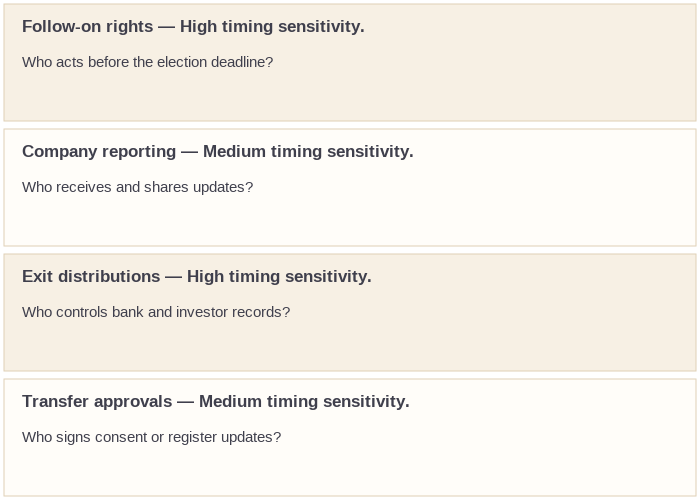
View matrix data and assumptions
| Function | Timing sensitivity | Continuity question |
|---|---|---|
| Follow-on rights | High | Who acts before the election deadline? |
| Company reporting | Medium | Who receives and shares updates? |
| Exit distributions | High | Who controls bank and investor records? |
| Transfer approvals | Medium | Who signs consent or register updates? |
What Makes an SPV Less Dependent on One Person
At least 3 distinct sets of records help show the stake's history:
- the register of investors and their stakes
- bank or escrow records
- records of the company and what the SPV holds
A transition becomes much harder when all three sit with one person.
An SPV may last for years, making routine admin part of protecting the stake. Sound records and access to service providers help it act for investors even when the team changes.
Investors still depend on the company and security for their return. The handover plan protects the structure they use to own that stake. It keeps reports and cash payouts moving until the investment ends.
Frequently Asked Questions
What makes SPV continuity institutional?
A backup needs a clear right to act and the means to do the work. Access to records then lets notices and payouts continue during the handover. Naming a substitute without that access leaves a gap.
Does a single-asset SPV need full-fund key-person language?
A single-asset clause can focus on the work that holding needs. It should connect the trigger to interim authority and a way to choose the next manager. Fees and carry then need terms that let the handover proceed.