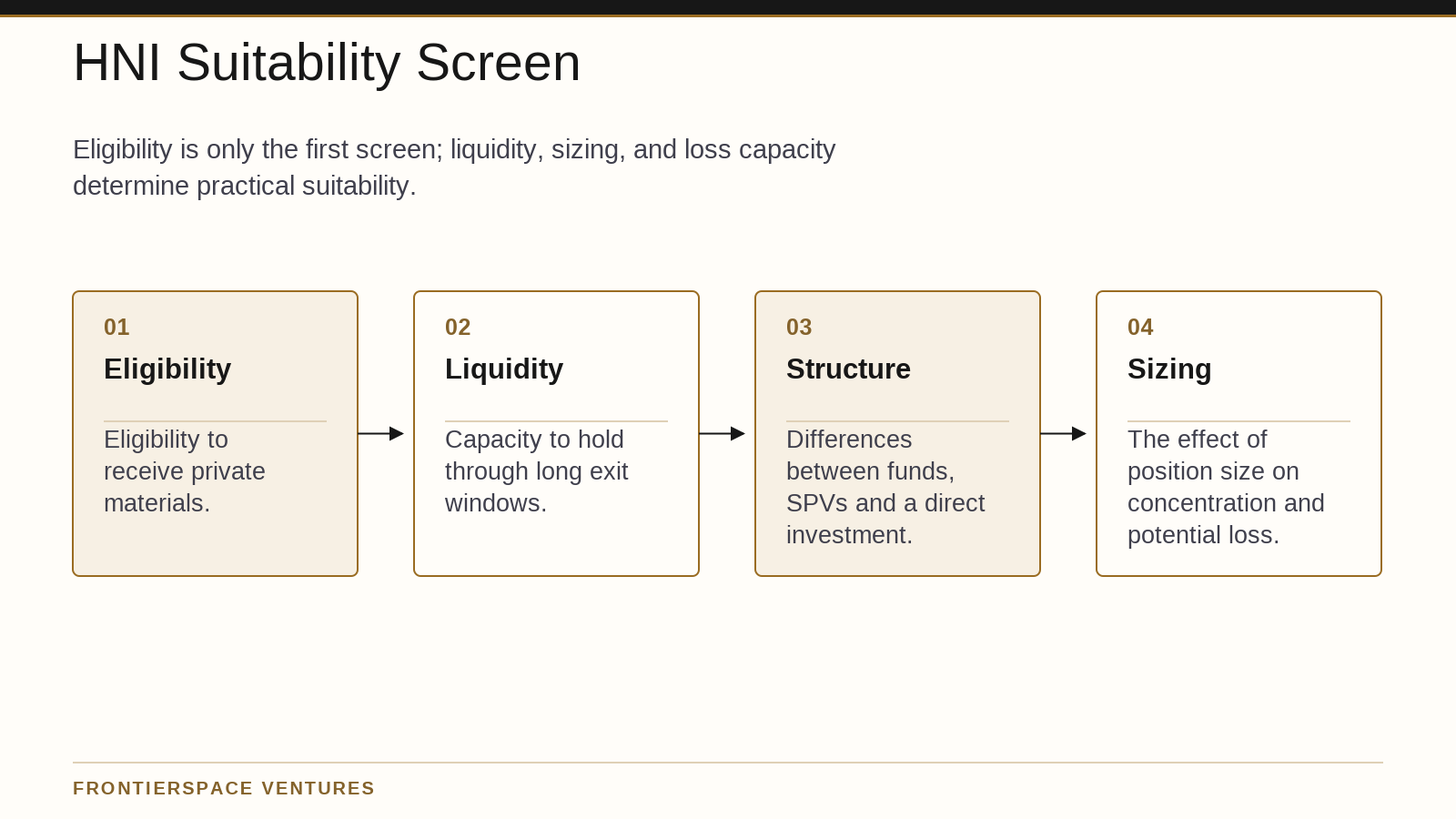
The right to invest is the first test. Cash needs, stake size and the loss the investor can bear then determine fit. The diagram shows this review order; stage width does not measure the chance of an outcome.
HNI Suitability Screen
The right to invest is the first test. Cash needs, stake size and the loss the investor can bear then determine fit.
View chart data and assumptions
| Step | Stage | What it establishes |
|---|---|---|
| 01 | Eligibility | Eligibility to receive private materials. |
| 02 | Liquidity | Capacity to hold through long exit windows. |
| 03 | Structure | Differences between funds, SPVs and a direct investment. |
| 04 | Sizing | The effect of position size on concentration and potential loss. |
How Much Illiquidity Can the Balance Sheet Carry?
A wealthy investor may qualify for a private offer yet find it a poor fit. The deal must also suit the loss they can bear and when they need cash. SEC guidance explains the access tests, which can cover wealth, income, credentials and certain family-office ties.
Passing an access test does not show how much cash the investor can afford to tie up. Liquid assets and the loss they could bear help answer that question. Those limits determine how the holding fits the portfolio.
The examples in this guide use a minimum commitment or deal size of $10 million. This keeps them relevant to large private-client portfolios.
An investor qualifies for a private fund and commits during a strong public market. Two years later, the fund calls for cash just as the investor's listed shares have fallen. The investor still meets the legal rules, but funding the commitment has become much harder.
Why Eligibility and Portfolio Fit Differ
A $10 million commitment is 2% of a $500 million portfolio. It is only 1% of a $1 billion portfolio. Those figures describe the first commitment. Follow-on rounds and later fund vintages can increase the total cash the investor has tied up.
Rules vary by offering and by where it is made. Its legal documents explain the tests used to review investors. Check those terms before assuming that one offer's access rules apply to another.
Why HNIs Consider Private Technology
Private technology offers a stake in companies before they list. Investors can join specialist managers and add a source of returns beyond their other private holdings. The route they choose sets the work and risk they take on.
Those benefits take time. A sound review process and clear reports help the investor follow the fund through a market cycle. This matters when reported values change but little cash comes back.
Venture Capital Versus Listed Equities
SEC Rule 144 generally calls for restricted shares to be held for 6 months for a reporting issuer or 1 year for a non-reporting issuer. That wait is only one condition for resale. Other rules may still limit a sale once it ends.
Listed shares tend to trade often at visible prices. A private sale needs an agreed price, which can be harder to judge. The company may also need to approve it even after the legal holding period ends.
Investors accept these limits to buy into a company at an earlier stage. Money set aside for near-term spending is a poor match for an asset that may take years to sell.
Funds, SPVs, Co-Investments, and Directs
Carta found that about 44% of SPVs charged a management fee. Among those charging a fee, the 2023 median was 1.9%. The investor still needs the fee terms to work out how much the charge costs over time.
| Structure | Best Use | Governance Focus |
|---|---|---|
| Fund | Delegated portfolio exposure across a manager's strategy | Manager selection, timing, and focus on net returns |
| SPV | Selected investments in a specific company or transaction | Security terms, vehicle economics, reporting, and sponsor alignment |
| Co-investment | Larger position alongside a trusted sponsor | Allocation rationale, same-term participation, and follow-on planning |
| Direct investment | Company-level ownership where the investor has a genuine advantage | Independent diligence, monitoring capacity, and exit path analysis |
Capital Calls and Illiquidity
On a $10 million commitment, the first-year call would be $2 million. Years two and three each need $3 million, leaving $2 million for year four. This uses 80% of the promise in the first three years, possibly before much cash has come back.
A fund draws the promised money over time. The first payment can therefore feel small compared with the full amount owed. An investment in one company may also need more cash in a later round.
Liquid assets can fund these calls even in a weak public market. Private holdings offer less help because they may be hard to sell just when cash is needed.
How to Assess a Manager
Split the manager's record into cash returned and the estimated value of shares still held. Then trace which deals made those gains. This helps test whether the manager has a repeatable way to find strong companies and win a stake.
The holdings help test that claimed edge. Company count shows how widely the fund spreads its bets, while reserves show what remains to support them. Together, they reveal how much the return depends on a few deals.
Company logos can show access but say little about the price paid. Deal records reveal the shares bought and the terms attached. Those details show whether the fund's access had a sound chance of producing a return.
Tax, Jurisdiction, and Suitability
Tax treatment depends on the investor and the vehicle. Where the investor lives and earns income can affect tax withheld from payments. The structure also shapes the tax reports they receive.
A separate legal and tax review can explain how the structure applies to this investor. Resolve those points before signing up, while the terms can still inform the choice.
Choosing a Structure That Fits the Investor
A fund leaves company choice to the manager. An SPV backs one company, so more of the result rests on that business. Direct deals and co-investments give the investor more say, but also more work to assess the deal.
Every route needs evidence that the business serves real customer demand. Share terms and price then define what the investor buys. A plausible route to cash completes the case; an assumed IPO date leaves that part untested.
Coinbase: A Direct Listing Converted Private Ownership Into Public Liquidity
Coinbase listed Class A shares on Nasdaq in April 2021 through a direct listing. Existing holders could sell registered shares in the market. Coinbase sold no shares and received none of the proceeds.
The listing registered shares for holders to resell. It raised no new capital for Coinbase.
Registered holders could then decide whether and when to sell their shares.
The prospectus set out different voting rights for Class A and Class B shares. Those differences remained when public trading began. A route to cash did not make the two classes identical.
A listing creates a way to sell, but some private shares may still be hard to turn into cash. Registration and transfer rules affect whether a holder can use that market. The share class and the way shares are held can limit sales even after public trading starts.
Primary source: Coinbase's direct-listing filing (2021). This case comes from public records. It is not a Frontierspace investment or return.
Frequently Asked Questions
Is venture capital suitable for every high-net-worth investor?
Venture can fit someone who can bear a loss and wait for an exit while meeting near-term bills. The size of the stake still matters. A cheque that fits a large portfolio may put too much of a smaller one's wealth behind one source of risk.
Are private-company investments liquid?
Private shares are usually hard to sell. Transfers face limits and often depend on an event led by the company. A funding round, a company sale or an IPO may let holders cash out. Tender offers and secondary sales are other routes. None is guaranteed to be open when the investor needs it.