Start with the client's needs and the vehicle's terms to assess fit. Records and reports then support the review before and after investing. This process is an example for discussion; its values and weights do not predict returns.
Adviser Review Flow
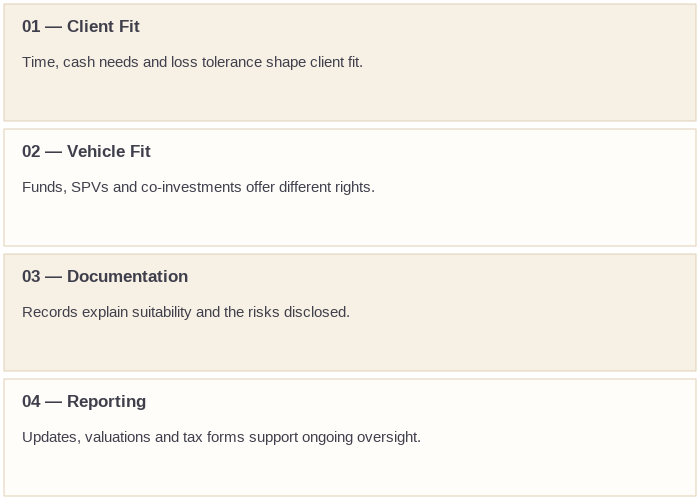
The client's needs and the vehicle's terms determine fit. Records and reports help the adviser test that fit before and after investing.
View chart data and assumptions
| Step | Stage | What it establishes |
|---|---|---|
| 01 | Client Fit | Time horizon, liquidity needs and risk tolerance. |
| 02 | Vehicle Fit | The role of a fund, SPV or co-investment. |
| 03 | Documentation | Records supporting suitability and disclosure. |
| 04 | Reporting | Client updates, valuation and tax-reporting responsibilities. |
The client's holdings, possible losses and cash needs set the limits for a new deal. The adviser must then judge whether it can support the investment after closing. That depends on where the deal came from and who handles values, calls and reports.
How Long Can the Client Hold the Investment?
Getting access may seem the hardest part of a private deal. The client still needs cash it can leave invested for years. Calls, tax forms and changes in reported value may continue while the holding remains hard to sell.
FINRA's private-placement guide calls for a reasonable review of both issuer and offer. The client's needs belong in that review too. A sound company can be a poor fit for someone who may need the cash back soon.
FINRA Rule 5123 covers member firms selling private placements. Unless exempt, they must file the required material within 15 calendar days of the first sale. If none was used, they must tell FINRA instead. The firm needs to check the offer to establish which duty applies.
A client with several private funds may ask about a $10 million SPV. Its company may look promising while already appearing in those funds. Existing calls and the client's cash needs can leave less room for the new stake than the company case alone suggests.
Does the Ticket Fit the Client's Portfolio?
A $10 million venture commitment uses 10% of a $100 million portfolio. It takes 2% of a $500 million portfolio and 1% of a $1 billion portfolio. The same cheque thus puts very different shares of the client's wealth at risk.
That share shows what a total loss would mean and what remains for other needs. But some apparently free cash may already be promised to private funds. Include uncalled commitments before judging how much room is left.
The client may want early access to tech companies or returns from outside public markets. These are different goals. Defining which matters helps the adviser judge whether the proposed structure serves it.
How Real Cash Needs Affect Suitability
Even a wealthy client may find a $10 million minimum too large. Cash needs, tax work and repeated company stakes can limit what fits. A good product still has to work within those limits.
Spending, taxes, purchases and family support may need cash before the investment pays out. Late exits and continued calls can widen that gap. If the client must sell public assets at a poor time to meet it, too much cash has been tied up.
Reported value can rise long before cash comes back. The valuation method shows what that mark means. The likely route to a sale then explains why the client may be unable to use the gain for years.
How the Structure Changes the Adviser's Work
Carta found that about 44% of SPVs charged a management fee. Median fees were 1.8% for SPVs below $10 million and 2% for larger vehicles. Structure therefore changes costs as well as the work needed to support a holding. Include those charges before treating an SPV as a simpler route into the deal.
A fund requires a view on the manager and its portfolio plan. An SPV or co-investment also requires a view on one company. For a secondary, the buyer must then ask why the stake is for sale and which rights come with it.
In a single-company fund, the business and its share rights drive much of the risk. Lower fees help a sound deal but cannot repair a weak one. The client's right to invest is a separate test from whether that risk fits the portfolio.
Suppose a $10 million commitment calls 20% in year one, 30% in each of the next two years and 20% in year four. The client pays $2 million, then two $3 million sums and a final $2 million before payouts. Liquid assets must cover that schedule.
The schedule turns a headline commitment into dated cash needs. Several funds may call in the same year, creating a larger combined demand. The chosen structures and sources of cash explain how the client would meet it.
How Company Holdings Reveal the Actual Spread of Risk
Split $100 million for private tech equally across 10 managers and each starts with $10 million. Give all $100 million to one manager and concentration starts at 100%. The same budget creates very different reliance on one firm.
Several funds may own the same late-stage firm or back one sector in the same cycle. Their holdings reveal that overlap where disclosed. Adding the repeated stakes shows how much risk sits behind the separate manager names.
Entering across vintage years puts less weight on one market period. A mix of managers and companies spreads the other sources of risk too. None of these choices promises a better return.
Documentation and Due Diligence
The terms define what the client owns, while company evidence helps test whether it is worth buying. Keep both in the record of the decision. They explain why the adviser judged that particular stake suitable.
- What shares or stake in a vehicle will the client receive?
- How do fees, carry and costs reduce the client's return?
- Which rights to reports and sales remain after closing?
- Conflicts: Where can the sponsor's interests diverge from the client's?
- Who handles the books, audit, legal work and tax reports?
- Who chose the investment, and who will track it?
The client's goal and risk limit give the answers their meaning. Unresolved gaps can still affect the recommendation even when every box in a checklist has been filled.
Client Reporting and Administration
After closing, call notices change cash forecasts and tax forms have dates to meet. Reported values can move too. Clear owners for these records help the client understand what changed and when more cash may be needed.
One vehicle held across many client accounts can create much more work than a single account suggests. The reporting team must keep up as more clients join. Its capacity therefore limits how widely the firm can support the holding well.
Explaining Venture Risk
A hard-to-sell stake may leave the client short of cash when it is needed. An uncertain mark may change sharply at the next round. If one company forms a large share of the portfolio, either problem can affect the overall result.
A gain in fair value cannot pay bills until a sale and payout turn it into cash. A delayed exit may also require another round of funding. Both affect the client's wider finances, beyond the value shown for the holding.
Explaining the Decision Clearly to Clients
Explain the expected benefit alongside the most capital the client could lose. The structure shows how the adviser plans to obtain that benefit. The main downside case then shows what could prevent it.
Airbnb: An IPO With Primary Capital, Seller Liquidity and Lockups
Airbnb priced its December 2020 IPO at $68 per share. The company sold most of the shares in the offer, while existing holders sold a smaller portion. That gave the two groups different uses for the cash.
Airbnb sold 50 million shares, while selling stockholders supplied about 1.3 million more.
Airbnb later reported the net cash left after paying the costs of the offer.
Public trading did not let everyone sell at once. Many holders who owned shares before the IPO still had lockups that barred sales for a period after the offering.
An IPO does not give every client the same chance to sell. Share type and eligibility set who may sell, while lockups and custody can delay access to cash. Taxes and price changes after listing then affect what the holder keeps.
Primary sources: Airbnb's IPO pricing (2020); Airbnb's 2020 Form 10-K. This public case has no link to a Frontierspace investment or return.
Frequently Asked Questions
Is venture capital appropriate for all wealth-management clients?
Venture can fit a client able to bear losses and wait an uncertain time for cash. Existing promises to private funds and future bills limit that capacity. Permission to invest alone does not show that the product fits.
What should advisers ask first?
The whole portfolio gives the new holding its context. Weigh the expected benefit against the cash needed while the stake is hard to sell. That shows what support the rest of the portfolio must provide.
The vehicle sets how the stake is held and reported. It must fit both existing holdings and the work the adviser can do after closing. These are part of the case for recommending it.