What the Extra Fee Layer Can Add
A venture fund of funds charges for choosing and overseeing other funds. Those funds also charge fees and carry, so the LP pays through both layers. The useful test compares what remains with the direct programme the LP could build and run itself.
Carta's 2025 fee review gives a base for venture funds. It found a median 2% fee during the investment period and 20% carry. A pooled fund adds its own charges above those costs. Its added value must cover that second layer before the LP gains.
The Full Cost of Each Investment Route
A direct programme keeps manager choice with the LP, along with the work of running it. A fund of funds charges to take on that work and may reach managers the LP cannot. The comparison needs cash flows after all costs to show what each route delivers.
| Route | Cost layers | Potential value |
|---|---|---|
| Direct funds | Underlying fees, carry, expenses, and internal LP cost | Direct manager choice and relationship |
| Fund of funds | Underlying costs plus fund-of-funds fees, carry, and expenses | Manager access, diversification, pacing, data, and administration |
Where the Improvement Comes From
Access adds value if it brings funds that improve the portfolio. Avoiding weak managers can help too. The platform needs evidence of those choices and their results, since a longer fund list alone proves little.
Co-Investments Can Lower the Blended Cost
Some platforms offer company stakes alongside funds at lower fees or carry. Those stakes can reduce the blended cost if they form enough of the portfolio. They also add company risk, so a cheap position still needs a sound case and a size that fits.
- The underlying funds' gross and net returns show what their costs remove before the pooled layer.
- The pooled fund then deducts its own fees, carry and expenses under its terms.
- A direct programme has its own staff, legal, data and access costs, even without a pooled fee.
- Direct company stakes may lower the blended fee while putting more risk in a few firms.
- Cash calls and payouts at both layers set when the LP pays in and gets money back.
The comparison then reaches beyond the stated fee. The second layer needs to improve net value or manage risk better than the LP could on its own. That case depends on the finished portfolio and the work each route requires.
What the Visible Fee Hurdle Means
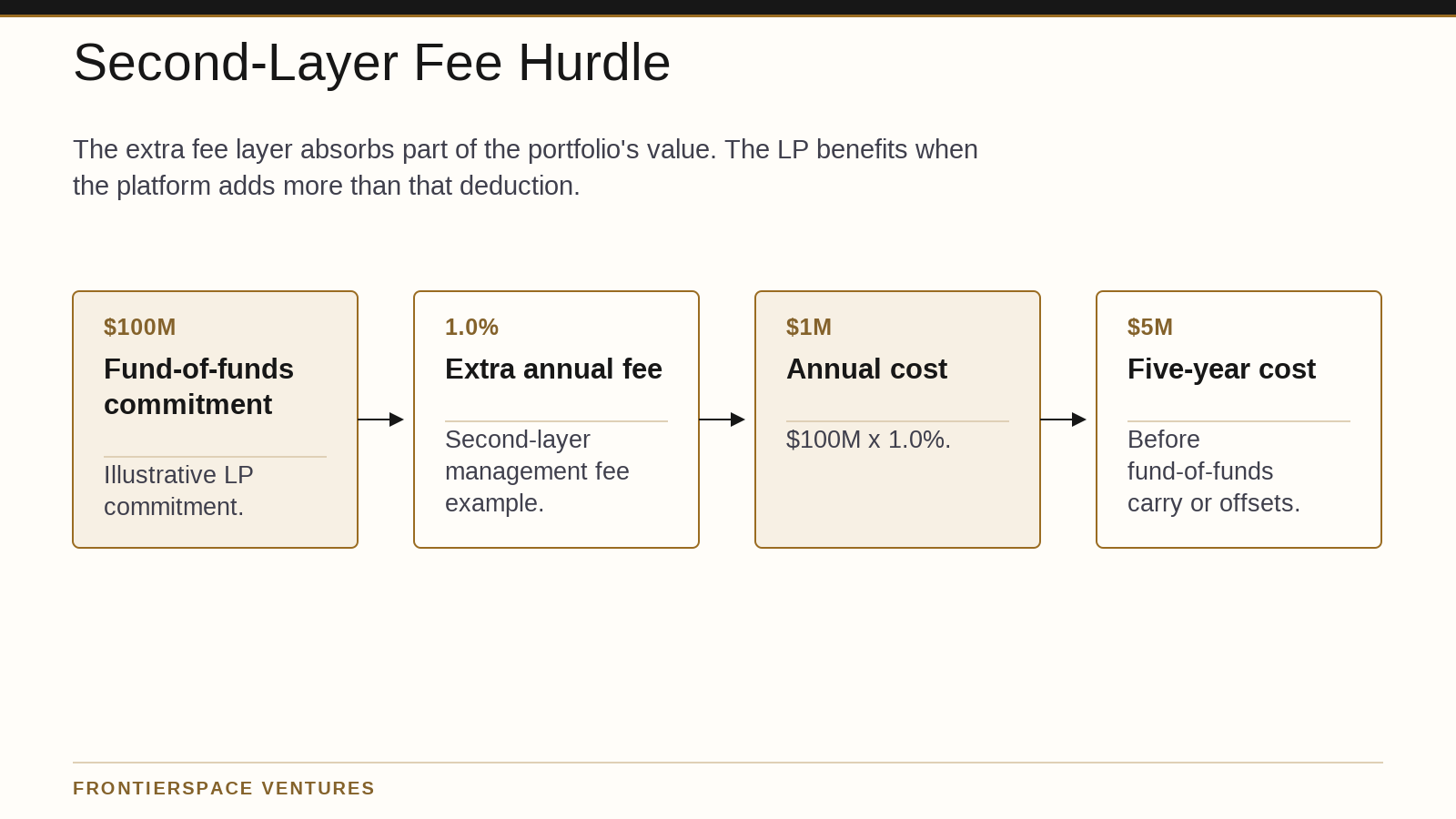
An extra 1% fee on a $100 million commitment costs $1 million in the first year. That comes above the costs of the funds held and before any carry charged by the pooled fund. The platform must add value beyond those deductions.
If the extra 1% applies to the same base for 5 years, the simple fee total is $5 million. That is the value absorbed before the LP sees any improvement. Extra carry raises the hurdle further.
How Access Can Affect the Result
Suppose $100 million of paid-in LP cash produces net value of $200 million directly or $215 million through the pooled route. The pooled result is 2.15x against 2.0x after all costs. Its extra layer has paid for itself on those values, though unsold stakes are not cash returns.
At one percent a year, an extra fee on a fixed $100 million base costs $1 million each year. Over five years, that comes to $5 million before carry or offsets.
Second-Layer Fee Hurdle
The extra fee layer absorbs part of the portfolio's value. The LP benefits when the platform adds more than that deduction.
View fee-layer assumptions
| Item | Amount | Assumption |
|---|---|---|
| Fund-of-funds commitment | $100M | Illustrative LP commitment. |
| Extra annual fee | 1.0% | Second-layer management fee example. |
| Annual cost | $1M | $100M x 1.0%. |
| Five-year cost | $5M | Before fund-of-funds carry or offsets. |
The Costs Within a Direct Programme
An LP with ten direct funds takes on manager searches, terms reviews and years of relationship work. Capital calls, value reports and new-fund requests continue after the first commitment. Staff and other costs for those tasks are part of the direct route's true price.
Those costs include:
- staff time and outside advice
- legal and data costs
- travel and work to maintain ties with managers
- the cost of weak access or missed re-ups
A fund of funds must cover both fee layers through what it adds. That may come from stronger manager choices, useful access or work the LP cannot do as well itself. Company stakes alongside funds and purchases of existing stakes may help, but their fees alone do not prove their value.
Frequently Asked Questions
Are two layers of fees always bad?
The extra layer raises the cost hurdle. Better access and selection can still clear it if they add more value than the fees remove. The result needs to be measured after both layers' costs.
Should large LPs avoid fund-of-funds?
A large LP may use a specialist to cover new managers or a region its own team does not know well. A clear role helps it judge the benefit. It can then see whether the platform fills a gap or repeats work it already pays for.