The Two Multiples Begin With Different Capital
The gap between 3x gross and 2x net involves both cash invested and cash returned. Fees and costs use some of the money LPs pay in, while carry takes part of the profit. The timing of calls and payouts then affects IRR. Gross and net figures measure different stages of that process.
Gross MOIC usually compares company stakes' value with their cost. Net MOIC uses the LP's cash returned and value still held, relative to all cash paid in. Some LP cash pays fees and costs, which is why the two multiples use different bases.
A Simple Path From Company Proceeds to the LP
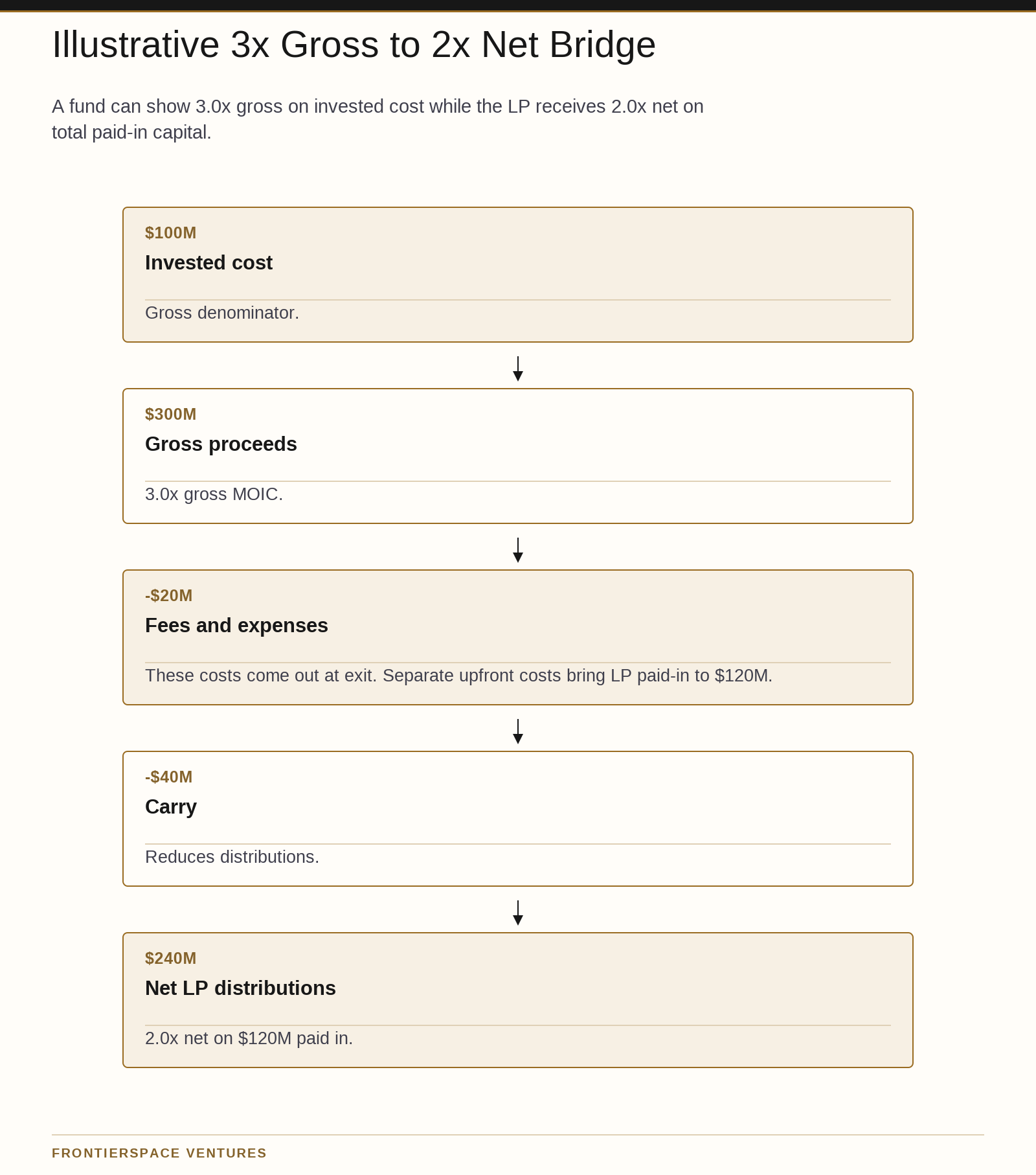
Suppose $100 million invested in companies produces $300 million of proceeds, or 3.0x gross. LPs also paid $20 million for upfront fees and expenses. Assume a separate cost bill of the same size comes out at exit, along with $40 million of carry. LPs then receive $240 million.
The LP paid in $120 million and received $240 million, which is 2.0x net. Comparing the same $240 million only with the $100 million invested cost would produce 2.4x, but that would ignore part of the LP's actual cash outlay.
The move from 3x gross to 2x net has two sides. Carry and costs paid from proceeds reduce cash returned. Upfront fees and expenses increase LP contributions above the amount invested in companies. Each charge enters once, according to when it is paid.
Market Terms Explain the Direction; Fund Terms Explain the Gap
Carta's 2025 fee review found a median annual management fee of 2% and carry of 20% across venture fund sizes. These charges help explain why the LP keeps less than the gross result. The fund's terms set the actual bill.
Carta found that the median fund above $100 million spends about 1% of its size on operating costs in its first five years. Those costs are separate from fees paid to manage the fund and from carry.
The gap depends on the fee base and when fees step down. Expense rules and the legal carry waterfall also matter. Two venture funds with the same gross result can therefore leave LPs with different net returns.
Timing Changes the Story Again
MOIC shows how much value exists, while IRR supplies the time dimension. A delayed distribution can leave the multiple unchanged while reducing IRR.
Reinvesting early proceeds can put more money to work and may improve the final multiple. It also keeps cash inside the fund that could have gone to LPs. That delays the payout measured by DPI.
Start with $300 million of gross proceeds. Deducting $20 million of fees and expenses at exit and $40 million of carry leaves $240 million paid to LPs.
Illustrative 3x Gross to 2x Net Bridge
A fund can show 3.0x gross on invested cost while the LP receives 2.0x net on total paid-in capital.
View gross-to-net data and assumptions
| Item | Amount | Multiple implication |
|---|---|---|
| Invested cost | $100M | Gross denominator. |
| Gross proceeds | $300M | 3.0x gross MOIC. |
| Fees and expenses | -$20M | These costs come out at exit. Separate upfront costs bring LP paid-in to $120M. |
| Carry | -$40M | Reduces distributions. |
| Net LP distributions | $240M | 2.0x net on $120M paid in. |
What Explains the Net Result?
The waterfall uses assumed cost and carry amounts to show how the figures connect. Actual cash flows and legal terms set each fund's result. As fees, carry and other costs arise, the gap can change over time.
Early fees can create a wide gap before company values rise. Later exits may offset some of that drag, while carry due to the manager creates another gap. Value still held can also change, so the reported net result is not yet fully secured.
- LPs pay fund costs as well as funding deals. Total paid-in capital can therefore exceed the cost of company stakes.
- Management fees and fund expenses are separate charges. Each needs its own place in the bridge.
- Realized carry has been paid. Accrued carry has been recognized in the accounts but is not yet paid.
- Recycled proceeds stay in the fund to be invested again. They do not become the LP payouts measured by DPI while they remain there.
- Cash paid back is a distribution. Marks on the shares left estimate value still held.
Tracing each cost shows how much of the company return is left for LPs. Adding cash-flow dates then explains the effect of timing on the net return.
Frequently Asked Questions
Is 3x gross always enough for 2x net?
A 3x gross result can lead to different net returns. Each fund has its own fee base and carry terms. Cash-flow timing, reinvested proceeds and the capital counted in the multiple also affect the result.
Should LPs ignore gross returns?
Gross returns show the result of the manager's company investments. Fund costs reduce what LPs receive, while the dates of their calls and payouts shape the return over time.