How Do Anti-Dilution Provisions Work?
Anti-dilution terms can lower the price at which preferred shares convert to common. The holder then gets more common shares, leaving founders, staff and others with a smaller share. This softens the effect of a lower-priced round but does not prevent every loss of ownership.
Cooley's Q4 2025 report found that down rounds fell as a share of its deals from the prior quarter. More companies raised at the same or a higher price. Lower-priced rounds still occur, so their effect needs to be tested before investing.
Of Cooley's 221 financings in Q4 2025, 12.8% were down rounds, compared with 19.3% in Q3. These figures cover one law firm's deals rather than the whole market. Such rounds can trigger anti-dilution clauses and change how ownership is split.
The Adjustment Happens Through Conversion
One preferred share may at first convert into one common share. A later issue at a lower price can reduce the old conversion price if the clause applies. This gives the holder more common shares when it converts.
Assume the original conversion price is $10. At that price, one preferred share converts into 1.0 common share. If a full-ratchet provision resets the price to $5, the same preferred share can convert into 2.0 common shares because $10 divided by $5 equals 2.0.
The adjustment gives the holder more common shares on conversion instead of refunding part of its cheque. Those shares can change ownership, votes and the eventual exit payout. The effect therefore lasts beyond the down round.
- Price starts the test: The new shares must fall under the clause. Their price must also be below the conversion price.
- Ownership can still fall: The clause may reduce dilution rather than remove it. A protected holder can still lose part of its ownership share in a new round.
- Legal basis: The charter, also called the certificate of incorporation, usually sets the conversion rules. Other terms can give rights to join later rounds or approve key choices. Check both to see what the holder can do.
Weighted Average Versus Full Ratchet
A weighted-average formula compares the new cheaper shares with the existing share base. A full ratchet ignores the issue's size and resets the protected price to the lower price. The NVCA Yearbook uses these two groups to describe venture terms.
- Broad-based weighted average: This uses a wider share count. It generally includes common shares, preferred as if converted, options and warrants. The charter defines what counts.
- Narrow-based weighted average: This uses a smaller share count. The same down round can then produce a larger adjustment.
- Full ratchet: The price resets to the new lower price. The number of new shares sold does not change that reset.
- No price adjustment: The conversion price stays the same. Existing holders face normal dilution from the new shares.
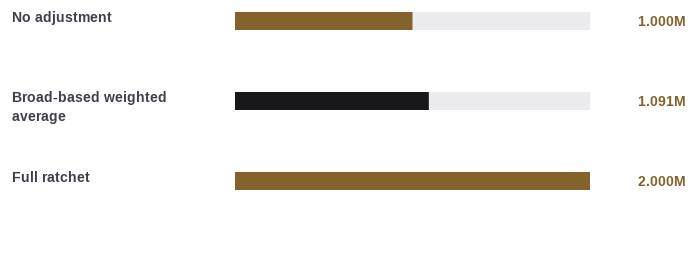
The chart keeps the company and funding round the same. Only the anti-dilution rule changes, so you can compare the formulas' effects.
This example starts with one million preferred shares and a $10 conversion price. Before the round, there are 10 million fully diluted shares. The company then sells two million shares at $5 to raise $10 million. With no adjustment, the preferred shares still convert into one million common shares. Broad-based weighted average raises that total to about 1.091 million, while full ratchet raises it to two million.
The Same Down Round, Three Conversion Outcomes
The new price is 50% below the old conversion price. In this case, full ratchet adds far more shares on conversion than broad-based weighted average.
View chart data and assumptions
| Treatment | Adjusted conversion price | Common shares per preferred | Common shares from 1.0M preferred |
|---|---|---|---|
| No adjustment | $10.00 | 1.000 | 1.000M |
| Broad-based weighted average | $9.17 | 1.091 | 1.091M |
| Full ratchet | $5.00 | 2.000 | 2.000M |
Why the Denominator Matters
The charter sets how common, preferred, options, warrants and convertibles count in the share base. A wider base usually makes the price change smaller. The new cheap shares form less of that total, so they have less weight in the formula. The label 'broad-based' alone does not fix the count.
In the illustrated case, the company begins with 10.0 million fully diluted pre-round shares and a $10 conversion price. It then sells 2.0 million shares at $5 to raise $10 million. Applying the disclosed broad-based formula produces a new conversion price of about $9.17. The number of common shares received for each protected preferred share increases from 1.0 to roughly 1.091.
- The base can include preferred shares, granted and ungranted options, warrants and convertibles. Leaving some out changes the count, which can change the price adjustment.
- Deemed issue price: A note, SAFE, warrant or bundle of securities may need special rules. These determine the price treated as paid for each share.
- Share series: Each preferred series may have its own conversion price and protection. The right to waive a change can differ too.
- Rounding and timing: Small differences in wording can build up when the formula is used more than once. The exact terms matter at each step.
Excluded Issuances Can Be Decisive
The charter may leave out staff grants, shares from existing convertibles, business purchases or other agreed issues. A low price on those shares may then trigger no change. Two firms selling at the same price can get different results from their clauses.
- Staff equity: Shares or options under an approved plan may be left out. That exception may apply only up to an agreed pool size.
- Existing claims: The terms may leave out shares from an option or warrant being exercised. Shares from a note or other instrument that converts may also be excluded.
- Business deals: Special rules may cover shares used to buy a company or fund equipment. They may also cover bank funding or a strategic partnership.
- Stock changes: Splits and stock dividends generally have their own rules to adjust shares in proportion. They do not use the down-round formula.
Suppose the company issues 4.0 million shares at $2.50 and raises $10 million. Using the same 10.0 million-share pre-round base, including the issuance in the broad-based formula lowers the conversion price from $10.00 to about $7.86. If the charter excludes the issuance, the conversion price remains $10.00. The commercial event is identical; the drafting changes the result.
Pay-to-Play, Waivers, and Amendments
New investors may ask holders to add cash, waive a price change or accept new share terms. A down round is therefore a negotiation as well as a formula. Voting thresholds and pay-to-play rules help decide which demands can take effect.
Cooley reported pay-to-play terms in 6.3% of its Q4 2025 financings, down from 9.9% in Q3. The figures describe its own deals at those dates. Where the term applies, keeping anti-dilution rights may require the holder to invest again.
- Pay-to-play: A holder that does not invest may lose its anti-dilution rights. Its shares may convert to common or move to another preferred series. The agreed terms set the penalty.
- The right to waive a change may rest with one class, one series or all preferred holders. That decides who can give up the protection.
- Funding talks: A company that needs cash may agree a wider change to its capital structure. The existing formula is one part of that bargain.
- A named holder may have its own rights to invest, consent or receive reports. Those can affect its stake even when the charter stays the same.
From the Clause to the New Ownership Split
A round must meet the clause's trigger before its formula sets a new conversion price. That price changes the share count and can alter exit proceeds. Each step depends on the terms and counts used in the step before it.
- Protected series: Find its issue price and current conversion price. Check the conversion ratio and how many shares exist. These set the starting point for that series.
- Trigger and exceptions: Check which new shares count as additional stock. The rules for their deemed price then help decide whether the formula applies.
- The common-equivalent count starts with the cap table. It adds the claims included by the clause, treating them as converted where the terms require it.
- Price change: Start with the old conversion price and the new round price. The formula also needs the cash or other value paid and the number of new shares.
- Ownership change: Compare the result with no adjustment, the agreed formula and a proposed waiver. Each may leave holders with a different share of the votes and value.
- Exit cash: Conversion choices work with preference claims, payment rank and rights to share the cash left. Debt and deal costs reduce that pool first.
What the Protection Costs Other Holders
A broad-based formula with a large share base may barely change the conversion price. A full ratchet can shift far more dilution to founders, staff and unprotected holders. The committee needs the calculation to assess that effect; the clause's name is not enough.
- The actual security: A label such as 'broad-based weighted average' names a method. The signed terms and share counts show how it works in this deal.
- Matching share counts: The formula needs a cap table that includes the option pool, convertibles, warrants and new-money terms. Those counts must match for the claimed protection to be sound.
- Different funding paths: A small down round may cause a small change. A larger shift in the share structure may have more effect. An excluded strategic share issue may cause no change at all.
- Reasons to stay: Protecting one class may shift dilution to founders, staff and other holders. Their smaller stakes can affect whether staff stay and whether the next round is easy to raise.
Protecting one holder can reduce other people's stakes and their reason to support the business. Staff may be less willing to stay, while new investors may dislike the revised cap table. Strong protection for one class can thus make recovery harder.
Frequently Asked Questions
Does anti-dilution protection prevent all dilution?
Price-based protection generally softens the effect of certain new shares issued at a lower price. It does this by changing the conversion terms. It does not keep ownership at a fixed percentage through every share issue.
Is broad-based weighted average always company-friendlier than full ratchet?
Broad-based weighted average uses both the price and size of the round. Full ratchet resets to the lower price without that weighting, so it usually has a larger effect. A small base or terms that leave shares out can still make a weighted-average change large.
Can an anti-dilution adjustment affect an exit?
A lower conversion price gives the holder more common shares on conversion. That can change the exit value at which converting pays more than taking the preference. It can also change how the cash left over is shared.
Which documents should investors review?
The charter sets the rights, and the current cap table shows who holds them. The term sheet, stock purchase agreement and investors' rights agreement add context. Votes, side letters, options and outstanding convertibles then help establish which shares count and how the clause works.
This article is a general guide. It is not personal legal, tax or investment advice. The signed terms, local law and facts of the round govern the rights and results.