The Right Company Count Depends on the Return Needed
A 50-company fund may still rely on a few sectors or large late-stage stakes. A 20-company fund may hold smaller, more balanced positions. The holdings and their weights show how risk is spread more clearly than company count alone.
A few companies can create most of a venture fund's value. The fund needs enough chances to find a winner and a large enough stake for that win to matter. The 2026 PitchBook-NVCA report shows a similar unevenness in market activity: a few large deals shaped investment value and exits. Those market totals do not measure fund returns.
Time makes the choice more consequential. A fund may run for 10+ years, so a large position can influence liquidity and follow-on decisions for a decade or longer.
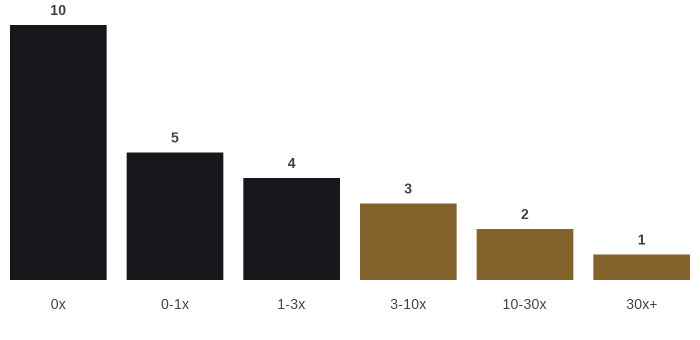
A few large winners can drive the fund's return even when many holdings return little or nothing. The 25-company example shows this uneven pattern. It is not a forecast or a market benchmark.
Concentration Trade-Off
A few large wins can drive the fund's return while many other stakes return little or nothing.
View chart data and assumptions
| Outcome band | Illustrative company count |
|---|---|
| 0x | 10 |
| 0-1x | 5 |
| 1-3x | 4 |
| 3-10x | 3 |
| 10-30x | 2 |
| 30x+ | 1 |
A 50-company fund has more chances to find a winner, but small stakes may limit each win's effect. A 20-company fund may own more of each business, so gains and losses both count for more. The stakes and possible losses need to fit the fund's plan.
Company Count Shows the Starting Shape
Equal weights make the starting point clear. Twenty companies begin at 5% each, while 40 begin at 2.5% each. Later cheques and changes in value then alter those weights, so neither fund is likely to stay equal.
The first cheque does not fix the fund's shape. Spreading reserves across many companies keeps its holdings broad. Putting most of that cash behind a few winners makes them larger, so even a wide fund can become narrow.
Concentration Can Be Useful
If 10% of the portfolio's cost is placed in one company and that investment returns 10x, it contributes 1.0x to gross fund value on its own. The same position can dominate reported value and risk long before exit.
A manager may choose fewer companies so that one strong winner can change the fund's result. Fewer holdings may also give the team more time to understand and support each business.
The same maths also shows the risk. When fewer stakes hold more of the fund's cash, each poor choice can cause more damage.
Diversification Can Be Necessary
Consider 30 equal positions: 15 return nothing, eight return 1x, five return 3x, and two return 10x. Together they produce about 1.43x gross before fees and reserves. Thirty companies sound diversified, but the result is still modest.
Adding companies gave the fund more chances and softened the risk of a single loss. It did not remove the need for large winners. Small stakes and modest outcomes can still leave the whole fund with a weak return.
Look-Through Exposure
Risk can repeat across funds as well as within them. Two managers may own the same company. Even firms with different names may rely on the same technology cycle or source of demand.
In a downturn, these companies may all need cash from the same funding market. The names look varied, but their shared need for funding makes the risks overlap.
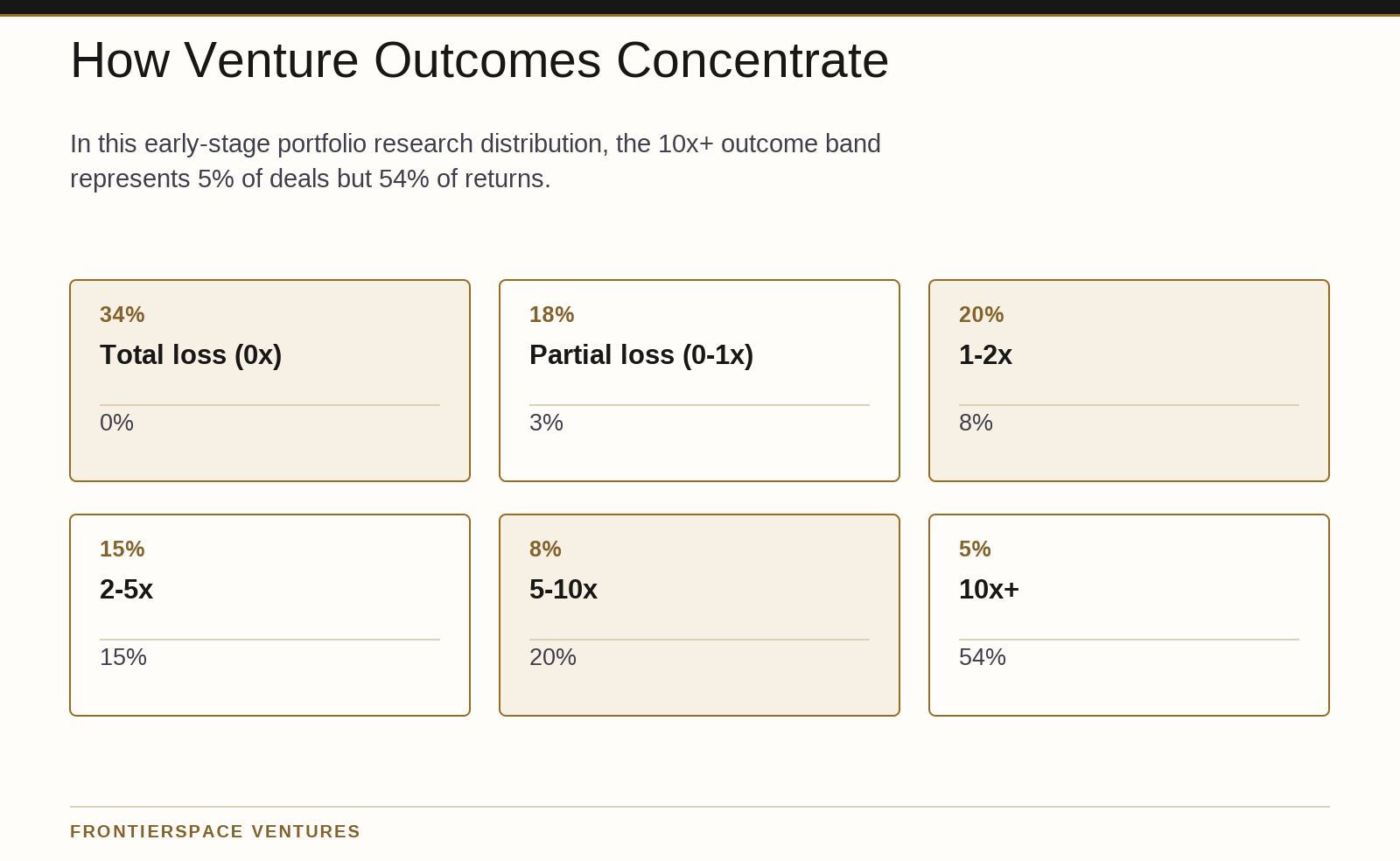
In this early-stage research sample, deals returning 10x or more made up 5% of deals but 54% of returns. NVCA presents the data as industry research on angel and early-stage portfolios. It shows a few large winners driving much of this sample's return, not a rule for all venture funds.
How Venture Outcomes Concentrate
In this early-stage research sample, deals returning 10x or more made up 5% of deals but 54% of returns.
View chart data and assumptions
| Outcome band | Share of deals | Share of returns |
|---|---|---|
| Total loss (0x) | 34% | 0% |
| Partial loss (0-1x) | 18% | 3% |
| 1-2x | 20% | 8% |
| 2-5x | 15% | 15% |
| 5-10x | 8% | 20% |
| 10x+ | 5% | 54% |
How Much of the Return Depends on the Outlier?
A stake equal to 5% of cost adds 1.0x of fund value if it returns 20x. A 2% stake adds just 0.4x. Market figures measure something else: in 2025, 487 megadeals took 67% of US venture deal value. That records where cash went rather than the return a fund earned on it.
A fund's target may rely heavily on its largest stake. To test that plan, work out how much of the target comes from that company. The share the fund expects to keep then sets the exit value it needs.
A stake can grow because the fund invests more, its paper value rises or it receives repeated bridge rounds. These paths give different evidence of progress. If the company later sells for less, a fund reliant on that holding can miss its target.
Reserves Decide the Portfolio's Final Shape
The first cheques only start to shape the portfolio. Later rounds may preserve stakes across many companies or build larger ones in a few leaders. They may also keep struggling firms alive in a weak market.
A reserve policy should explain what earns a company more capital. This helps separate a strong case from an attempt to rescue an earlier cheque. The cash left then limits how many other companies the fund can support.
The Investment Case Behind Concentration
The fund needs enough separate chances to survive losses and enough of each winner for a gain to matter. Its portfolio plan tests that balance across large and small stakes.
WhatsApp: the operating profile behind an outlier transaction
WhatsApp reached a huge number of users with a small team before its sale was announced. It illustrates the kind of large winner that can shape a fund's return, provided the fund owns enough of it.
Sequoia said more than 1 million people joined each day. This rapid growth was visible before the sale.
Sequoia reported about 14 million active users for each engineer. The team was small for that level of use.
Facebook offered cash and stock for the company. It also offered separate employee RSUs, which would vest over time.
A large business win changes a fund's result only if it owns enough of the company. WhatsApp shows that link, but the fund cannot count on finding such a winner in every vintage.
Primary sources: Sequoia on WhatsApp's growth (2014); Meta's WhatsApp deal plan (2014). This public case shows a business with unusual scale and growth. It is not a Frontierspace investment or return.
Frequently Asked Questions
How many investments make a venture portfolio diversified?
Company count alone cannot show how well risk is spread. Stage, sector and region matter, as does reliance on the same funding and exit markets. Funds with the same number of holdings can carry very different risks.
Should LPs prefer concentrated or diversified venture funds?
The right balance depends on the manager's strengths and the LP's other holdings. Fewer, larger stakes let a win have more effect. More stakes can reduce reliance on just a few results, but each win may matter less.