One winner can carry the fund
A company can grow sharply yet fail to return the fund. The manager may own too little at exit, or buyers may pay a lower price than expected. Testing ownership, dilution, price and timing shows which of these changes would matter most.
Start with the assumptions the investment case needs to hold. Change them one at a time, then test two weakening together. This shows what the return depends on; it does not make the forecast more accurate.
CalPERS' 2026 private equity review shows why the spread of results matters to the whole fund. Venture outcomes are uneven, so a change in a few large stakes can move the total. Rebuilding the base case reveals how much rests on them.
The gross gain also changes before it reaches the LP. Under a common 20% carry term, part of the profit goes to the manager. A large company gain can therefore leave a much smaller net return.
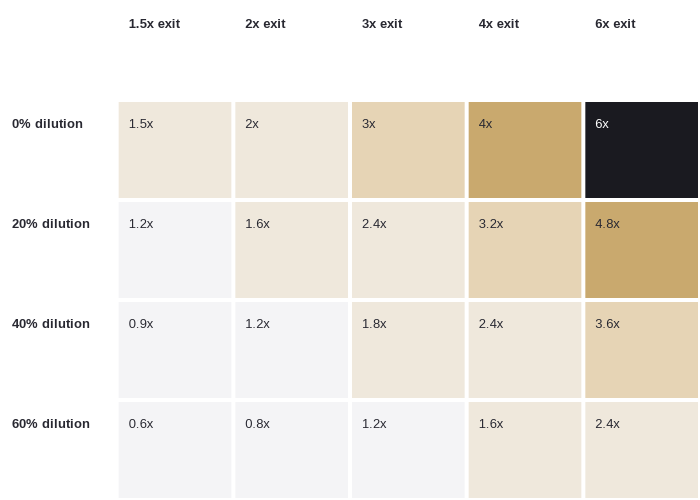
A strong exit can still give the fund a modest return if dilution shrinks its stake. This example multiplies the exit multiple by the share of original ownership kept. It shows gross MOIC before fees, carry, taxes and the effect of timing.
Return Sensitivity Drivers
A strong exit can still give the fund a modest return if dilution shrinks its stake.
View chart data and assumptions
| Review area | 1.5x exit | 2x exit | 3x exit | 4x exit | 6x exit |
|---|---|---|---|---|---|
| 0% dilution | 1.5x | 2x | 3x | 4x | 6x |
| 20% dilution | 1.2x | 1.6x | 2.4x | 3.2x | 4.8x |
| 40% dilution | 0.9x | 1.2x | 1.8x | 2.4x | 3.6x |
| 60% dilution | 0.6x | 0.8x | 1.2x | 1.6x | 2.4x |
Ownership can matter as much as the exit
At a $5 billion exit, a 2% stake pays $100 million before costs. If the fund holds only 1%, it gets $50 million from the same sale. The company's success has not changed, but the fund's share has.
A model may defend a $5 billion exit but assume the stake never shrinks. Later rounds and a larger option pool can reduce it. The company can then reach that sale price while returning less to the fund than planned.
A 25% dilution event reduces a 2% stake to 1.5%. At the same $5 billion exit, gross proceeds fall from $100 million to $75 million. The company still succeeds; the fund simply captures less of that success.
The Rest of the Portfolio Changes the Winner's Burden
In a 20-company portfolio with equal costs, one 10x deal adds 0.5x to fund value. A 20x deal adds 1.0x. The other 19 holdings still decide whether the fund merely returns capital or turns that win into a strong overall multiple.
This is where the loss ratio and reserve plan meet. More failures increase the burden on the leaders. Poorly directed follow-ons add cost without preserving meaningful ownership. Changes in the winner and the rest of the portfolio therefore interact.
A Few Cases Can Reveal the Main Risks
Keep the same base case when testing time, dilution and asset values. A later exit changes the yearly return. A smaller stake reduces a winner's impact, while a lower mark reduces NAV. Keeping other inputs fixed lets the LP compare these effects.
| Case | What Changes | LP Question |
|---|---|---|
| Base | Manager's stated ownership, timing, and exit assumptions. | Is the case internally consistent? |
| Delay | Same exit value, but liquidity arrives three years later. | Does IRR still fit the LP objective? |
| Dilution | Ownership declines through follow-on financings. | Does the winner still move the fund? |
| Mark-down | Largest unrealized positions are reduced significantly. | How dependent is performance on current NAV? |
How the Result Reaches the LP
Carta reports median terms of 2% management fee and 20% carry. Company proceeds first add to the fund's gross value. Fees and carry then reduce the cash reaching the LP, so a strong company result may leave a more modest net gain.
Timing belongs in the same bridge. Moving an exit three years later leaves the multiple unchanged but lowers IRR. A discounted secondary can reduce both. Fees, expenses, and carry then determine how much of the remaining value reaches the investor.
What the Sensitivity Table Reveals
The largest changes show where the case is most exposed. If ownership drives the result, check reserves and dilution. If current marks matter most, examine the evidence for those values. If delay has the largest effect, test how the payout schedule fits the LP's cash needs.
The table points to the assumptions that need the strongest evidence. Checking them gives the LP more reason for confidence than leaving them unsupported. It shows where further review may help while keeping the future uncertain.
Company count and cheque size set the fund's first stakes. Reserves and dilution then change what it owns over time. The portfolio plan therefore sets much of the range tested in these cases and the size of each winner's possible contribution.
Klarna: Company Progress and Valuation Can Move in Opposite Directions
Klarna raised $800 million of common equity in July 2022, during a severe public-market downturn. Its post-money value was $6.7 billion, which it said was still three times its 2018 level. The case shows how business progress can coexist with a lower investment value.
Klarna planned to use the new cash mainly to expand in the US.
The new price was still far below the prior peak in its private-market value.
Klarna also reported roughly 2 million transactions a day. Investors could weigh that scale against the lower price.
A company can gain users and strategic value while the price investors will pay falls. Market multiples can move against business growth. The return model needs to allow for both forces.
Primary source: Klarna's $800 million funding round (2022). This case comes from public records. It is not a Frontierspace result.
Frequently Asked Questions
Which variables matter most in a venture fund sensitivity analysis?
Exit price, timing and the stake kept shape company proceeds. Reserves and losses change the rest of the fund, while fees and carry reduce what LPs keep. Testing these inputs shows which moves the final result most.
Is a sensitivity analysis a return forecast?
Sensitivity analysis changes key assumptions to show how the result responds. This helps the LP understand what drives the case. It does not predict which version of the future will occur.