What return must the fund produce?
The plan sets company count, first cheque size, target stakes and reserves. Suppose a $100 million fund expects one winner to return the fund. Its stake at exit determines how large that win must be, while follow-on cash helps it keep that stake.
The same calculation applies across the portfolio. If a few large wins must drive the return, the plan shows what each would need to contribute. The LP can then test whether those outcomes fit the market the fund serves.
Cambridge Associates' benchmarks group results by vintage, sector and location. The deals on offer change with the market. Spreading stakes across years and strategies helps manage that risk. A manager being ready to take cash does not remove the need to plan its timing.
The evidence takes time to develop. Cambridge Associates cautions that a private fund may need about 5 to 6 years before its rank against peers becomes meaningful. Early results therefore need more care when used to judge the plan.
A $100 million fund could start with $5 million in 20 companies or $10 million in 10. More companies give it more chances to find a winner. Larger stakes make each win matter more, but each loss hurts more too. The choice depends on the stakes it can buy and their later cash needs.
Fund size sets the burden
A $100 million fund reserving 50% has $50 million left for first cheques. Across 5 companies, that is $10 million each on average. If it cannot invest that amount at its chosen stage without changing price or ownership, the fund size does not fit the strategy.
A larger fund can write bigger cheques, enter later rounds or add companies. Each choice changes the plan. Later rounds may buy less ownership per dollar, while more companies can leave each stake too small to affect returns.
Why Ownership at Exit Matters
A $10 million cheque at a $50 million post-money value buys 20% of the company. If two later rounds each dilute existing holders by 20%, that stake falls to 12.8%. This assumes no pro rata investment to defend it.
Entry ownership is only the start. More companies reduce reliance on one business. But dilution can leave stakes so small that even a large exit barely moves fund returns. Fewer, larger positions give winners more impact and make mistakes more costly.
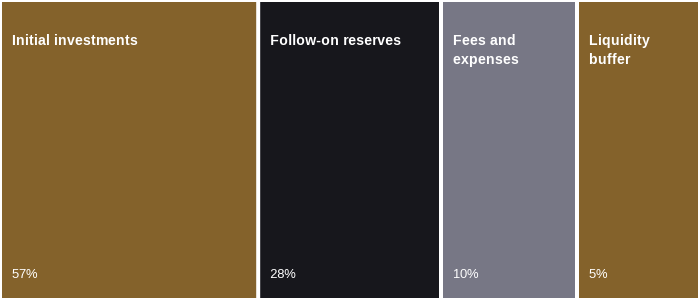
First cheques, follow-on reserves, fees and cash buffers all use the same fund budget. The fund terms, strategy and reserve policy decide how it is split.
Portfolio Plan Levers
First cheques, follow-on reserves, fees and cash buffers all use the same fund budget.
View chart data and assumptions
| Area | Treatment |
|---|---|
| Initial investments | 57% |
| Follow-on reserves | 28% |
| Fees and expenses | 10% |
| Liquidity buffer | 5% |
Reserves are a second portfolio decision
With $50 million reserved across 5 companies, the fund has $10 million each on average. Giving that cash to 4 emerging winners raises the average to $12.5 million. The reserve policy thus shapes which stakes the fund can keep through later rounds.
Seed companies often need several rounds before exit, so their reserve needs can be large. Later-stage or secondary deals may need less. Each new cheque still needs fresh evidence: reserves can prolong a weak bet as easily as support a strong one.
How Much the Fund Depends on Outliers
Carta notes that venture deals can return 100x or even 1,000x, while many return zero. A fund's reliance on those winners depends on how large its stakes are. The losses elsewhere then determine how much the winners must make up.
Suppose the leading company exits at half the value planned or takes longer to return cash. Either can change the fund's result, while more losses elsewhere add strain. If small changes break the case, the fund relies on fewer outcomes than its company count suggests.
Different Companies Can Share the Same Risks
Twenty firms can share one risk if they need the same customers, funding market or route to exit. A winner can also become a large share of NAV, the fund's reported net value. Look across sector, region and later-round backers to see where these risks overlap.
What Does the Construction Mean for the LP?
Company outcomes feed into the LP's net MOIC and net IRR after fund costs. The schedule of calls and likely distributions shows when those outcomes could affect cash. This connects the manager's portfolio choices to the LP's liquidity needs.
CalPERS: Construction Rules Before Individual Selections
CalPERS' June 2024 policy set portfolio rules before the choice of managers. It defined private-equity strategy ranges and limits on deals staff could approve. That made the plan enforceable. A list of attractive deals cannot do that job.
Within private equity, the policy gave venture capital a range of 0% to 12% of NAV. This set how much of the reported value could sit in venture.
Growth and expansion had a wider range of 5% to 30%. This left more room for later-stage investments.
Staff could approve deals only up to a set limit. Larger commitments still needed the committee's consent.
These limits belong to CalPERS, but they show how rules guide each deal's place in a portfolio. Agreed ranges and approval powers make the plan usable. Rules for exceptions then explain how a deal outside those limits can be considered.
Primary source: CalPERS' June 2024 fund policy. This public case shows how CalPERS sets its rules. It is not a Frontierspace investment or return.
Frequently Asked Questions
How many companies should a venture fund hold?
There is no single right company count. Target stakes and reserves set the cash needed for each holding, while stage and fund size limit how many will fit. The resulting mix must then be tested for sector risk and reliance on large winners.
Why do venture funds maintain reserves?
Reserves let the fund add cash to chosen companies and defend its stakes in later rounds. Each cheque still needs a sound case. Without that judgment, extra cash can deepen an earlier mistake.