The Ownership Path From Seed to Exit
New rounds, option pools and convertibles change the share count before exit. Later cheques can offset some of that dilution. The stake left after each event becomes the starting point for the next.
Market data helps set assumptions for each round. The company's own funding path then shows how those rounds might combine. That path sets both likely dilution and the cash needed to keep the stake.
Carta's 2025 report found median dilution of about 16% per round from seed through Series C, down from about 18% a year earlier. This gives a reference for one round. A forecast needs to apply the company's likely sequence of rounds.
Dilution Multiplies Across Rounds
Assume a company completes three financings that dilute the existing holders by 20%, 16%, and 13%. After the first round, the investor retains 80% of its opening stake. The next round leaves 84% of that smaller position, and the third leaves 87% of what remains. Multiplying the factors shows that about 58.5% of the original ownership survives.
Adding the percentages gives a 49% loss and 51% remaining, which overstates the loss. Later rounds act on the smaller stake left by earlier ones. The percentages therefore need to be multiplied as retained shares, not added as losses.
| Step | Round dilution | Ownership left from a 10% opening stake |
|---|---|---|
| Seed entry | Initial purchase | 10.00% |
| Next round | 20% | 8.00% |
| Following round | 16% | 6.72% |
| Later round | 13% | 5.85% |
The arithmetic also works backwards. If an investor expects to retain 58.5% of its opening stake and wants roughly 2% at exit, it needs to begin near 3.42%. An entry target that ignores the likely financing path is therefore not an ownership plan.
How a Seed Stake Changes Along the Path
A 5.0% seed stake falls to about 2.63% after four rounds of dilution: 20% → 16% → 13% → 10%. That is nearly half the opening stake, before a secondary sale or option-pool change. A follow-on cheque could alter the result by buying more shares.
Carta's data helps frame each step. In 2025, the largest change was at Series B, where median dilution fell from about 15% to 12.9%. A company's price, cash needs and round size can still put it above or below that median.
Less Ownership Can Still Be Worth More
Dilution gives up a share of the company to fund its growth. Owning 6% of a firm able to reach product-market fit may be worth more than 10% of one that runs out of cash. The useful comparison is the value of the stake left after funding, rather than the percentage lost alone.
The round's terms help decide whether that trade is worthwhile. A capable lead, more runway and a credible plan can support the case for dilution. A larger round with heavy preferred claims and no better outlook may leave the early holder with both a smaller stake and a weaker claim.
Option Pools Add a Separate Dilution Event
A new investor may ask for a larger staff pool before closing. Adding it to the pre-money share count puts that dilution on current holders first. The new investor then buys at a lower price per share despite the unchanged headline value.
Granted awards, unused pool shares, warrants and convertibles each affect the share count. New funding shares add to it too. Showing each change separately reveals what reduced the seed stake; one fully diluted percentage can hide the cause.
Protecting Ownership Requires New Capital
Pro rata rights keep the option to buy more shares in a later round. The fund still needs to pay for them to protect its stake.
Keeping 5% in a company raising a $200 million primary round takes $10 million. This assumes the fund gets its full share and no other change affects the share count. The follow-on may be much larger than its first seed cheque.
Each follow-on buys a stake at a new price. Its expected return competes with other uses of scarce reserves. Defending every position can leave less cash for stronger opportunities.
How a Fund Can Manage Dilution
- Opening stake: Buying more at entry leaves more room for later dilution.
- Pro rata rights: These preserve the option to buy more shares, though the fund still needs cash to exercise them.
- Follow-on choice: More cash buys another stake at the new price. Its value depends on what the company can achieve from that point.
- Between rounds: Small grants and claims that convert into shares can add up before the next raise.
- Proceeds: The stake left after dilution earns its return at exit. Preferred claims help set how much sale cash reaches it.
Estimate the stake left at exit and the cash needed to protect it. Together, those figures show whether the final holding could still make a useful contribution to the fund.
This example follows a seed stake through several rounds. Each dilutes the share left by the round before it.
Seed Ownership Dilution Path
Several moderate rounds can cut a 5% seed stake to about half its starting size.
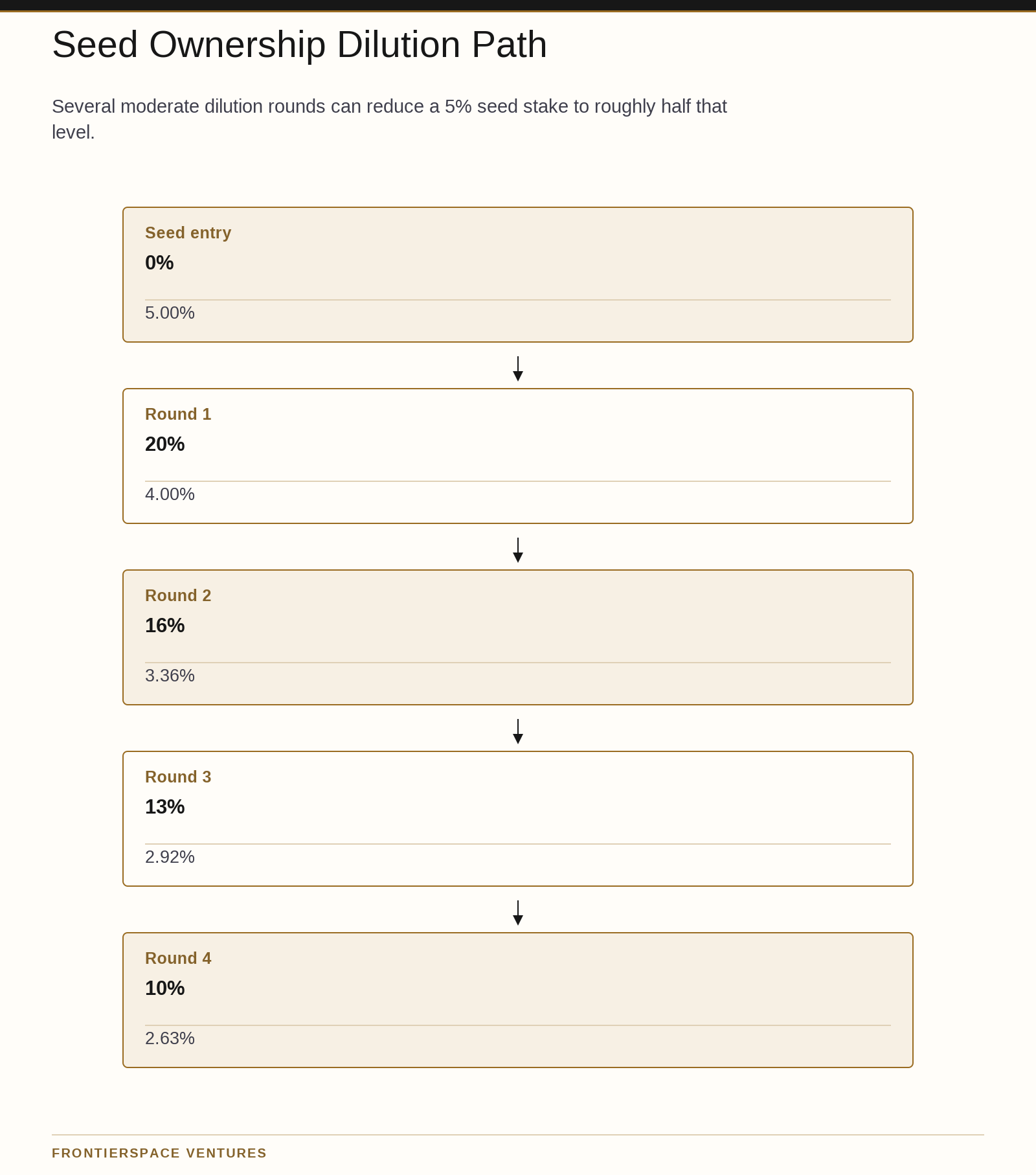
View dilution data and assumptions
| Stage | Dilution assumption | Remaining ownership |
|---|---|---|
| Seed entry | 0% | 5.00% |
| Round 1 | 20% | 4.00% |
| Round 2 | 16% | 3.36% |
| Round 3 | 13% | 2.92% |
| Round 4 | 10% | 2.63% |
How Ownership Affects the Fund Result
The final 2.63% stake pays different amounts at different exits. Debt and preferred claims may reduce the cash available to it. Any cheques used to protect that stake also increase the cost of earning the return.
Trace company proceeds to the fund, then subtract expenses and carry to reach the LP result. That path shows what came from company quality and the initial stake. It also shows the effect of later dilution and cash spent to limit it.
Frequently Asked Questions
Is dilution always bad for seed investors?
New cash can add more value than the share given up. If it improves growth or the chance of survival enough, the smaller stake may be worth more than the larger one was before the round.
Can pro rata rights prevent dilution?
Only when the investor exercises them. The right preserves an option to invest; the fund still needs capital and an allocation in the round.