The Ownership Implied by an Exit
To return the fund, a company stake must produce at least as much as the fund's size. Both the exit price and the stake left after dilution set that amount. For example, 10% of a $1 billion exit gives $100 million before fund costs.
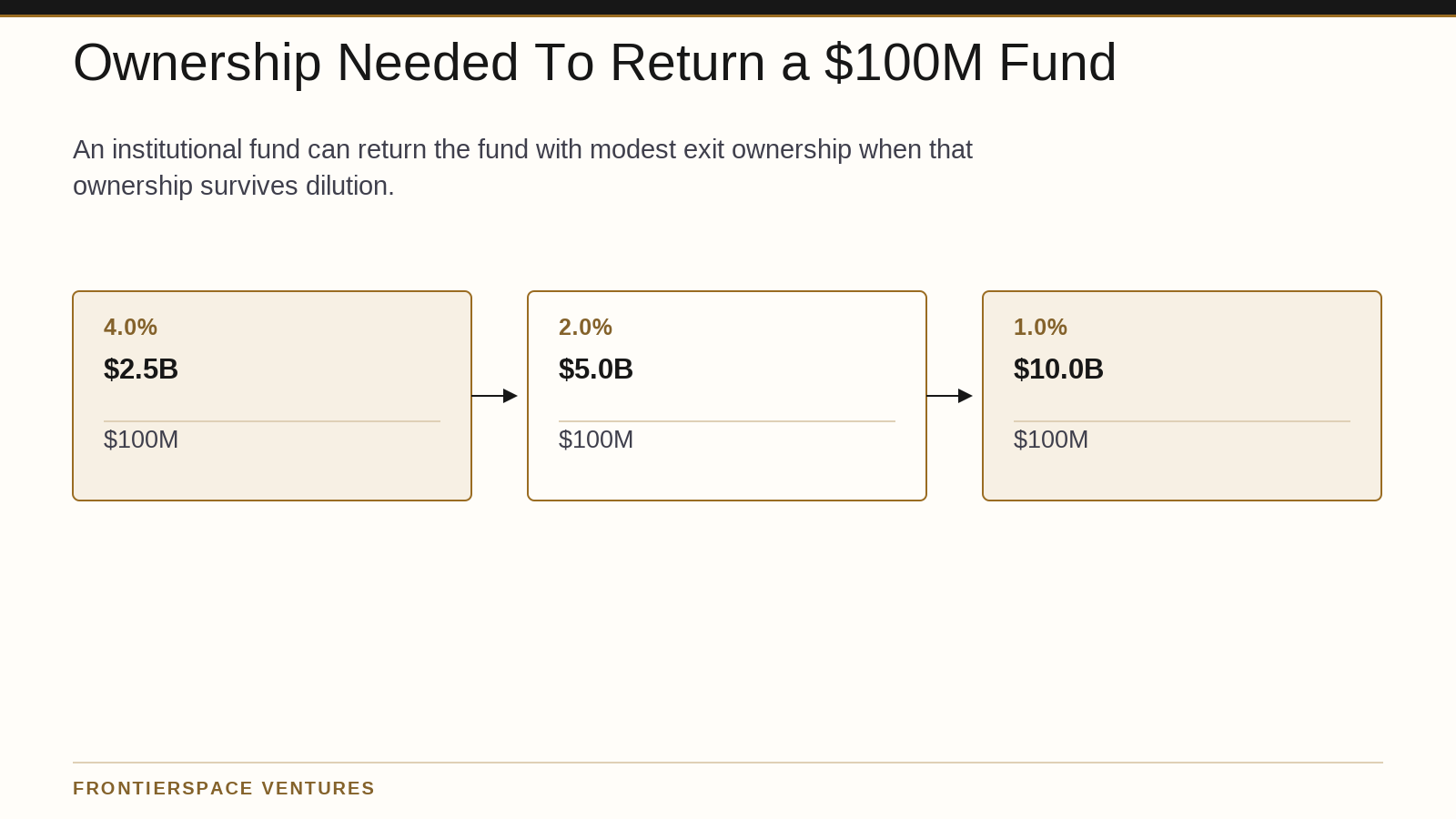
For a $100 million fund, 2.0% of a $5 billion exit produces $100 million before fund costs. A $10 billion exit needs only 1.0%, while a $2.5 billion exit needs 4.0%. The company outcome and the retained stake do the work together.
Opening Ownership Through Later Rounds
The closing cap table shows the first stake. Later rounds and pool increases add shares, reducing that percentage unless the fund buys enough to keep up. Entry ownership is therefore only the starting point.
Carta's 2025 private-market review found median dilution of about 16% per round from seed through Series C. That was below roughly 18% a year earlier. A lower rate still adds up when a holder goes through several rounds.
Even at the lower 16% median, several rounds can consume a large part of the opening stake. The cumulative path matters more than the change in any single year.
The Effect of Several Financing Rounds
Start with 4.0% and apply dilution of 20%, 16% and 13% over three rounds. The stake falls to roughly 2.34%, nearly half its starting size. The company need not have performed poorly for that reduction to occur.
The venture fund's ownership plan connects its target to follow-on choices. Start with the entry stake and likely funding rounds to estimate what remains. A harder funding case shows how much further it might fall.
Pro-Rata Rights Create a Follow-On Choice
A pro-rata right allows the fund to invest in a later round. Using it requires more capital at the price offered in that round. Preserving 4% in a company raising a large round may require a substantial follow-on cheque.
A follow-on uses cash that could back another holding. A better business at a good new price may justify that choice. Keeping the same percentage alone does not show what the new cheque can earn.
Ownership Is Still an Approximation of Proceeds
In a large exit, multiplying the stake by company value gives a useful first estimate. A smaller sale may first pay senior preferred claims. A fund with 2% of fully diluted shares can therefore receive less than 2% of the headline price.
The cap table shows who owns the shares. The payout waterfall shows what those shares can claim. Several preferred classes or structured rounds can make the cash share very different from the ownership share.
Required exit ownership falls as exit value rises. The examples use a $100M fund.
Ownership Needed To Return a $100M Fund
Even a modest stake can return the fund if the exit is large enough. What matters is how much of that stake survives dilution.
View ownership data and assumptions
| Exit value | Ownership needed | Gross proceeds |
|---|---|---|
| $2.5B | 4.0% | $100M |
| $5.0B | 2.0% | $100M |
| $10.0B | 1.0% | $100M |
How Exit Ownership Becomes a Fund Return
The visual shows how a small stake can return the fund at a huge exit, but with little room to fall short. A 1% stake produces $100 million only at a $10 billion value, before fund costs and carry.
The ownership path has several connected parts:
- the fully diluted stake bought by the first cheque;
- how much later rounds may dilute it;
- cash kept in reserve to use pro rata rights;
- the stake expected at exit; and
- the proceeds that could reach the fund and its LPs.
How much ownership is enough depends on the fund and company. Two percent can matter greatly at a plausible $5 billion exit but little at a $300 million sale. Pair the stake with a likely outcome and the cash needed to get there to judge its value.
Frequently Asked Questions
Is 1% enough ownership for a venture fund?
One percent may be enough at a very large exit. Lower sale prices, preferred claims and fund costs can reduce its contribution. Fund size and the range of plausible exits give that stake context.
Can follow-on reserves protect ownership?
Reserves help keep a stake when the fund chooses which follow-ons to back. Spreading that cash too widely leaves less for its best prospects.