What Decision Is the Scorecard Meant to Support?
A fund of funds can compare young managers before their returns have matured. Scores put the evidence in order but still need judgment. Poor deal sourcing and no clear method for valuing assets cause different problems. The same points lost may therefore hide different risks.
ILPA's DDQ shows how much a manager review covers. A scorecard connects those facts to the investment case. The evidence behind each score explains why the reviewer reached that view.
Cambridge Associates notes that private-fund quartile ranks can shift for years. They often need five to six years to become more useful. Until then, the LP may learn more from who drove each deal and how the team works than from its current rank.
A scorecard should turn a young manager's strengths into a clear review record. This model is an example for discussion. Its values and weights do not predict fund returns.
Emerging Manager Scorecard
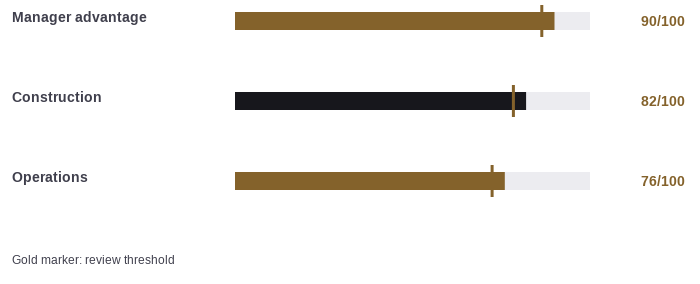
A scorecard should turn a young manager's strengths into a clear review record.
View chart data and assumptions
| Review area | Illustrative score |
|---|---|
| Manager advantage | 90/100 |
| Construction | 82/100 |
| Operations | 76/100 |
A manager may find and judge deals well but lack systems to report to large LPs. An experienced administrator, a clear valuation process and agreed report dates may close that gap. The review should distinguish work that can be fixed from a flaw in the investment case.
How the Weights Shape the Investment Debate
A 100-point scorecard might give 25 points to the team and its own results. Sourcing and the portfolio plan could get 20 each, operations 15, and alignment and references 10 each. These weights express the LP's priorities. Giving daily operations too much weight can make a polished firm look strong despite a weak investment case.
| Category | What To Test |
|---|---|
| Manager advantage | Specific, evidence-backed reason the manager can source and win opportunities. |
| Attribution | Deal-level proof of who sourced, underwrote, supported, and exited investments. |
| Portfolio plan | Fund size, company count, ownership, reserves, dilution, and loss-ratio assumptions. |
| Operations | Administrator, auditor, valuation policy, reporting, compliance, and cash controls. |
| Alignment | GP commitment, carry allocation, vesting, fees, and behavior under stress. |
What the Path From Introduction to Investment Reveals
Raw volume can mislead. In 2025, 487 megadeals represented 3.2% of US deal count and 67% of value. A manager's claim to see many companies says little unless the relevant ones reach serious review.
Trace who found a deal and which facts changed the team's view before closing. Deals it declined at the same stage show the other side of that judgment. Together, these records explain more than a count of introductions.
Ownership and Fund-Size Fit
A $250 million fund making 12 first cheques of $10 million invests $120 million and keeps roughly 50% for reserves. Raising each cheque to $15 million uses $180 million instead. That leaves much less room to support the same companies in later rounds.
Fund size changes what the manager needs from its deals. Cheque size and company count set the first holdings. The stakes left after dilution then show whether a successful company can still move the fund's return.
More reserves can seem safer, but a larger fund still needs enough suitable deals. If the manager cannot find them at its chosen stage, it may move into later rounds or pay more. The larger budget can thus change the original strategy.
Reference Quality
A set of 12 reference calls might cover 4 founders, 3 co-investors, 3 former colleagues and 2 current or former LPs. Some should come from outside the manager's chosen list. This broadens the evidence beyond the people it offered to introduce.
References can fill gaps in deal records. Founders explain how access was won and what help followed. Former colleagues clarify who did the work, while LPs can describe the reporting when a company or relationship struggled.
A concrete example adds more than general praise. The source's independence matters too. A senior title alone does not make a favourable account complete or free from bias.
Co-Investment Capability
Co-investment access can add value if the manager shares deals fairly and gives LPs enough facts before the deadline. An invitation alone does not prove this ability. The main fund must still come first.
How the Scorecard Connects to the Investment Memo
Strong scores backed by clear evidence support the decision. Less certain claims reveal gaps that future reports may help resolve.
- Records and references can test what the manager says. They help show whether its claims hold up beyond its own account.
- A claim backed mainly by the manager leaves more doubt. Fresh evidence could still change the reviewer's view.
- A missing fact matters most when its answer could reduce the cheque or rule out the fund.
- Keep key open questions in the memo so they remain part of the final decision.
The scorecard forms part of the wider manager review. The LP questions help the team gather evidence for each score. Together, they connect the numbers to a reasoned choice.
ILPA DDQ: Operations Belong on the Scorecard
ILPA's questionnaire goes beyond returns and company logos. The team and its process show how it chooses deals. Asset values, fees, conflicts, reports and service providers then show how the firm handles its other duties to LPs.
The model covers:
- how the firm is run
- the investment plan
- past returns
- fund terms
- conflicts of interest
- how assets are valued
- reports to LPs
Grouping these facts helps the LP compare fund managers.
Young fund rankings can take several years to become more informative.
A fund of funds can review a young firm's reports and daily work alongside its investment approach. Deal records and references show who made the choices behind past returns. They help explain whether the new team can do the same.
Primary sources: ILPA's fund review questionnaire; Cambridge Associates on venture fund results. The ILPA DDQ is a public source. It does not describe Frontierspace returns.
Frequently Asked Questions
Should an emerging manager scorecard produce an automatic decision?
A scorecard creates a common basis for review and shows gaps in evidence. The committee still decides whether the strategy fits and whether each weakness can be fixed.
Which scorecard categories usually matter most?
The manager's edge and the team's own results form the core case. The proposed fund size then tests whether that edge can still work. Daily operations and rewards must also support the team in serving large LPs through the fund's life.