How a Checklist Supports an Investment Case
A checklist brings the team's record, plan, terms and daily work into the investment decision. The same evidence can lead two LPs to different choices. A fund that suits one LP's holdings and cash needs may fit the other poorly.
Hamilton Lane's guide to GP reviews uses five core questions about the team, net returns, cash access and portfolio plan. These help the memo explain why the fund fits or fails to fit. A list of meetings alone cannot support that choice.
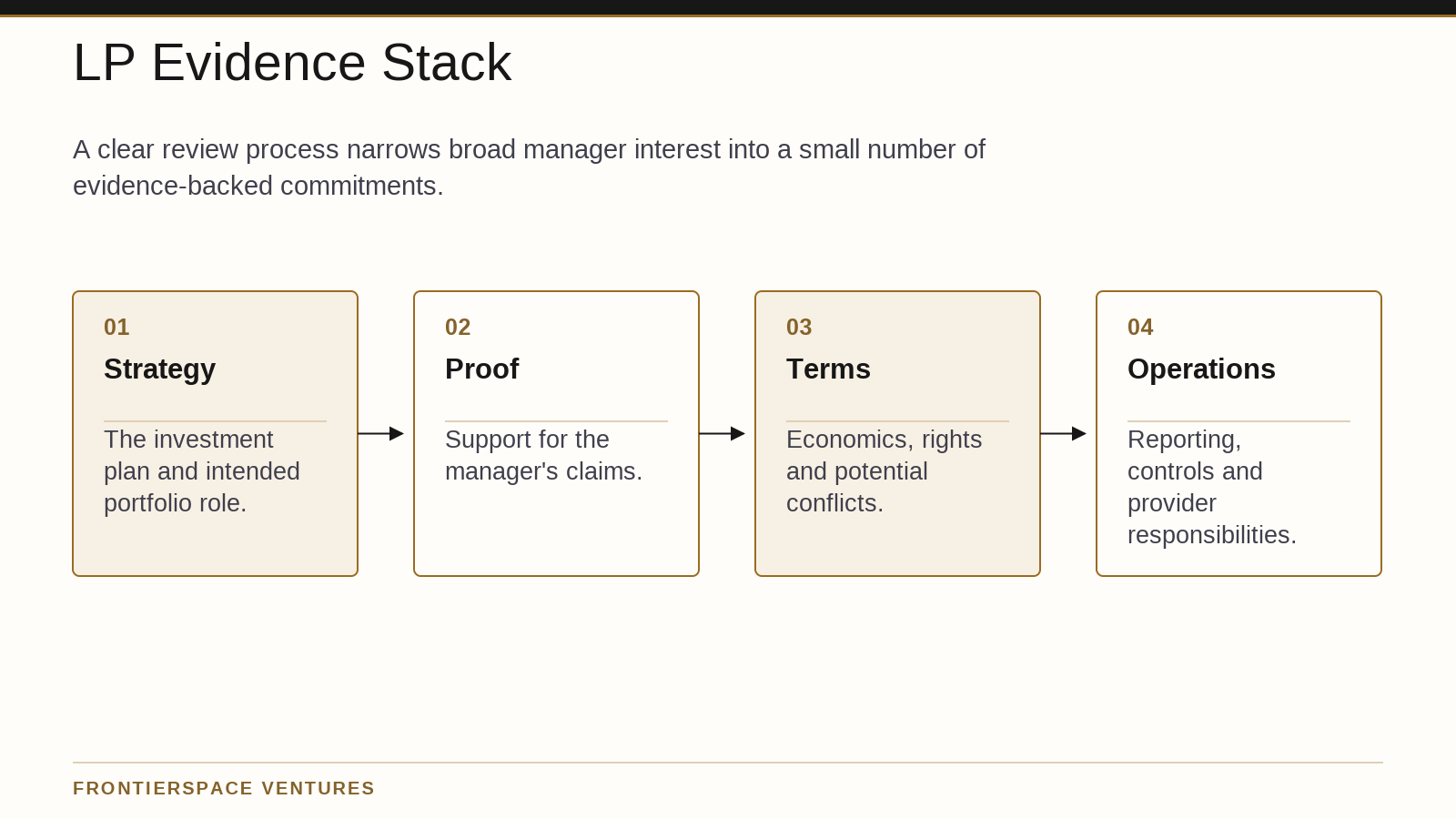
A clear review turns a broad list of managers into a few choices backed by evidence. The chart shows the order of the checks. The width of each stage does not measure pass rates or fund returns.
LP Evidence Stack
A clear review turns a broad list of managers into a few choices backed by evidence.
View chart data and assumptions
| Step | Stage | What the evidence explains |
|---|---|---|
| 01 | Strategy | The investment plan and intended portfolio role. |
| 02 | Proof | Support for the manager's claims. |
| 03 | Terms | Economics, rights and potential conflicts. |
| 04 | Operations | Reporting, controls and provider responsibilities. |
This guide is for LPs and family offices reviewing a venture fund or a related private-tech strategy. It gives the discussion a clear order. It does not replace legal or tax advice.
An LP with several seed-stage software funds may gain little new exposure from another one. Even a strong manager can therefore be a poor fit. The review must show what the proposed fund adds.
1. Fit with the investment plan
Private investments commonly tie up cash for 10 years or more. Since a fund's stated end date does not guarantee an exit, the LP must consider whether it can wait longer.
A fund may fill a gap by stage or open a market the LP cannot reach alone. That role explains why it might be worth adding. Cash needs and limits on currency risk then help set the commitment.
The same purpose must be tested against existing holdings. If the new fund repeats companies or a strategy the LP already owns, a strong manager may still add little. The review needs to show what changes after the fund is added.
2. Manager Selection: Evidence of an Advantage
Carta's 2017-vintage sample reported 4.08x TVPI at the 90th percentile, 2.53x at the 75th percentile and 1.89x at the median. The wide spread shows why manager choice matters, but a past winner may not repeat its result. The LP needs to know how the team chose and supported those holdings.
A real investment can reveal how the claimed advantage works. How did the opportunity arrive? Why did the founder choose this fund, and what work led the team to invest?
A passed deal can reveal the limits of that advantage. Its relevance to the new fund also depends on whether the same people remain and whether the approach works at a larger size.
3. Sourcing and Selection
Trace how a lead moved from an early introduction to a serious review, committee work and a term sheet. This reveals how the manager makes decisions. A large list of leads alone shows little about that process.
Finding a deal and winning a place in it require different work. The review should show who did each part. A large flow of leads may be less useful if the manager rarely wins access to the deals it wants most.
4. Portfolio Plan
In 2025, 487 US megadeals took 67% of total venture deal value, despite forming just 3.2% of deal count. This market figure does not describe any one fund's holdings. It shows why the LP must inspect stake sizes and overlap instead of relying on company count.
Fund size sets the budget for initial cheques and reserves. Their balance determines the ownership the fund can buy and preserve through dilution.
The stake a fund keeps determines the exit value each winner must reach to meet its target. If that value is far beyond the manager's market, the return goal may not fit the strategy.
5. Entry Judgment
Entry judgment becomes clearer in the information available at the time. The valuation case shows which assumptions supported the price and which would have made it too high. Share class and preference then affect the cash received at a weak exit.
Initial ownership can shrink through later rounds. Pro rata rights offer a way to protect it only when reserves leave enough capital to take part.
6. Terms and Alignment
Recent venture funds still have median terms of 2% management fees and 20% carry. The LP needs to see how those terms apply across the fund's life. Charges after the period for new investments can also change the total cost.
The GP commitment shows how much capital the partners put at risk. Its funding source helps reveal their personal exposure. A fee waiver or loan may leave them bearing a different risk from a cheque paid from their own cash.
Fees and carry reduce the LP's net return. Related SPVs or assets held before a fund buys them can also create conflicts. When several vehicles want the same company, the rules for sharing deals show how the manager handles those competing claims.
7. Operations and Reporting
Follow a cash call from approval to the bank account and quarter-end report. Check who performs and reviews each step. The same review should establish how the manager, administrator and auditor check asset values.
Cash paid in, cash paid out, cost and fair value explain how the account changed. If a value relies on judgment, the LP needs to know the method and who approved it. News from the company then gives those figures context.
8. Liquidity and Risk
Faster calls and slower distributions can put pressure on cash at the same time. A forecast that combines both shows the strain that separate cases can miss.
A longer wait may put pressure on the fund to sell shares or move assets to a continuation vehicle. Discounts and conflicts can limit the cash these routes provide.
The Final Investment Memo
The fund DDQ for LPs gathers evidence on the team, plan, record and proposed holdings. It adds terms, daily work and references to support the committee's decision. The final memo should make both the case and its limits clear.
- What evidence supports the choice to commit?
- What could make the fund unsuitable?
- Which questions remain open, and how material are they?
- What new facts would change the conclusion?
Adobe-Figma: Strong Operating Metrics Still Ended Without an Exit
In September 2022, Adobe agreed to buy Figma for roughly $20 billion in cash and stock. The companies ended the deal in December 2023. They had found no clear path to approval from regulators, so the announced exit did not close.
Adobe planned to pay roughly half in cash and half in stock.
The business figures included net dollar retention above 150%. Gross margin was near 90%.
Strong business figures did not remove the risk that the deal would fail. When it ended, so did that route to an exit.
An announced sale becomes cash only if the deal closes. Required approvals, closing terms and rights to end the deal can prevent that outcome, even for a strong company.
Primary sources: Adobe's plan to buy Figma (2022); Adobe and Figma end the deal (2023). This public case has no link to a Frontierspace investment or result.
Frequently Asked Questions
What is the most important part of venture fund due diligence?
Actual deals reveal who created the result and how the manager's claimed edge worked. The new fund's size and plan then show whether that approach can work again. This link makes the past record useful.
What is a common venture fund red flag?
A gap between the old record and the proposed fund is a serious concern. A new team or strategy may make earlier results less useful. Large changes in target ownership or fund size can weaken the link too.