The Exit Required by the Entry Price
Entry price sets how much a venture fund owns for its cheque. A $10 million investment at a $200 million post-money value buys half the stake it would at $100 million. The company then needs a much larger exit to pay the fund the same amount.
At a $100 million post-money valuation, $10 million buys 10.0%. At $200 million it buys 5.0%, and at $300 million it buys 3.33%. Holding the company constant isolates the effect of price on the fund's share of the eventual outcome.
What Exit Does the Ownership Require?
Ownership connects today's cheque to future proceeds. To produce $100 million before costs, a 10% stake needs a $1 billion exit. A smaller 5% stake needs $2 billion, while 3.33% needs roughly $3 billion. The same cash target therefore calls for different company outcomes.
For a $100 million fund, returning its headline size from one company depends on the stake bought. The same $10 million cheque needs a $1 billion exit at 10.0% ownership. At 3.33%, it needs roughly $3 billion.
A stronger company may deserve a higher price if a large exit is much more likely. The business evidence needs to support that bigger outcome and the price paid for it.
Why Market Prices Matter to the Whole Fund
One costly deal may be a deliberate choice. Higher prices across the portfolio have a wider effect: each cheque buys a smaller stake. Unless cheques grow too, more firms need bigger exits to produce the same cash for the fund.
The 2026 NVCA Yearbook put the median seed pre-money value at $16 million in 2025, up 78% from the 2021 peak. This gives market context. The actual company's prospects, stake and deal terms still set its return case.
That $16 million median matters to a fund writing roughly fixed cheques. As prices rise, those cheques buy less. The required exits can grow across the portfolio even though the stated strategy stays the same.
Dilution Raises the Hurdle Again
The opening stake is only the first step. If later rounds halve a 10% position, the fund reaches the exit with 5%. If they halve a 5% position, it arrives with 2.5%. At the same $1 billion exit, the two investments then produce $50 million and $25 million respectively.
Using pro rata rights buys more shares at a new price and uses reserves. It can keep the final stake closer to the opening one. The stake left at exit sets the proceeds, while both cheques form part of the cost.
A Good Company Can Still Produce a Weak Investment
A company can build a real product, grow fast and reach a sound exit yet disappoint an investor. If the entry price required a much bigger outcome, the fund may earn little. Business success alone does not settle the return on the price paid.
A required exit implies a business of a certain scale and a buyer or public market willing to pay for it. More capital may be needed along the way. A price that depends on several exceptional outcomes leaves little room for error.
A higher post-money value buys less ownership for the same cheque. That smaller stake needs a larger exit to produce the same proceeds.
Entry Valuation and Required Exit
The same $10M cheque needs a much larger exit when entry valuation rises.
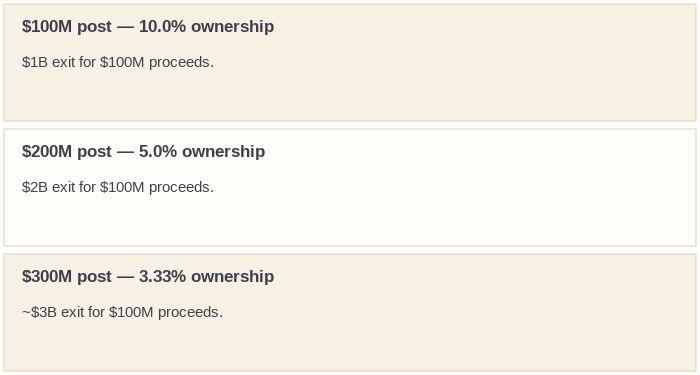
View valuation data and assumptions
| Post-money valuation | $10M ownership | Exit needed for $100M proceeds |
|---|---|---|
| $100M | 10.0% | $1B |
| $200M | 5.0% | $2B |
| $300M | 3.33% | ~$3B |
How Weaker Assumptions Change the Range
The visual isolates entry price. A lower exit, another round or a delay can add pressure to the real case. Buying more shares may preserve the stake, but also increases the cost of earning its return.
The calculation turns a debate about a 'high' price into a test of what must happen next. It shows the required exit, further cash needs and upside left for the risk. Those answers can guide reserves and pro rata choices well before the sale.
Questions for the Investment Committee
- What ownership will the fund hold after the next round and at exit?
- Which company outcomes produce 1x, 3x or enough cash to return the fund?
- How much more cash is needed to keep those stakes?
- Would the position still matter if the exit arrived later or below plan?
The price and stake bought together show which company outcome the fund needs. That link makes the return case easier to judge.
Frequently Asked Questions
Is a high entry valuation always bad?
A stronger company may deserve a higher price. The fund still needs a credible path from the stake bought to an exit large enough to matter.
Should institutional funds avoid expensive rounds?
A costly round can still be worth joining. The stake bought, rights to buy more and likely dilution show what may remain at exit. That final stake must justify the cash invested and contribute enough to the fund.