What Does “Return the Fund” Actually Require?
For a company to return a $100 million fund, the stake must pay at least $100 million before fund fees and carry. At 10% ownership, that needs a $1 billion sale. If ownership falls to 5%, the required sale price doubles to $2 billion.
That same fund needs $200 million of gross proceeds to reach 2.0x and $300 million to reach 3.0x before any preferred economics or recycling are considered. Merely returning $100 million is therefore a milestone, not a strong final result for LPs.
How Much Must Each Company Return?
Suppose the fund still owns 2% at exit. Receiving $100 million requires selling that stake at a company equity value of $5 billion. If ownership falls to 1%, the required value doubles to $10 billion. A listing at that price alone does not put cash in the fund.
The opening stake therefore tells only part of the story. At 2% ownership at exit, the needed value is $5 billion; at 1%, it is $10 billion. The stake left after dilution sets which outcome the fund needs.
A seed fund may start with 10% and hold much less after several rounds. Pro rata rights let it buy more to limit that decline, provided reserves and the new price support the choice. The stake expected at exit is therefore a better guide to proceeds.
The Exit Market Shapes the Return
A strong company still needs a buyer or another route to cash before it can pay the fund. The 2026 NVCA Yearbook shows how much that exit market can vary.
NVCA reported $217 billion of US venture exit value in 2025. Despite the recovery, this was only 27% of the 2021 peak. An improving market can still leave funds with few chances to sell.
One Winner Is Only One Possible Path
A single company can produce the entire $100 million. So can two companies that each produce $50 million, or five that produce $20 million apiece. The total is the same, but the portfolio risk is not.
Relying on one winner needs both a rare exit and a large enough stake in it. Several moderate exits spread company risk but require more wins. Stage, cheque size and likely losses help show which path fits the fund.
To return one hundred million dollars, a one percent stake needs a ten billion dollar exit. Retaining two percent cuts that to five billion dollars. At four percent, the required exit is two point five billion dollars; at ten percent, it is one billion dollars.
Small Changes in Exit Ownership Change the Required Exit Dramatically
When the fund owns little of a company, keeping more of that stake has a large effect. An extra percentage point can cut billions from the exit needed to produce $100 million.

View ownership and exit calculations
| Ownership at exit | Exit value needed | Gross proceeds |
|---|---|---|
| 1% | $10.0B | $100M |
| 2% | $5.0B | $100M |
| 4% | $2.5B | $100M |
| 5% | $2.0B | $100M |
| 10% | $1.0B | $100M |
Valuation and Proceeds Can Differ
The Yearbook also reported 859 active unicorns with $4.34 trillion of aggregate valuation. Those figures measure paper value; cash proceeds depend on when the companies exit and how much each fund owns at that point.
That gap between marks and cash matters most for the largest unsold stakes. Holding 2% of a company valued at $5 billion implies $100 million, but a sale is needed to realize it. Later dilution and preferred claims can reduce the amount received.
How Company Outcomes Add Up
For each key company, combine the stake left, future cash needs and likely range of exit values. Its possible proceeds then feed into the fund's total.
That total may need one rare $10 billion outcome, several large exits or many smaller wins. Showing the path reveals risks hidden by a smooth forecast for the whole fund.
As the stake falls, the fund needs a larger exit to receive the same gross amount. These examples exclude fund costs.
Exit Value Needed To Return $100M
A smaller stake needs a much larger exit to return the same $100 million fund.
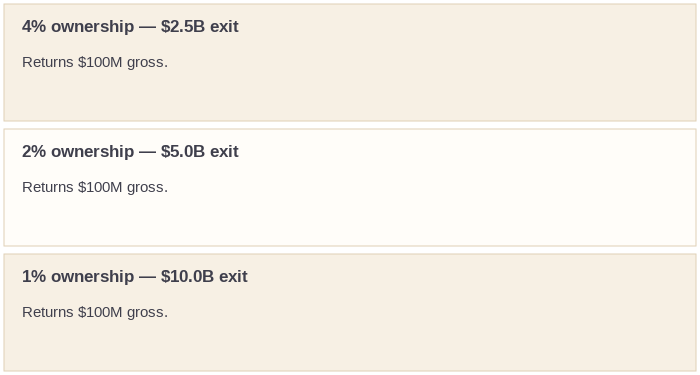
View calculation data and assumptions
| Fund ownership at exit | Exit value required | Gross proceeds |
|---|---|---|
| 4% | $2.5B | $100M |
| 2% | $5.0B | $100M |
| 1% | $10.0B | $100M |
When the Largest Contributors Disappoint
This compact view shows how quickly the required sale price rises as the fund's stake falls.
Lower prices, more dilution or later cash from the biggest holdings can weaken the whole return. Waiting longer for the same cash lowers IRR, while costs and carry reduce the LP's share. If a small change in one company breaks the case, the company count hides how much depends on that holding.
- Test exit values 30% or 50% below the biggest forecasts. The change shows how much room the return case has for poor outcomes.
- Keeping the same stake may require more cash. That cash also raises the cost of the investment.
- In a smaller sale, senior preferred holders may take cash before the fund's class gets paid.
- Gross company proceeds can exceed the cash LPs receive after fund costs.
A sound fund model allows many companies to miss their best case. It shows which outcomes matter and what stake is needed in each. Several paths to an acceptable return make the plan less reliant on one ideal result.
Frequently Asked Questions
Can one company return a $100 million fund?
One company can return the fund if the exit and retained stake are large enough. That leaves the result tied to a single outcome. Whether the manager can repeat it is a separate question.
Should a $100 million fund target only huge exits?
Several moderate exits can also return the fund. That path needs large enough stakes and losses kept under control.