What Happens When Spending Slows?
Discounts, cash support or marketing can produce growth that the company cannot afford to sustain. Customers who stay, use the product and pay after that support falls give stronger evidence. Their behaviour helps show whether demand can last on its own.
A popular category can bring customers and cash to many firms at once. The 2026 NVCA Yearbook shows that effect in AI during 2025. Each company still needs evidence that people want its own product.
NVCA reported that AI companies captured 65.4% of US VC deal value in 2025, up from 50.9% in 2024. That concentration describes sector interest. It does not establish lasting demand for any particular product.
Customer Behavior After the First Sale
A first sale may reflect curiosity or a large discount. A renewal shows that the product met a need beyond that first offer. Tracking use and spending after customers have had a chance to leave gives firmer proof.
Repeat purchases and referrals add evidence of demand. Those sales differ from ones won through fresh promotion. That distinction helps show how much growth may last without a constant push.
Growth From Spending and Growth From Demand
| Signal | What it may show | What can make it misleading |
|---|---|---|
| High new sales | Strong demand and a working sales motion | Heavy discounting, long free pilots, or one large contract |
| Rapid user growth | Useful product and word of mouth | Paid acquisition, incentives, or low-intent sign-ups |
| Rising revenue | Customers are willing to pay | Services work that does not scale with the product |
| Large pipeline | Market interest | Early conversations with no budget or decision date |
| Low churn | Customer value | Annual contracts that have not yet reached renewal |
Customer Cohorts Reveal What New Sales Can Hide
Total revenue can rise while old customers leave if new sales hide the churn. Tracking customer groups over time exposes that loss. Software renewals show who chooses to stay. In a marketplace, use without cash rewards shows how much demand can last on its own.
The right metric varies by business. The question stays the same: does customer value hold up after the initial push ends?
Growth Quality Affects the Next Financing
The next lead investor will test what growth costs. Cash spent to add retained gross profit shows whether new customers strengthen the business. If that cost keeps rising, the company has not yet shown that growth brings greater efficiency.
A young firm may accept weak efficiency while it learns. It needs a clear view of what should improve and how much cash that proof will take. Those choices set the cost of the learning period.
Questions That Change the View
- What happens when the offer ends? Growth that holds without discounts or incentives gives a clearer view of lasting demand.
- Do old customers stay? Groups that have reached renewal or repeat purchase provide evidence.
- What sales are growing? Software, deal fees and services earn different margins. Customers may also buy them again at different rates.
- Can sales repeat? Wins beyond one founder-led deal help show whether a sales process is taking shape.
- Does the product spread? Referrals, expansion, and shorter sales cycles can show customer pull.
Together, these checks show how much growth customers drive and how much the company must keep buying. A stronger case combines repeat demand with costs and margins that can support the next stage.
Signals That Growth May Be Low Quality
NVCA put AI deal value at $222 billion in 2025, 6.5x its 2020 level. That surge in sector interest can raise growth expectations for individual firms beyond what their own evidence supports.
Suppose ARR rises from $5 million to $10 million while the business retains only 70% of prior-year revenue. It must replace $1.5 million of lost revenue before producing any true net growth.
Evidence Behind the Growth Claim
Suppose a company spends $10 million on sales and marketing to win new recurring revenue. After direct costs, those new sales add $5 million of gross profit a year. Repaying the outlay takes longer than earning the same profit for $5 million. Both cases must use gross profit so the comparison holds.
Fast growth tells more when customers stay, spend more and cost less to serve or acquire. Margin and customer-led demand help show whether that growth can last.
Growth Quality Check
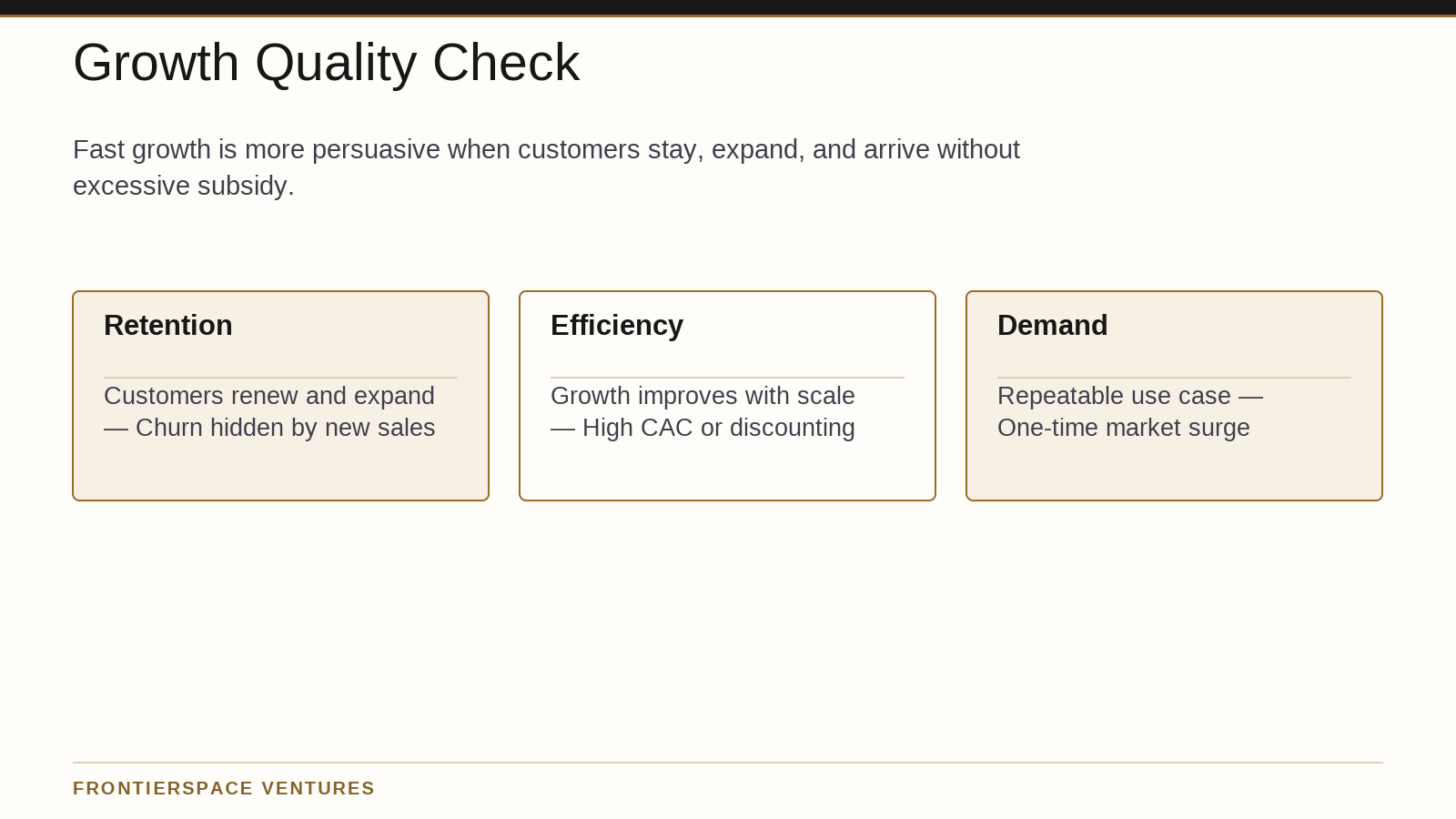
Growth tells more when customers stay and buy more. Demand that holds without large cash rewards gives firmer evidence that it can last.
View checklist data and assumptions
| Signal | Positive evidence | Concern |
|---|---|---|
| Retention | Customers renew and expand | Churn hidden by new sales |
| Efficiency | Growth improves with scale | High CAC or discounting |
| Demand | Repeatable use case | One-time market surge |
The Quality of Growth Appears When Spending Slows
A useful experiment is to slow one source of spending and watch the customer response. Do renewal and usage hold? Does gross margin improve when custom services are reduced? The result is more informative than another quarter of aggregate growth purchased in the same way.
Spending can amplify demand already there or keep growth alive only while cash lasts. Watching what customers do when the spending falls helps tell the two apart.
Frequently Asked Questions
Can a fast-growing company still lack product-market fit?
Yes. Paid acquisition or discounts can create demand that fades when support ends. A short burst of urgency or custom services can also boost sales. Customer retention and the cost of winning business show whether that growth can last.
What is a better signal than growth alone?
Keeping customers gives the cost of winning them context. Continued use, further sales and the margin earned show whether those buyers repay what it cost to reach them.