The Milestone Comes Before the Fundraise
A startup with 18 months of runway does not have 18 months to become fundable. Preparing a raise, meeting investors, completing diligence and closing all take time. The next milestone has to arrive early enough to leave room for that process before cash runs low.
The time to reach a milestone and close a round sets the cash buffer. Carta's Q2 2025 Series A review shows why room for delay matters: fewer companies raised even as prices rose for those that succeeded.
Carta found Series A deal count fell 18% year over year in Q2 2025, while cash raised fell 23%. Its valuation data covers completed rounds. Companies that tried and failed to raise are outside that price sample.
What a New Lead Would Have to Believe
A new investor may need proof that customers stay or margins improve with growth. A regulated firm may need an approval first. The milestone matters when it changes that investor's view of risk; more of the same early evidence may not be enough.
The milestone also helps set the round size a new investor will support. Asking for a large cheque before reaching that scale leaves fewer possible leads.
How Much Runway Is Left?
If the milestone takes ten months and the round takes six, 18 months of runway leaves just two months spare. A delay uses that buffer and narrows the company's choices. The lead investor may then gain more power over the terms.
What Makes the Next Round Easier or Harder?
| Area | Stronger case | Harder case |
|---|---|---|
| Runway | Fundraise starts with time to choose | Cash runs low before diligence can finish |
| Customer evidence | Retention and expansion support the growth story | Revenue depends on discounts, pilots, or one customer |
| Round size | Capital need fits the next set of investors | Company needs a very large round without matching scale |
| Insider support | Existing investors can bridge timing if needed | Insiders are unwilling or unable to invest more |
| Last valuation | Progress supports a higher or stable price | The company must grow into an earlier peak price |
The Company and the Investor Market Both Matter
A company can perform well but struggle to raise if few investors write cheques of that size. A lead that has reviewed the data and discussed terms gives firmer evidence than one asking to stay informed.
Public prices and sector interest can change the funding market. A milestone that once supported a large round may no longer do so, leaving a smaller raise as a possible path.
When the Round Is Delayed or Fails
- Lower burn extends the runway, while earlier cuts leave more time to judge their effect on the business.
- An insider bridge can cap the cash at risk and tie it to a clear milestone.
- A smaller round at fair terms may preserve more options than waiting for an unrealistic price.
- Early sale talks give buyers time to assess the company while it still has other choices.
- Repeated short notes and structured rounds add claims to the cap table. Those terms can make a later round harder to close.
Funding risk depends on company decisions as well as markets. Cutting burn or starting a raise sooner preserves choices. Waiting for a market recovery uses time that the cash budget may not allow.
Milestone Time and Fundraising Time
A company with 14 months of cash that needs 10 months to reach Series A metrics has only 4 months left. Diligence and term talks use part of that window, while a closing delay can use the rest. Its 14-month runway therefore hides a much smaller funding buffer.
In Q2 2025, Carta found Series A deal count fell 18% year over year and cash raised fell 23%. Values rose for the rounds that did close, showing why higher prices alone do not imply easier funding.
Milestones Within Their Market Context
A company adding $2 million of net new ARR with $6 million of net cash burn has a 3.0x burn multiple. Both inputs must cover the same period. Whether that attracts funding depends on growth, margin, category and the market at the time.
The next-round case links proof of progress to runway, price and the strength of the investor group.
Next-Round Readiness Checklist
The milestone needs to arrive with enough cash left to close the next round. Evidence that comes too late may not save the funding plan.
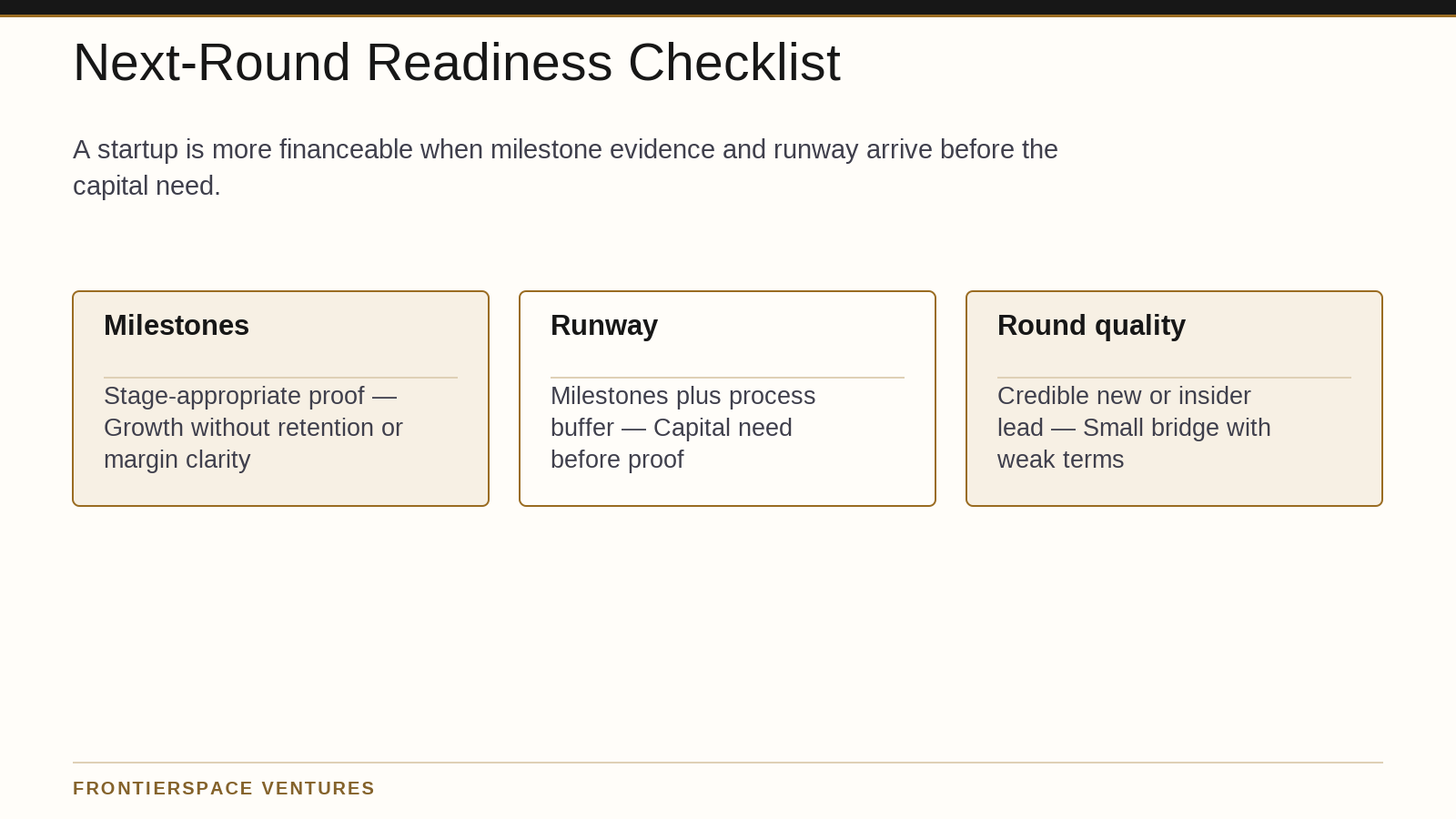
View checklist data and assumptions
| Area | Good signal | Risk signal |
|---|---|---|
| Milestones | Stage-appropriate proof | Growth without retention or margin clarity |
| Runway | Milestones plus process buffer | Capital need before proof |
| Round quality | Credible new or insider lead | Small bridge with weak terms |
Frequently Asked Questions
Does a strong existing investor guarantee the next round?
Existing backers can help, but a new lead will judge the company's progress and price for itself. Support from other backers and market demand then shape whether the round can close.
Should funds underwrite through the next round?
The chance, timing, size and terms of the next round shape today's deal. Testing different paths shows how much runway or insider support the company may need before new cash arrives.