A Partial Sale Changes the Certainty of the Return
A partial realization means selling some shares for cash while keeping the rest. Once that cash reaches LPs, DPI rises. The shares left still form part of TVPI, but their value can change. The sale thus secures part of the return while leaving the rest at risk.
Total reported value may barely move when a fund sells part of a stake at its carrying value. Some of that value can now become cash paid to LPs, measured by DPI. The rest remains an estimate in RVPI, so it is still exposed to a change in the share price.
A $40 Million Sale's Effect on the Metrics
Suppose LPs have paid $100 million into a fund. It pays them $40 million from a sale and still holds shares marked at $180 million. DPI is 0.4x, RVPI is 1.8x and TVPI is 2.2x, ignoring fees and carry and holding the remaining mark fixed.
If the shares sold at their carrying value, paying out the proceeds mainly moves value from RVPI to DPI. LPs can now spend the $40 million, reinvest it or use it for future capital calls. The remaining $180 million still depends on the company and the exit market.
Liquidity Can Improve While TVPI Later Falls
If the $180 million residual mark falls by 25%, it becomes $135 million. Together with $40 million already distributed, total value is $175 million, so TVPI falls from 2.2x to 1.75x.
The decline comes from the lower residual mark. By completing the partial sale first, the fund reduced the amount exposed to that change and secured $40 million in cash.
Why Partial Liquidity Matters in a Slow Exit Market
The 2026 NVCA Yearbook reported $217 billion of US venture exit value in 2025. That was twice the 2024 level, yet only 27% of the 2021 peak.
At 27% of the 2021 peak, the 2025 exit market still offered limited routes to cash. A partial sale may give a fund a way to pay LPs from a stake that might otherwise remain unsold.
Cash Today Has an Opportunity Cost
Selling part of a strong company can reduce the final return if its shares keep rising. Keeping every share leaves the fund fully exposed to that company and risks missing a chance to sell. The choice weighs cash now against the possible gain from waiting.
Cash today gives up future gains on the shares sold, but the peak price cannot be known in advance. A fund that has already paid plenty to LPs may have more room to wait. One under pressure to return cash may value the same offer more highly.
A partial sale raises DPI when the cash reaches LPs. The value of shares still held continues to affect TVPI.
Partial Realization Metric Bridge
A partial sale raises DPI once cash reaches LPs, while the remaining shares can still change the total return.
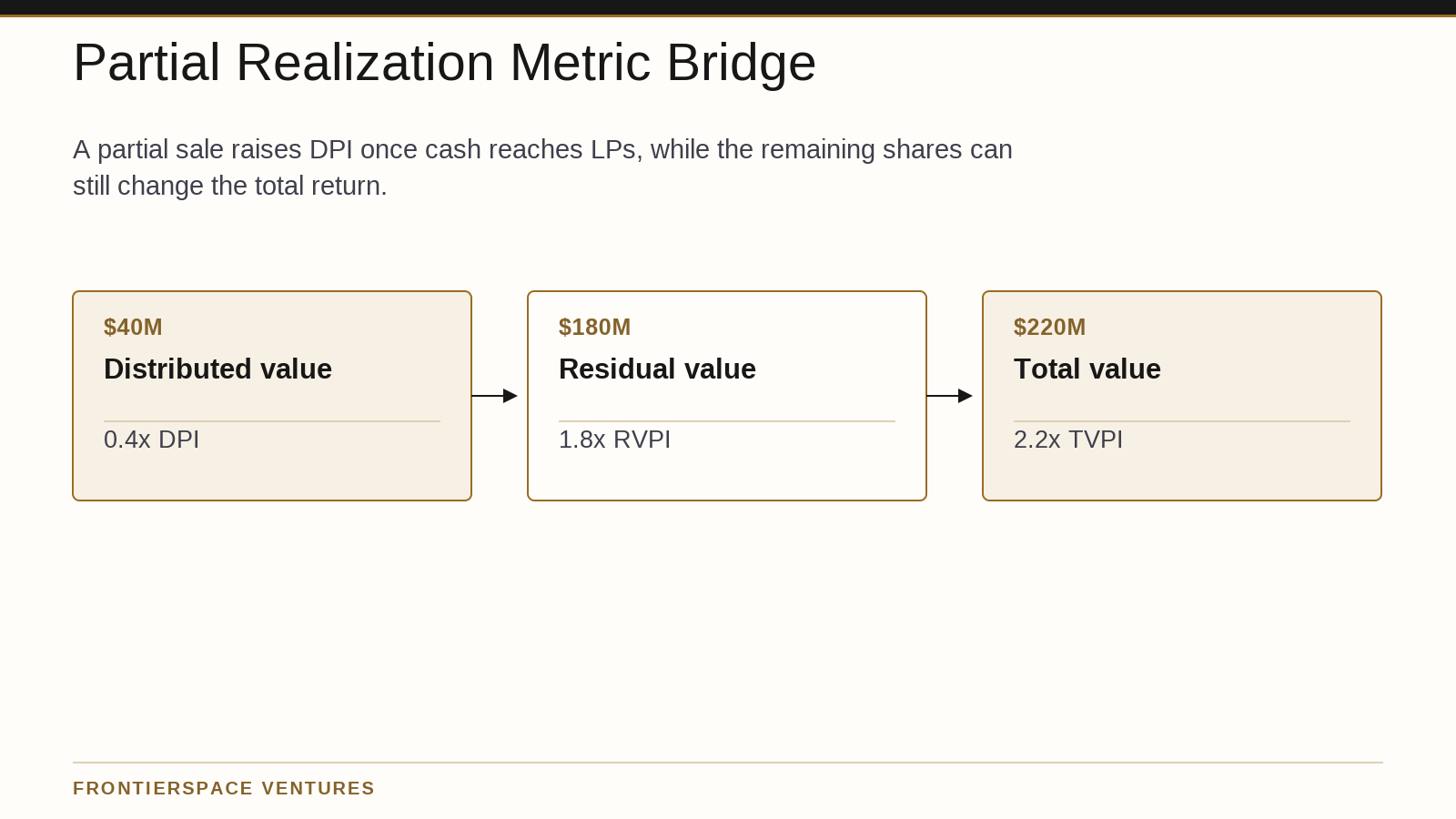
View bridge data and assumptions
| Component | Amount | Multiple on $100M fund |
|---|---|---|
| Distributed value | $40M | 0.4x DPI |
| Residual value | $180M | 1.8x RVPI |
| Total value | $220M | 2.2x TVPI |
Cash Returned and Value Remaining
The sale price gives evidence about the shares left. A price above carrying value may support a higher mark; a lower price may challenge the old one. Before applying it, compare share rights, since the buyer may have paid for a different set of claims.
Transfer fees and carry reduce cash reaching LPs. Start with gross proceeds, then trace costs and the amount the fund keeps. That shows how much of the sale actually becomes an LP payout.
What the Sale Leaves Behind
- How much of the original position was sold?
- Was the price above or below the prior carrying value?
- Did the buyer receive the same security and rights?
- How much cash reached LPs after costs and carry?
- Did the sale change the value used for the shares left?
The cash paid out shows how much value LPs have secured. The stake left shows how much future gain or loss still depends on the company.
Frequently Asked Questions
Does a partial realization reduce upside?
A partial sale can reduce the final gain if the company keeps growing. It also reduces the stake at risk and can return useful cash to LPs. The decision weighs the value of that cash against the exposure sold.
Is DPI more important than MOIC?
DPI measures cash returned relative to capital paid in. MOIC measures total value against cost and can include unsold shares. TVPI uses LP paid-in capital as its base and includes both cash returned and value still held.