Selling Before Exit Is a Portfolio Decision
An early sale trades some future upside for cash today and less risk. Its value depends on the price, the stake left and how long the fund can wait. A partial sale can return cash to LPs while preserving a share of the company's next stage of growth.
The choice weighs cash at closing against an uncertain future value. Even a strong company may need trimming if it dominates the fund or the fund is nearing its end. Those limits help set how much risk the fund can keep taking on the business.
What Would the Sale Accomplish?
If LPs have paid $100 million into a fund, a $30 million share sale paid out in full raises DPI by 0.3x. That can matter when LPs have received little cash, even if the fund retains most of the stake.
A sale can trim a company that dominates NAV. In an older fund, it can turn a long-held mark into cash without waiting for an IPO or acquisition. Those benefits need their own case, apart from the manager's wish to raise a new fund.
Private Liquidity Is Becoming a Normal Decision Point
Carta's 2025 private-market review counted 396 tender offers on its platform. That was up 62% from 2024.
Nearly 20% of those 396 tenders came from companies at Series E or later. Such offers can bring cash before a full exit. Venture funds therefore need a consistent way to judge when taking it serves LPs.
The Offer Compared With the Return From Waiting
Suppose a fund can receive $50 million today but expects $75 million for the same shares in three years. The extra $25 million depends on future events. Weak results or a dilutive round could reduce it before the fund can sell.
Weak, base and strong cases show the range of outcomes from holding the shares. Even with a central forecast above $50 million, that cash offer may make sense. It can reduce reliance on one company or help close a fund nearing its end.
Liquidity Always Gives Up Some Optionality
Selling half of a position at a $500 million company value removes half of the fund's exposure to a later $1.5 billion exit on those shares. Cash today has a cost: the fund gives up that part of the future upside.
A partial sale lets the fund take some cash while keeping part of the upside. The portion sold sets how much risk comes off the books and how much possible gain is given up.
How a Sale Changes the Remaining Portfolio
Selling the best company raises DPI only when cash reaches LPs, and it may leave them with weaker holdings. The result depends on both that payout and the quality of what remains. A smaller NAV can still carry too much risk in a few companies.
A related buyer can create a conflict over price. An independent pricing process, advice and clear disclosure help show how the fund addressed it. Some deals also need LP consent under their terms.
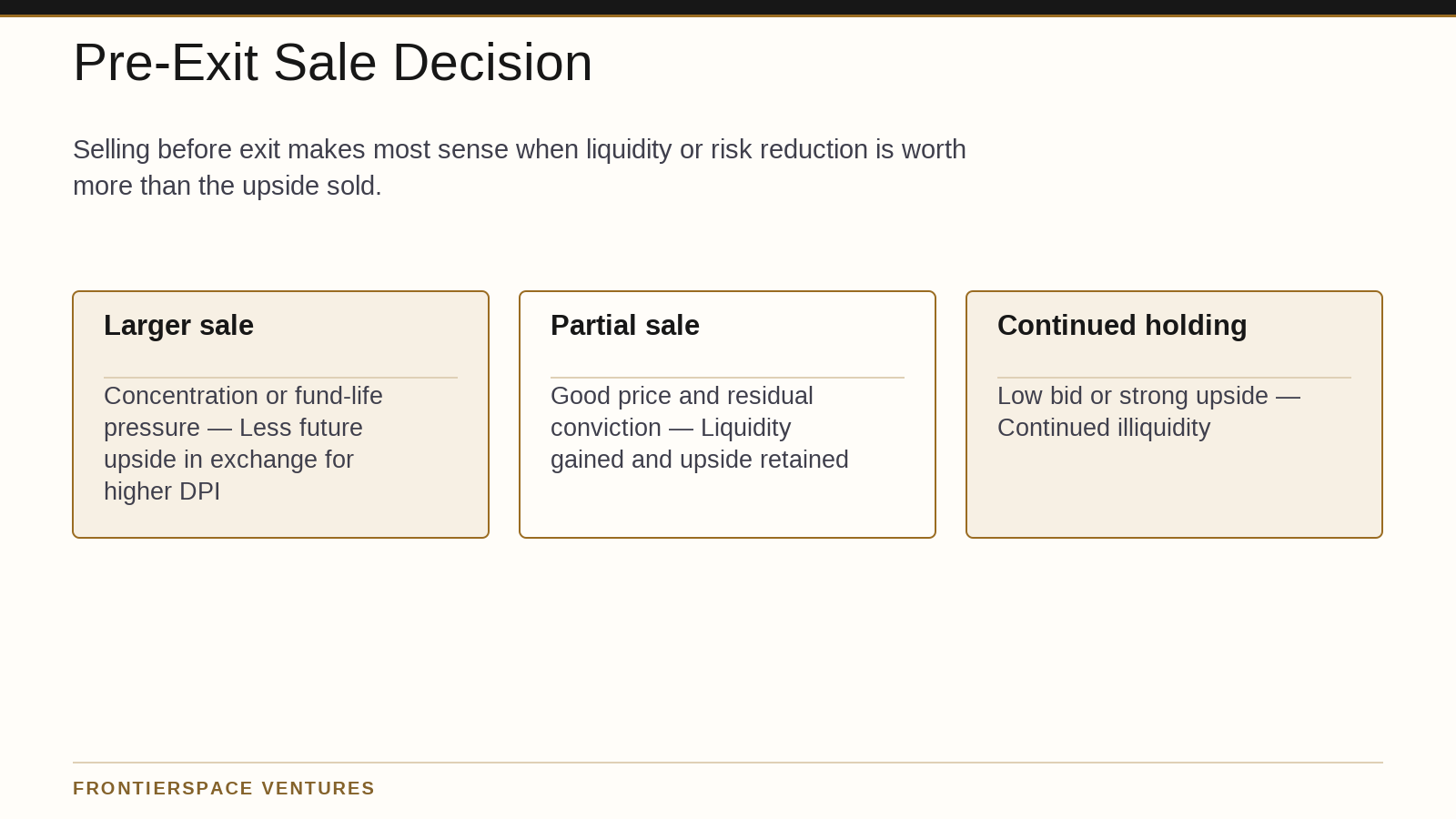
Pre-Exit Sale Decision
Selling before exit makes sense when the cash and lower risk are worth the possible gain given up.
View decision data and assumptions
| Decision | Typical trigger | Main trade-off |
|---|---|---|
| Larger sale | Concentration or fund-life pressure | Less future upside in exchange for higher DPI |
| Partial sale | Good price and residual conviction | Liquidity gained and upside retained |
| Continued holding | Low bid or strong upside | Continued illiquidity |
Cash Today and the Value of Waiting
The sale record should show how much was sold and kept, and how the price compares with carrying value. It should also state whether the cash goes to LPs or is recycled into new deals. Together, these explain what LPs gain from the sale.
The case for holding needs more than a future price: the wait for a sale and further dilution can change the return. If the buyer is linked to the manager, LPs also need to know how the process set a fair price.
An early sale makes sense when the price, cash and lower risk are worth the upside given up. That case should stand on its own for the fund. Pressure to raise the manager's next fund can pull the choice in a different direction.
Frequently Asked Questions
Does selling before exit mean the manager has lost conviction?
A manager can still believe in the company while selling for portfolio reasons. Taking some cash reduces reliance on that company. Keeping part of the stake lets the fund benefit if it grows further.
Should funds sell to improve DPI?
A sale can improve DPI once cash reaches LPs, but that gain comes with less future upside. A better reporting metric alone cannot make poor sale terms worthwhile.