What Does a Venture Capital Term Sheet Actually Decide?
Two deals at the same $40 million pre-money value can give investors different stakes and rights. The option pool changes ownership, while payment order changes the exit payout. Board votes, vetoes and pro rata rights then shape what the holder can do. The term sheet needs to connect all those parts.
A term sheet records the deal before both sides spend more on final papers. The market affects who has more power in those talks. Company quality and cash needs then shape the terms each side can seek, while demand from other investors affects how far it can push.
Carta's Q1 2026 report, published May 29, 2026, put capital raised on its platform at $30.4 billion. The down-round rate fell to 11.4%. More than 60% of the money went to AI companies, so conditions still differed sharply across sectors.
What a Venture Capital Term Sheet Does
Lawyers use the term sheet to prepare the final deal papers. For a priced preferred round, it usually links six areas:
- The purchase: The amount invested, shares and price define what is being bought. The pre-money or post-money value sets the basis for that price.
- Ownership: The option pool, notes and SAFEs add to the share count. Their treatment helps set how much old holders are diluted.
- Rights at a weak exit: Payment order sets who gets cash first. Conversion, dividends and anti-dilution terms can change the claim or the shares it becomes.
- Control: Board seats, class votes and vetoes divide the power to make decisions. Reports and founder terms add duties to those rights.
- Later rounds and sales: Pro rata rights can let the buyer invest again. First-refusal, co-sale and transfer rules then set how shares may change hands.
- Getting to closing: The review and legal papers may leave conditions to meet. Costs, privacy rules and the no-shop period affect how both sides reach that point.
The final papers set the legal result of the term sheet. The NVCA model documents, reviewed on July 25, 2026, show where the terms go. The charter and purchase agreement hold part of the deal. Investor-rights, voting and transfer agreements add the rights used while holding or selling the stake.
A signed term sheet is a guide. The main rights usually appear in several final documents. This map assumes a US priced round using preferred shares. The documents and legal result may differ by deal and location.
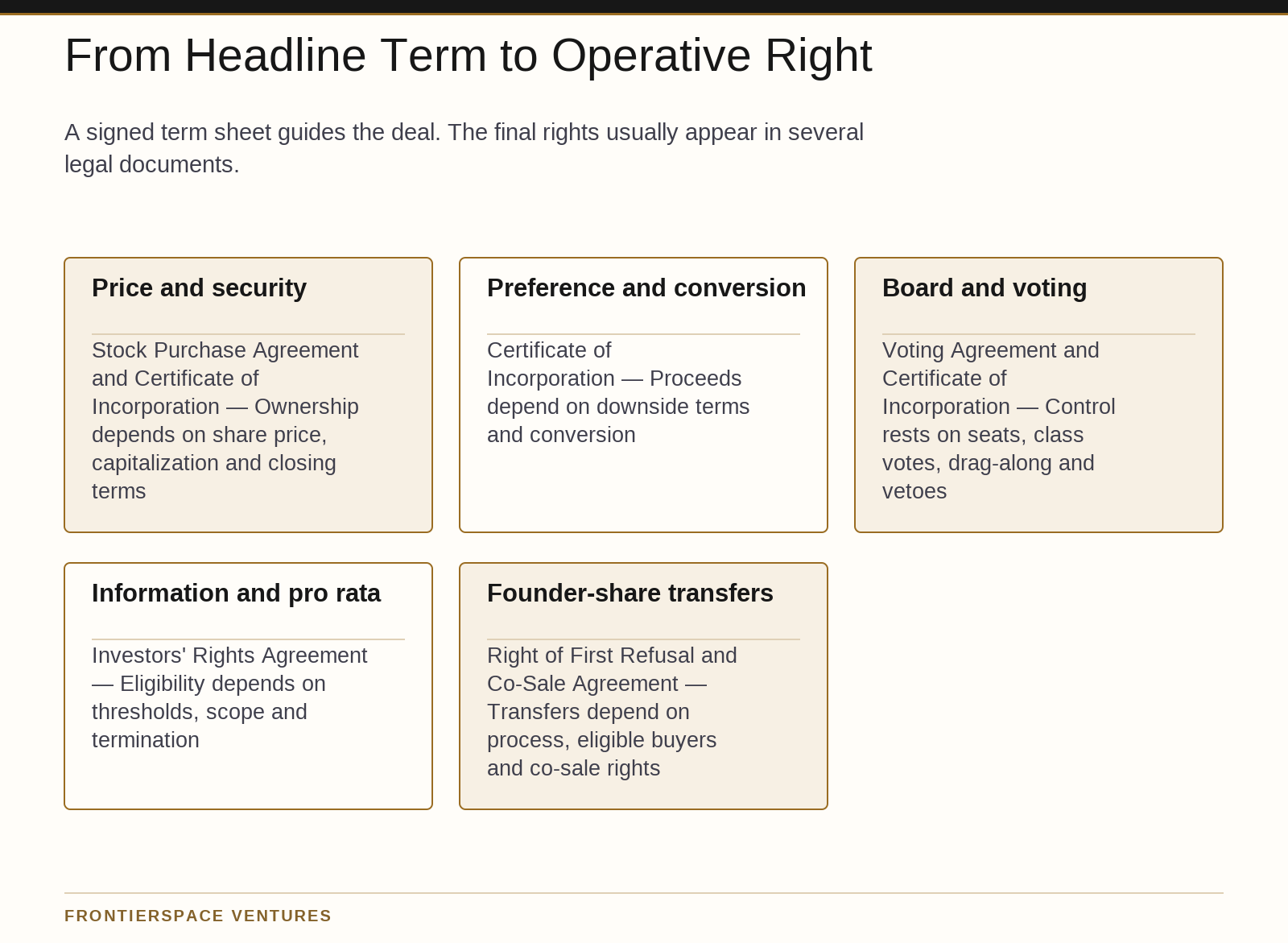
From Headline Term to Operative Right
A signed term sheet guides the deal. The final rights usually appear in several legal documents.
| Term-sheet area | Common document location | Review focus |
|---|---|---|
| Price and security | Stock Purchase Agreement and Certificate of Incorporation | Ownership depends on share price, capitalization and closing terms |
| Preference and conversion | Certificate of Incorporation | Proceeds depend on downside terms and conversion |
| Board and voting | Voting Agreement and Certificate of Incorporation | Control rests on seats, class votes, drag-along and vetoes |
| Information and pro rata | Investors' Rights Agreement | Eligibility depends on thresholds, scope and termination |
| Founder-share transfers | Right of First Refusal and Co-Sale Agreement | Transfers depend on process, eligible buyers and co-sale rights |
View chart data and assumptions
| Term-sheet area | Common document location | Review focus |
|---|---|---|
| Price and security | Stock Purchase Agreement and Certificate of Incorporation | Ownership depends on share price, capitalization and closing terms |
| Preference and conversion | Certificate of Incorporation | Proceeds depend on downside terms and conversion |
| Board and voting | Voting Agreement and Certificate of Incorporation | Control rests on seats, class votes, drag-along and vetoes |
| Information and pro rata | Investors' Rights Agreement | Eligibility depends on thresholds, scope and termination |
| Founder-share transfers | Right of First Refusal and Co-Sale Agreement | Transfers depend on process, eligible buyers and co-sale rights |
Valuation, Price, and Ownership
Pre-money and post-money values measure different amounts. The agreed share count turns that value into a price for each share. Options, warrants, SAFEs and notes may enter that count under their terms. Their treatment decides which claims dilute old holders before the round.
Add a $10 million cheque to a $40 million pre-money value and the post-money value is $50 million. The investor owns 20%: $10 million divided by $50 million equals 20%. This assumes no pool increase, conversion or other dilution.
- Issued shares are only the starting count for pricing. Promised grants, warrants and shares from conversions can add to it.
- When the pool grows: An increase before the round usually falls more on old holders. Adding it after the round spreads that dilution differently.
- Later closings may depend on a date, milestone, investor choice or defined test.
- Price protection: A later round can change what today's price buys. Anti-dilution and other future-round terms set how it does so.
Liquidation Preference and Participation
Liquidation terms set who is paid first in a sale or winding up. A right to share the balance or convert can change preferred holders' upside. Dividends may also add to the claim paid before common.
Suppose $10 million buys a stake of 25% after conversion, with a 1x non-participating preference. At a $30 million exit, the holder takes the $10 million claim rather than $7.5 million from conversion. At a $60 million exit, conversion pays $15 million. This example leaves out fees, debt, other share classes, dividends and deal-specific changes. Carta explains how these choices work.
- Non-participating preferred: The investor compares its preference with common shares. It takes the path that pays more.
- Participating preferred: The investor may take its preference and then share in what remains. A cap may limit the total.
- Payment order: Preferred classes may share a rank. They may instead be paid one after another under the agreed terms.
- Events that trigger payment: The terms may treat a merger or sale as a liquidation. That starts the payout waterfall even if the company is not wound up.
Downside, base and strong exits reveal how the same terms change proceeds. Preference can still matter in a successful outcome.
Governance and Protective Provisions
A board vote and an investor veto apply to different choices. The board acts under its duties to approve company actions. Some major changes may also need a separate vote by preferred holders.
Suppose a 5-seat board has 2 common designees and 2 investor designees. Both sides agree on the remaining 1 independent seat. Rules for choosing and removing that person can shape control. The count alone does not show who may approve a round, budget, new executive or sale.
- Board rules: Who can appoint, replace or remove a director? Quorum and observer rights then set how the board can meet and who can attend.
- Vetoes may cover new shares, debt and deals. They can also apply to dividends, charter changes or a company sale.
- Consent might sit with one class or all preferred holders. It may instead belong to the lead investor or require a stated share of votes.
- A special right may end after a stated event. It may also lapse when the holder's stake falls below a set size.
Consent rights can protect major interests. If too many choices need approval, or the rules are hard to use, they can also delay routine work.
Pro Rata Rights, Anti-Dilution, and Future Rounds
Pro rata rights let an investor buy shares in later rounds. Anti-dilution rules change the conversion terms after some lower-priced rounds. The two rights solve different problems.
An investor that skips two rounds, each diluting old holders by 20%, keeps 64% of its original stake: 80% times 80%. The size of each round sets that cut. Pool changes and note conversions can reduce the stake further, while a right to join the round may let the investor defend it.
- A holder may need major-investor status or a large enough stake to use the right. A stated event may also end it.
- The right may let the holder buy only its pro rata share. Some terms also let it ask for shares that others leave untaken.
- Anti-dilution: Broad-based weighted average and full ratchet are different methods. The choice can change how many shares the holder gets after a down round.
- Shares left out: The formula may exclude employee grants or shares used in a strategic deal or company purchase. Check which issues count before applying it.
Information, Transfer, and Founder Terms
Some rights that matter every day get less attention than price.
- Reports and access: Reports, budgets and inspections help holders follow the business. Due dates and sharing rules set when investors and their advisers can use those facts.
- Founder terms can reset vesting or give the company a right to buy shares back. Lockups can limit sales, while non-solicit clauses and other duties can govern conduct.
- First-refusal rights let a party match a share sale, while co-sale rights may let others join it. The terms set the deadline for using each right on a founder transfer.
- Drag-along terms can require holders to join an approved sale. They also set protections for those taking part.
- A right may have a start date and tests a holder must meet. Those conditions decide who can use it in practice.
Owning a stake does not by itself grant reports, votes or freedom to sell. Each right needs support in the documents. The holder must check those terms beside its share count.
Binding Provisions and the Path to Closing
Many term sheets say most deal terms do not bind either side until final documents are signed. Some process terms may bind at once.
- No-shop: For a set period, the company may agree not to seek or discuss another funding offer. That gives the current buyer time to work on the deal.
- Private talks: The parties may limit who can learn about the talks, terms or investor. Rules on announcements set what can become public.
- Expenses: The term sheet may assign legal and review costs. It may also set a cap or require a closing.
- Open conditions: Closing may still need diligence, approvals and final papers. Key-person terms or a minimum raise may also have to be met.
- Law and remedies: These terms help decide how a binding process rule is read. They also affect what a party can do if it is broken.
A signed term sheet begins the path to funded capital. Diligence, legal papers, approvals and closing still take time and may leave open issues to resolve.
How the Terms Work Together
The ownership maths shows the stake bought. Payout terms then test its value at a weak exit, while decision rights show who controls key steps. Closing conditions set what remains before the investor owns it.
- The cap table connects price, ownership, option pools, conversions and the full share count.
- The preference and rank set a first claim on sale proceeds. Rights to share the balance or convert can change what the holder gets. Dividends may also add to the claim as time passes.
- Decision rights: Board and class votes set who approves major choices. Investor consent and holding thresholds can add tests, while reports shape what those voters know.
- Pro rata rights may let the holder add cash, while anti-dilution terms change the shares received. Pay-to-play and staged-funding rules add conditions. Together, they shape what a flat or down round does to the stake.
- Some terms describe the proposed deal without binding either side yet. Others may bind at once, including rules on no-shop, privacy, costs and governing law. The wording decides which is which.
- The final charter and agreements give effect to the deal. Changed wording or conflicting definitions can alter what the term sheet appeared to promise.
What Ownership Do the Headline Terms Buy?
The term sheet joins the stake bought with its rights and risks. Ownership, protection at a weak exit, control and later funding need to be read together.
Several features determine how that package works:
- Company quality and price together: A strong company can still be too expensive. A low price only helps when the business is sound.
- Exit cases: Test later rounds and different sale prices. They can reveal effects hidden by familiar labels.
- Working together: Investor rights can protect value. Unclear voting rules may instead cause disputes or leave both sides unable to act.
- Matching documents: The final papers must give effect to the agreed price and control terms. Changed wording can change the deal.
Test the combined terms when the business improves and when it weakens. An unexpected path can also reveal effects that were hard to see at signing.
Frequently Asked Questions
Is a venture capital term sheet legally binding?
It depends on the wording and local law. Most term sheets leave the main deal non-binding while some process terms can bind at once. Those may cover privacy, no-shop, costs or governing law. A lawyer can check how the relevant law treats them.
Is the highest valuation always the best term sheet?
The highest value may dilute holders less today, but other terms can change the benefit. Preferences and pool treatment affect the payout, while board and veto rights affect control. Staged funding and rights in later rounds then test how the deal holds up over time.
What should an investor model before signing?
Start with ownership after the round, payouts at several exits and the approvals needed. Then model a later round with and without pro rata investment. That shows how the stake and need for cash may change.
Does a term sheet contain all investor rights?
Rights usually sit across several final papers. The charter and purchase agreement set part of the deal. Investor-rights and voting agreements add other powers. First-refusal and co-sale terms then set who can match or join a sale, with transfer rules adding further limits.
This article gives general information. It offers no legal, tax, accounting or investment advice for a reader's own case. Their facts, goals and location may change the answer.